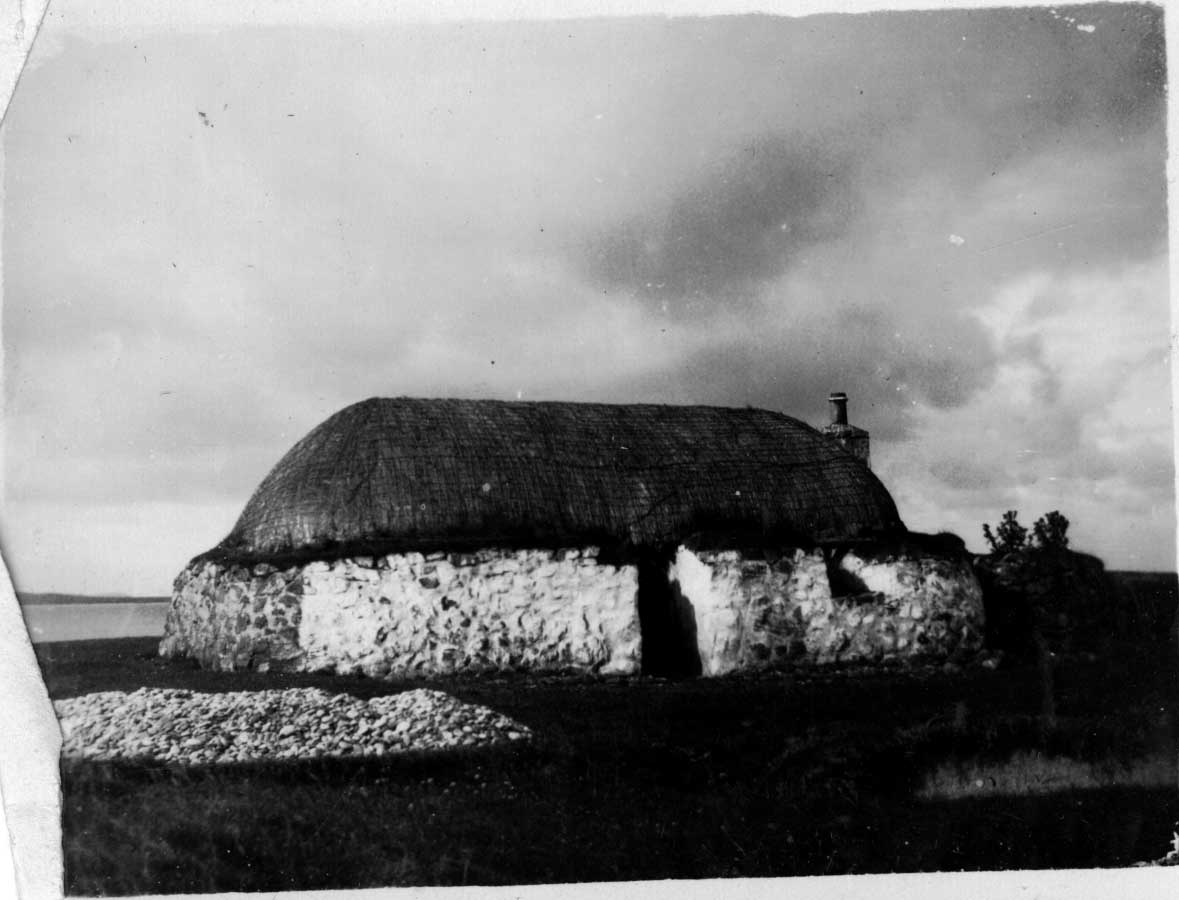
Black and white photograph of thatched house at Brock in 1925.
Taigh na Buaile, Brock, home of Lachainn Iain `s a` bhean, the grandparents of Anneen Black. From a small photograph album titled ‘Tiree 1925’ thought to come originally from Silversands.
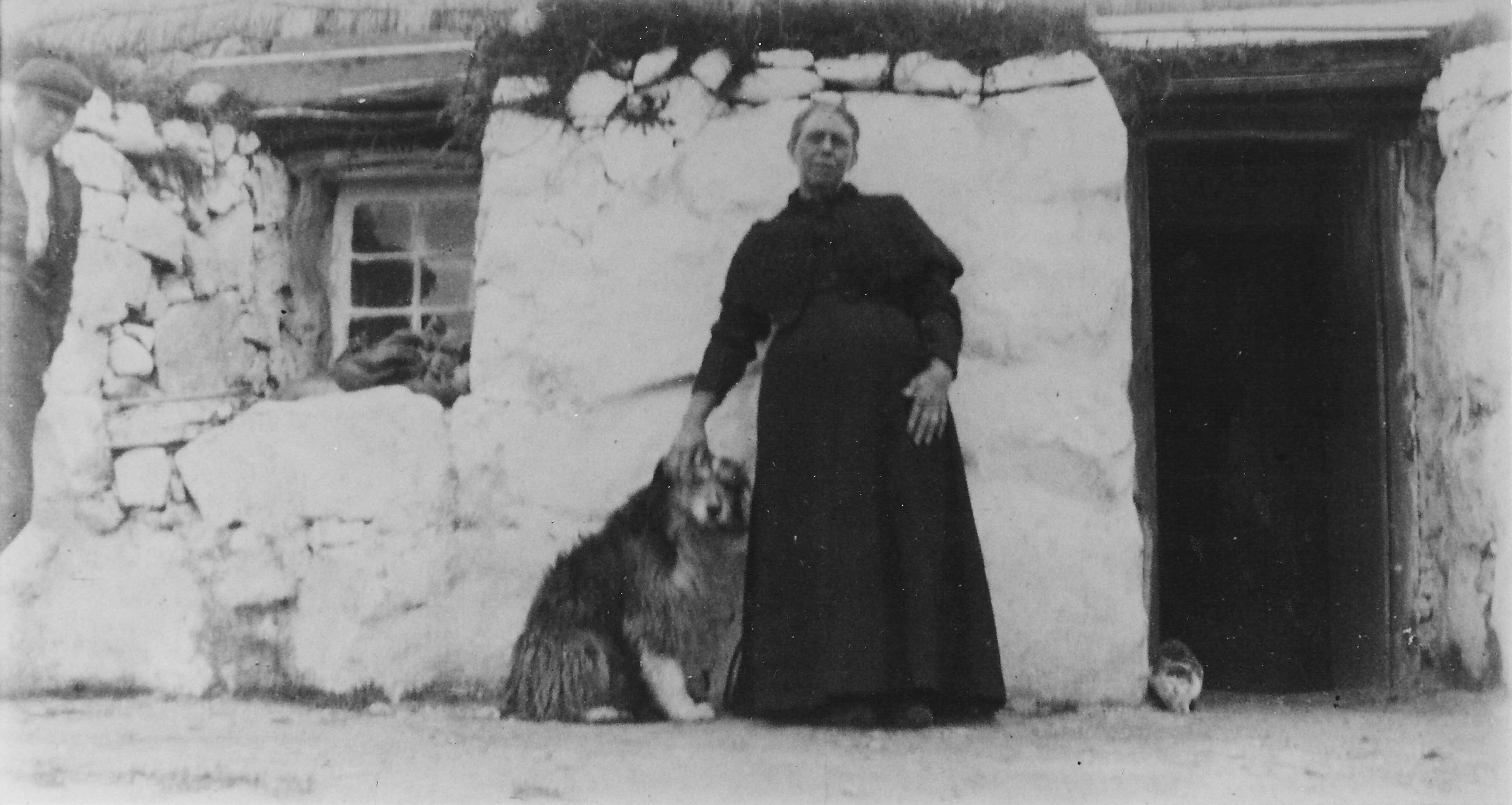
Photograph of Morag Cameron in the doorway of her thatched house in Moss.
Courtesy of Mr Angus Munn
Morag Cameron is pictured here standing in the doorway of her thatched house in Moss. The thatch is secured with coir rope and weighted down with stones. The rounded roof is characteristic of Tiree houses.
Inside would be a kitchen at one end and a best room at the other. The head of the house would occupy a small bedroom, a’ clòsaid, off the hall with the rest of the family sleeping in the loft. It was not uncommon for such houses to hold twelve people.
Traditionally the walls at the front of the house, the chimneys and around the windows were painted with white lime made by burning limpet shells. The walls inside were also given a coating of lime twice a year, in the summer and at New Year.
Black and white photograph of Morag Cameron, Moss, ca 1920s.
Morag Cameron outside her thatched house in Moss in the late 1920s. Note the thatch secured with coir rope weighted with stones. The ruin is opposite the `Greenbank` (with the post box). Morag was known as Mòr a` Phaal Aal because her father`s nickname was Phaal Aal / Pale Ale.
Audio cassette recording of Seumas na Croige with Alan Boyd.
Alan Boyd talks to James MacDonald (Seumas na Croige) of West Hynish about his sea-faring days and being shipwrecked in World War I, his schooldays at Balemartine School, the people of West Hynish and Bail’ Ur, their nicknames and genealogy, fishing and different types of seaweed, thatched houses, healing powers, Captain Donald MacKinnon of the Great China Tea Race, and place-names in Balephuil and West Hynish. Gàidhlig neo-mhodail: Tha Ailean Bòid a’ bruidhinn ri Seumas Mac Dhòmhnaill (Seumas na Croige) as na Cùiltean mu na làithean aige aig fairge agus mar a chaidh am bàta air an robh e air na sgeirean ’sa Cheud Chogadh, làithean sgoile ann am Baile Mhàrtainn, muinntir nan Cùiltean agus am Bail’ Ùr, a far-ainm agus an sloinneadh aca, iasgach, deifir sheòrsa feamainn, taighean tugha, comasan leigheis, an sgiobair Dòmhnall Mac Fhionghainn, fear Reis Mhòr an Ti Shina agus ainmean-aite ann am Baile Phuill agus na Cùiltean
Audio cassette recording of John MacKinnon, Kilmoluaig, and John Fletcher, Balemartine, interviewed by Maggie Campbell on 2/112002.
John MacKinnon (Iain Aonghais) of Kilmoluaig and John Fletcher (Iain Chaluim) of Balemartine talk to Maggie Campbell in November 2002 about the Hynish complex built by the Lighthouse Commission, the names and genealogy of the people who lived there, the work involved in its renovation, the earlier water sources, the scales and weighing of stone blocks taken by boat to Skerryvore during its construction and the skill of Alan Stevenson. Tha Iain Aonghais a Cillmoluaig agus Iain an Fhleisteir a Baile Mhàrtainn a’ bruidhinn ri Magaidh Chaimbeul anns an t-Samhain 2002 mu obair na togalaichean ann an Haoidhnis a bha air an togail aig Ùghdarras nan Taighean Solus, ainmean agus an sloinntearachd aig na daoine a bha fuireach an sin, an obair a bha co-cheangailte ris an nuadhachadh, màthair-uisge roimhe seo, tomhas agus cudthrom nan clachan a bha air an toir a mach gun Sgeir Mhòr ann am bata aig an àm a’ togail agus sgil Alain Steapanach.
Photograph of Archibald MacLeod thatching an outhouse in Balevullin in the 1940s
Courtesy of Ms Linda M. Gowans
George Holleyman, an archaeologist posted to Tiree during World War II, photographed Archibald MacLeod thatching an outhouse in Balevullin in the early 1940s. Thatching is started down at the tobhta, the ledge at the top of the wall, with the first row of sheaves being put on tips upwards.
After the first row, the sheaves are placed tips downwards until the ridge is reached when they are laid across the top with the tips on alternate sides. The thatch is put on thicker at the back, the windward side, and slightly halfway up the roof to give a more rounded shape.
As new thatch is laid on top of old, the ridge becomes almost flat. At this stage, the thatch has to be partially stripped off before the next layer is applied. Re-thatching is required every two to three years.
Black and white photograph of Archibald MacLeod, Balevullin.
Tiree has the greatest concentration of surviving thatched houses in the Scottish islands. In the photograph, Archibald MacLeod is shown thatching an outhouse in Balevullin. The rafters are first overlain with a layer of thin turf slices carefully cut from the moorland and tapered at the sides so that they lie flush on the roof. The thatching material, usually marram grass, is cut with a scythe between September and March and tied into small sheaves which are then positioned on top of the turf. The completed thatch is secured with wire netting weighted down with heavy beach pebbles. Re-thatching is required every 2-3 years.
Black and white postcard of the Kirkapol Lodge, 1920s.
The Lodge at Kirkapol showing the original entrance in around the 1920s. The child in the photograph is probably Elizabeth Milne, the grandaughter of Lady Frances Balfour, the sister of the Duke of Argyll.