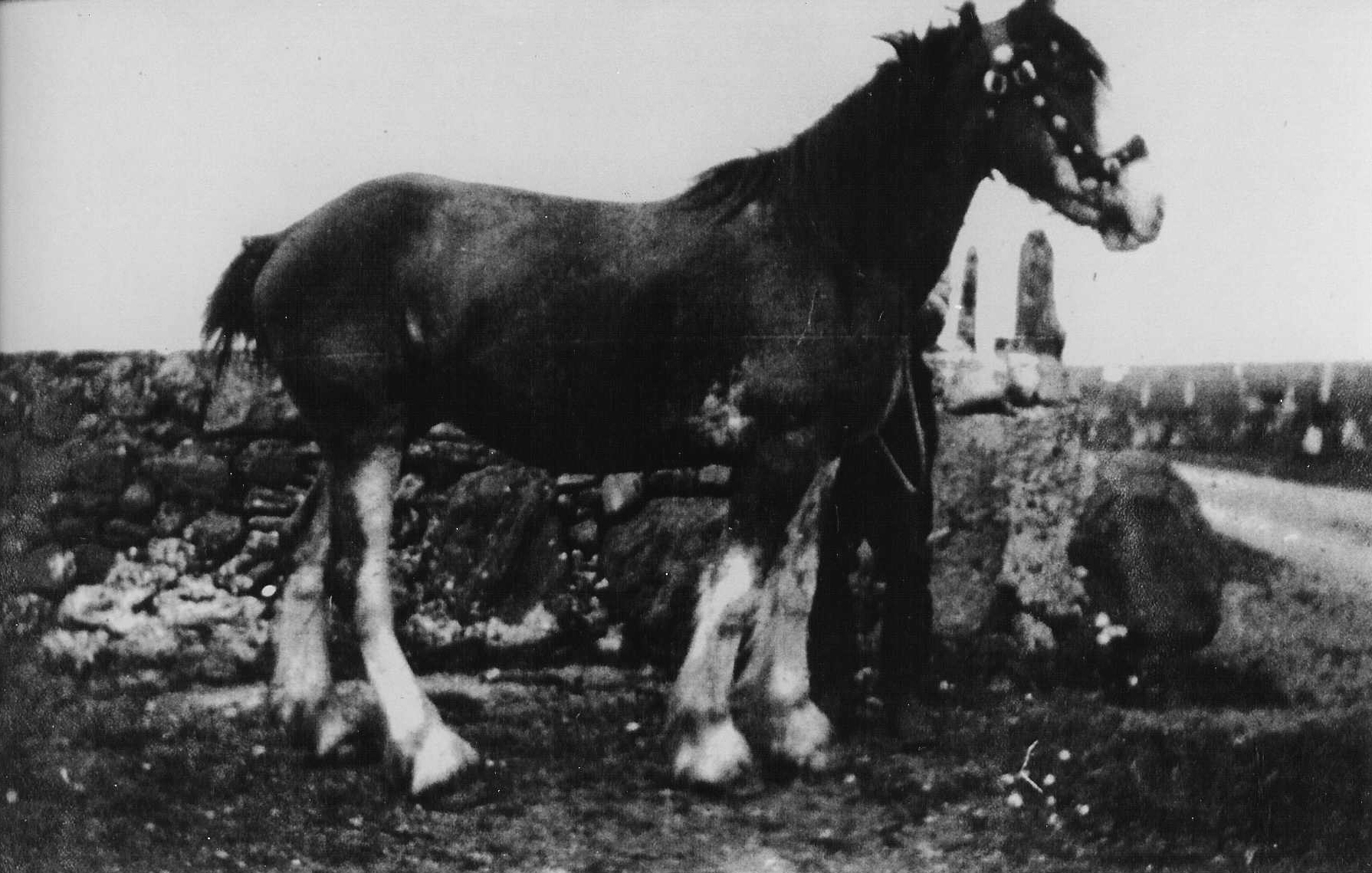
Black and white photograph of John MacLean of Cornaigbeg with a Clydesdale stallion.
John MacLean of the Brae, Cornaigbeg, with a Clydesdale stallion, probably photographed in the 1930s. The harness went through the belt around the stallion and was used to control him.
Audio cassette recording of John MacKinnon of Kilmoluaig talking to Maggie Campbell in October 1999.
John MacKinnon (Iain Chaluim) talks to Maggie Campbell in October 1999 about the people and places in and around Kilmoluaig, the use of lichen to dye cloth red, various ruins in the area around Loch Bhasapol where there used to be salmon and trout, the son of Sir Donald MacLean who spied for Russia, how the Green got its name, the once frequent sand drifts, the water drawn from wells, working crofts with horses, planting oats, turnips and potatoes, taking grain to the mill at Cornaig and the scarcity of people where they were once so plentiful. Tha Iain Chaluim a’ bruidhinn ri Magaidh Chaimbeul anns an Dàmhair 1999 mu na daoine agus àiteachan ann agus mun cuairt Cill Moluaig, feum crotail airson aodach a dhath gu dearg, diofrach thobhtaichean mun cuairt Loch Bhasapol far am b’ àbhaist bradan agus bric a bhi, mac fear-uasal Dhòmhnall ’IcIllEathain a bha na fhear-brathaidh airson an Ruis, mar a fhuair ‘An Green’ ainm, na cathaidhean gainmhaiche a b’ àbhaist a bhi ann, uisge air a tharraing a tobraichean, ag obair air na croitean le eich, a’ cur coirce, neipean agus buntàta, a’ toirt sìol don mhuilinn ann an Còrnaig agus cion nan daoine far an robh iad uaireigin gu math lìonmhor.
Audio cassette recording of Alasdair MacKechnie and Angus MacLean talking to Maggie Campbell in October 1999.
Alasdair MacKechnie of Mull and Angus MacLean of Scarinish talk to Maggie Campbell in October 1999 about bringing cattle from Tiree to the Ross, the links between the Ross and Hynish when Skerryvore was being built, how fishermen came from South Uist to teach the Ross people how to fish at the time of the potato blight, the exchange of peat for potatoes with Tiree people, regular peat-cutting trips to the Ross from Tiree, the ferry links that used to exists; two songs are sung: Fàgail Loch Buidhe and Mhairi Mhin Mheall-Shieileach. Tha Alasdair ’IcEachairn a Muile agus Aonghas Dhòmhnuill Eòghainn Mhòr a Sgairinis a’ bruidhinn ri Magaidh Chaimbeul anns an Dàmhair 1999 mu bhi toirt beathaichean as Tiriodh gu ’n Ros, an co-cheangal a bha eadar An Ros agus Haoidhnis nuair a bha an Sgeir Mhòr ga togail, mar a thàinig iasgairean a Uibhist a Deas a dh’ ionnsachadh iasgach do mhuinntir an Ros an àm bliadhna a chailleadh am buntàta, an t-suaip mòine ri muinntir Thiriodh airson buntàta, cuairtean riaghailteach do ’n Ros airson mòine, co-cheangal bhàtaichean a b’ àbhaist a bhi ann; tha da òran air an seinn: Fàgail Loch Buidhe agus Mhàiri Mhìn Mheall-Shuilean
Bell gun with firing mallet used as a humane killer for slaughtering cattle and sheep. Originally used by Tiree butcher, Donald Archie MacLean, to slaughter cattle and sheep, this humane killer was given to the vetinary on the island, Robert Beck, in the 1960s. Made of cast iron, the maker’s name, W. W. Greener of Birmingham, is embossed around the rim of bell. Once loaded with a single bullet, the bell was positioned on the front of the animal’s head and the gun fired by hitting the trigger (the protruding knob) with the wooden mallet. Although very efficient and humane, it required two hands to operate and another person to steady the animal’s head. Not considered safe enough for use indoors, humane killers with captive bolts are now used instead.
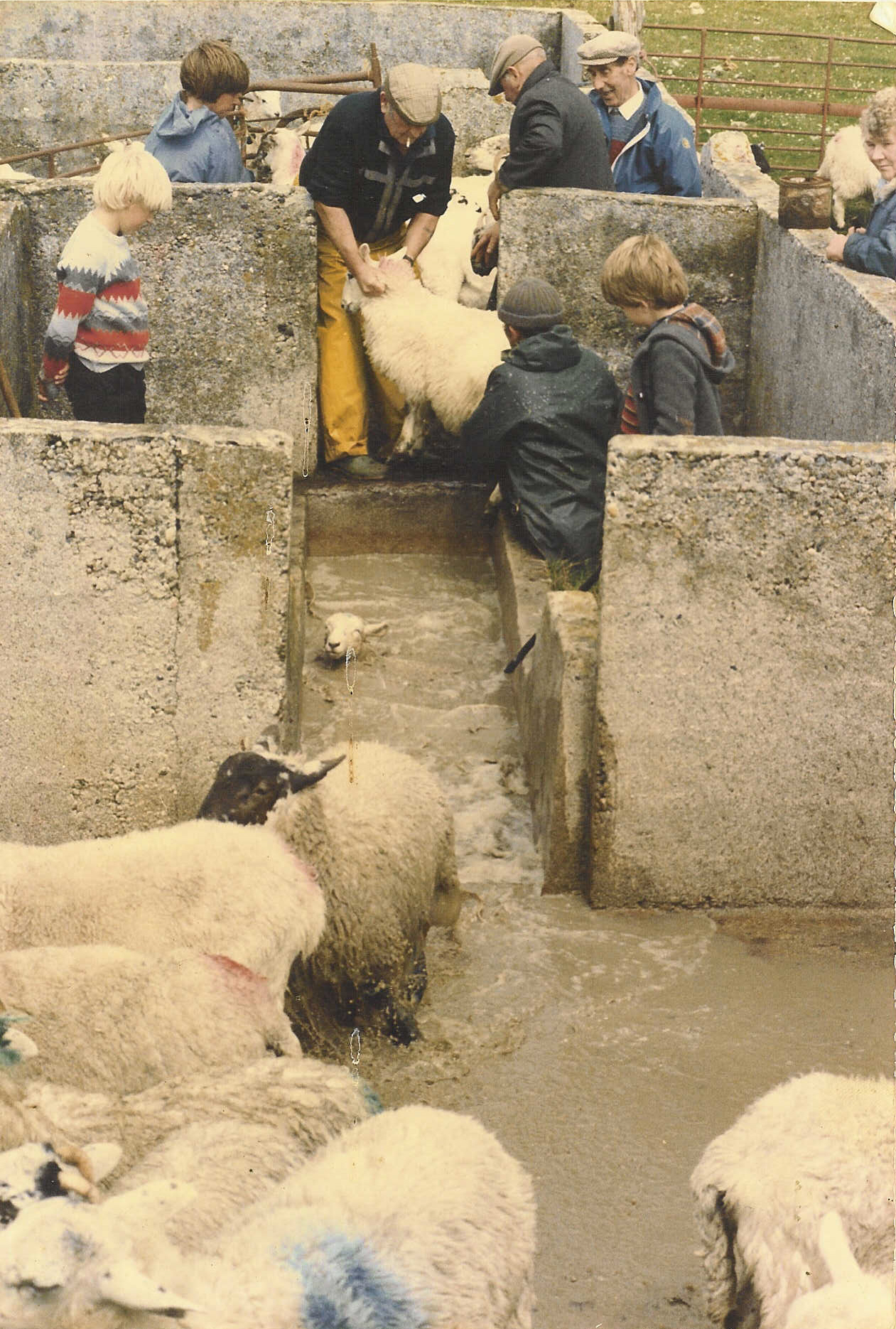
This photograph shows sheep being put through a dip-bath at Balephuil in 1987. Twice-yearly dipping was compulsory up to 1989 in an effort to eradicate scab, a disease caused by a parasitic mite that can result in severe loss of condition and death, especially of lambs. Dipping also treated other parasites such as blowfly maggots and ticks.
The majority of dips contain organophosphates (OP) which were originally developed as chemical warfare agents. The effects of exposure can include headache, exhaustion, blurred vision, muscle twitching and confusion. People subsequently handling sheep can also be at risk.
As well as being hazardous to health, sheep dips are harmful to wildlife and the environment, and their disposal is problematical. Nowadays most crofters on Tiree use non-OP pour-on treatments to control parasites on their sheep.
Colour photograph of sheep-dipping in Balephuil in 1987.
Sheep-dipping in Balephuil in August 1987. L-R: (front) Etty MacDonald, unknown, unknown, (back) unknown, John MacPhail, John Brown, David MacClounnan.