Donald Sinclair (Dòmhnall Chaluim Bhàin) of Balephuil sings ‘Bràigh Rùsgaich’, talks about the tacksman of Grianal Niall Dubh, sings ‘Lachlann ’ic Nèill ’ic Lachlainn’ and ‘Solbhag Bheag’, talks about Coinneach Odhar, recites part of a song about the ‘Black School’, the supernatural powers of Iain Dubh MacLeod and a boy who could perform magic, sings ‘Gillean Ghleann Dail’ and ‘MacGriogair o Ruadh Shruth’, talks about technical terms used on boats, sings a sailing song, talks about molluscs and their uses, sings a fragment of another song and talks some more about the Grianal tacksman.
Hector Kennedy of Kilkenneth talks about the death by fever of Rev. Duncan MacDougall’s wife and two children, house improvements, exchanging crofts, the kelp factory, the MacDonalds, tells a story about Niall Eachann, talks about the shop at Bail’ Ùr, shopkeeper Duncan MacKinnon, the ditches around Mannal, Balemartine, Loch a’ Phuill and Loch Bhasapol, John MacMillan shepherd to farmer Donald Campbell (Dòmhnall a’ Ruighe) at Baugh and the Reef, the Hendersons of Balemartine who lived for a while under an upturned boat, John MacNeill, tenants’ rent and the Campbells of Kilmoluaig who emigrated to Canada.
Hector Kennedy of Kilkenneth talks about the death by fever of Rev. Duncan MacDougall’s wife and two children, house improvements, exchanging crofts, the kelp factory, the MacDonalds, tells a story about Niall Eachann, talks about the shop at Bail’ Ùr, shopkeeper Duncan MacKinnon, the ditches around Mannal, Balemartine, Loch a’ Phuill and Loch Bhasapol, John MacMillan shepherd to farmer Donald Campbell (Dòmhnall a’ Ruighe) at Baugh and the Reef, the Hendersons of Balemartine who lived for a while under an upturned boat, John MacNeill, tenants’ rent and the Campbells of Kilmoluaig who emigrated to Canada.
Donald Sinclair (Dòmhnall Chaluim Bhàin) of Balephuil sings ‘Bràigh Rùsgaich’, talks about the tacksman of Grianal Niall Dubh, sings ‘Lachlann ’ic Nèill ’ic Lachlainn’ and ‘Solbhag Bheag’, talks about Coinneach Odhar, recites part of a song about the ‘Black School’, the supernatural powers of Iain Dubh MacLeod and a boy who could perform magic, sings ‘Gillean Ghleann Dail’ and ‘MacGriogair o Ruadh Shruth’, talks about technical terms used on boats, sings a sailing song, talks about molluscs and their uses, sings a fragment of another song and talks some more about the Grianal tacksman.
Book `They Came From Tiree` by Gene Donald Lamont.
A history of Tiree from 7000 BC to 1851 AD with chapters on the economic situation in the late 18th and early 19th centuries, the famine years and emigration to Canada.
Articles about the lairds of Coll, holiday-makers, extract from the diary of a Swiss visitor in 1807, the school, corncrakes, the pier, Campbell of Cornaig, names, RSPB, missionary Malcolm MacDonald, midges and the Community Council among others.
Framed photograph of Turnbull`s 1768-9 map of Tiree
Turnbull`s 1768-9 map of Tiree, original of which is in the collection of the Duke of Argyll at Inverary Castle and copied by RCAHMS.
Tiree in 100 Objects – 1 – The Turnbull Map
We start this epic series with a map. It is huge – 8 feet by 6 – and painted on canvas. It belongs to the Duke of Argyll and sits in his archives at Inveraray Castle. We have a small copy in An Iodhlann. In 1768 the Campbells had owned Tiree for less than one hundred years, but already the Duke had decided to use his crown jewel not as a clan chief, but as its landlord. Driving up revenues from this fertile island was this main aim, and moving a medieval farming system into the modern age was his method. First he needed to know the island’s potential.
Heanish area of Turnbull’s map of Tiree, hand-painted 1768
James Turnbull was his chosen surveyor for this enterprise. We know very little about him, other than it took him five weeks to travel to Tiree and return to his Edinburgh home. But he was obviously a supremely skilled professional and his map a thing of lasting beauty as well as being a treasure trove of information about the island in the 18th century. The boundaries of the old farming townships curve through the landscape (for example either side of the Caolas road), every house is drawn in its place and every field and its furrows are marked precisely. The map was drawn thirty years before the crofts were marked out: the thirty or so houses in Vaul are clustered at the bay, just east of Seaside, while the township’s cropped fields cover the golf course!
Turnbull also wrote an accompanying field-by-field report: ‘Barapol: Field number 44; Infield; A compound of loam, gravel and clay, a good soil’. He calculated that 3,474 acres, 25% of Tiree’s land area, were sown with oats and barley – numbers we can only dream about today!
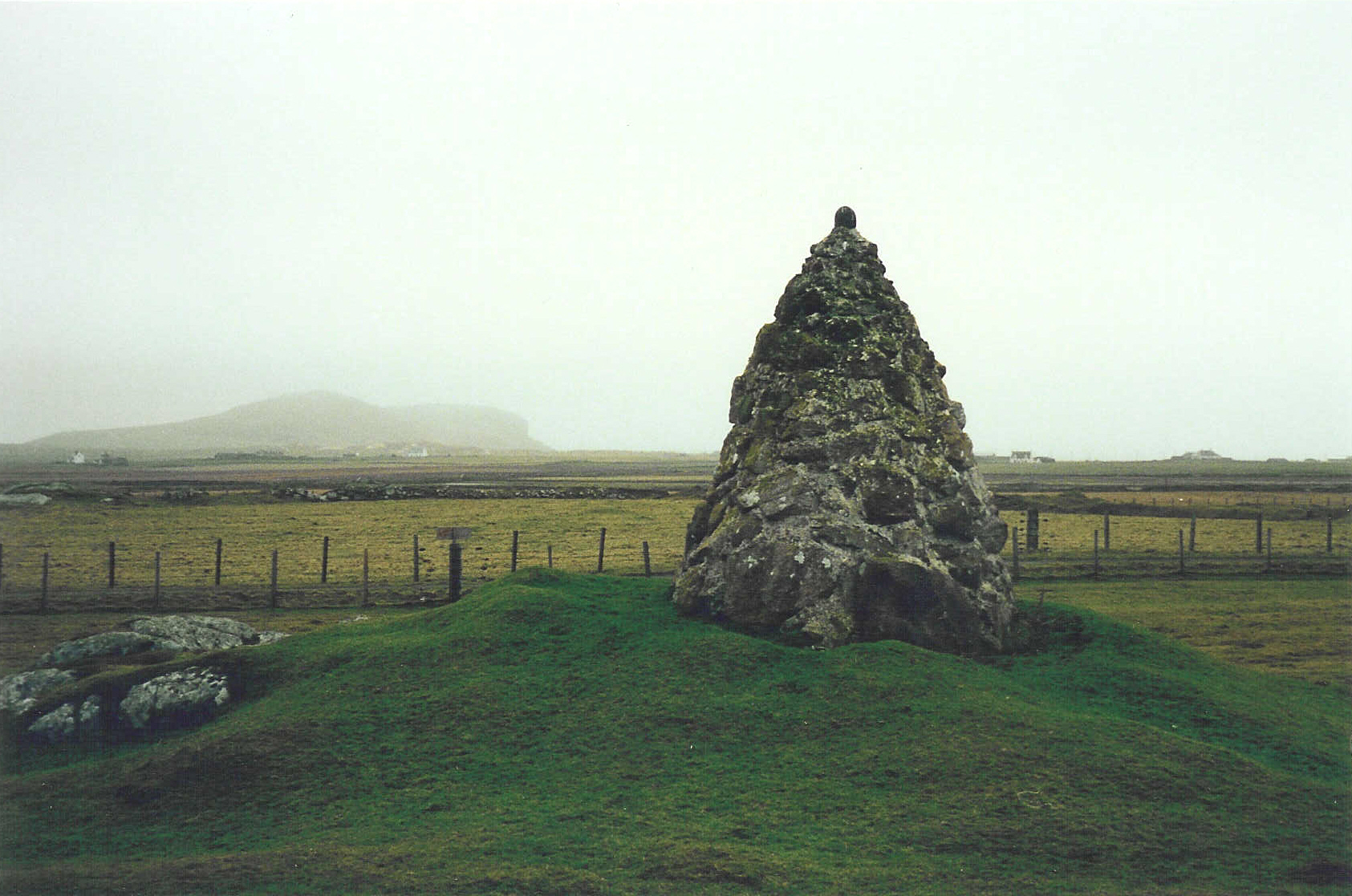
Photograph of Tùr Mhic Chaluim at Kilkenneth in 2001
Born in Argyll in 1849, the Reverend Donald MacCallum was radicalised by what he saw of the Clearances and became the crofters’ and cottars’ champion. This was a rare stand for a minister at that time dependant as they were on their landlord for manse, glebe and living.
He served in Loch Geàrr, Arisaig and Skye, where he became the only Highland minister of that era to be imprisoned for his political beliefs. He came to Tiree in 1887 but was forced out after 18 months by the Argyll family who refused to support him.
The crofters of Tiree erected the cairn in his honour. The inscription read: ‘Tùr McCallum, 1st July 1889. Bas no Buaidh. Death or Victory.’
Colour photograph of Tur Mhic Chaluim in Kilkenneth in 2001.
Tur Mhic Chaluim in Kilkenneth photographed in February 2001 by Catriona Hunter. The memorial was erected in honour of the Reverend Donald MacCallum who was born in Argyll in 1849. He was radicalised by what he saw of the Clearances and became the crofters’ and cottars’ champion. This was a rare stand for a minister at that time dependant as they were on their landlord for manse, glebe and living. He served in Loch Geàrr, Arisaig and Skye (where he became the only Highland minister of that era to be imprisoned for his political beliefs), then came to Tiree in 1887. He was forced out after 18 months by the Argyll family who refused to support him. The inscription reads: ‘Tùr McCallum, 1st July 1889. Bas na Buaidh. Death or Victory.’