Local news about large consignments of livestock for the southern market, the deaths of Flora MacFadyen of Salum and Catherine MacDonald of Caoles, and the shortage of accommodation for visitors close to the golf courses.
Audio cassette recording of a ceilidh with Maggie Campbell, Neil MacLeod and Murdoch MacDonald in 1998.
Maggie Campbell and Neil MacLeod of Kilmoluaig sing several songs composed by Tiree bards and a love song; Murdoch MacDonald of Kilmoluaig talks about shepherding, harvesting, the spring work on a croft, bulk buying of groceries, sharing barrels of herrings, travelling people, first-footing, home-coming events during the Glasgow fair, barn weddings and blanket washing days.Tha Magaidh Chaimbeul agus Niall MhicLeòid a Cill Moluag a’ seinn iomadach òran air an cur ri chèile aig bàird Thirisdeach agus òran gaoil; Murchadh MhicDhòmhnaill a Cill Moluaig a’ bruidhinn mun obair cìobair, obair foghair, obair an Earraich air a’ chroit, ceannach biadh ann am meudachd, a’ roinn barraille sgadain, na ceàrdan, a’ dol a mach air oidhche na Callaine, cùisean aig àm tighinn dhachaigh re Faidhir Glaschu, bainnsean sàbhail agus làithean nigheadh na plaideachan.
Audio cassette recording of Jean MacCallum, Balevullin talking to Maggie Campbell in 2000.
Jean MacCallum of Balevullin talks to Maggie Campbell in 2000 about the people she knew as a child, including Nurse MacDonald, her friends and family and what she got up to, her schooling, her love of working outside with animals, meeting her mother and half-brothers and -sisters and of eventually meeting her sister, the people in Balevullin, the shops and the butcher’s, wartime rations and being sent back to Glasgow but returning to Tiree.
Photograph of two men bagging sheep fleeces in the 1920s or 1930s.
Courtesy of Mrs Mairi Campbell
The bagging of fleeces sheared from Tiree sheep. These fleeces were transported off the island. This picture was possibly taken in Balevullin in the 1920s or 1930s.
Black and white photograph of an unknown man bagging fleeces in the 1920s or 1930s.
Bagging fleeces for transport possibly in Balevullin in the 1920s or 1930s.
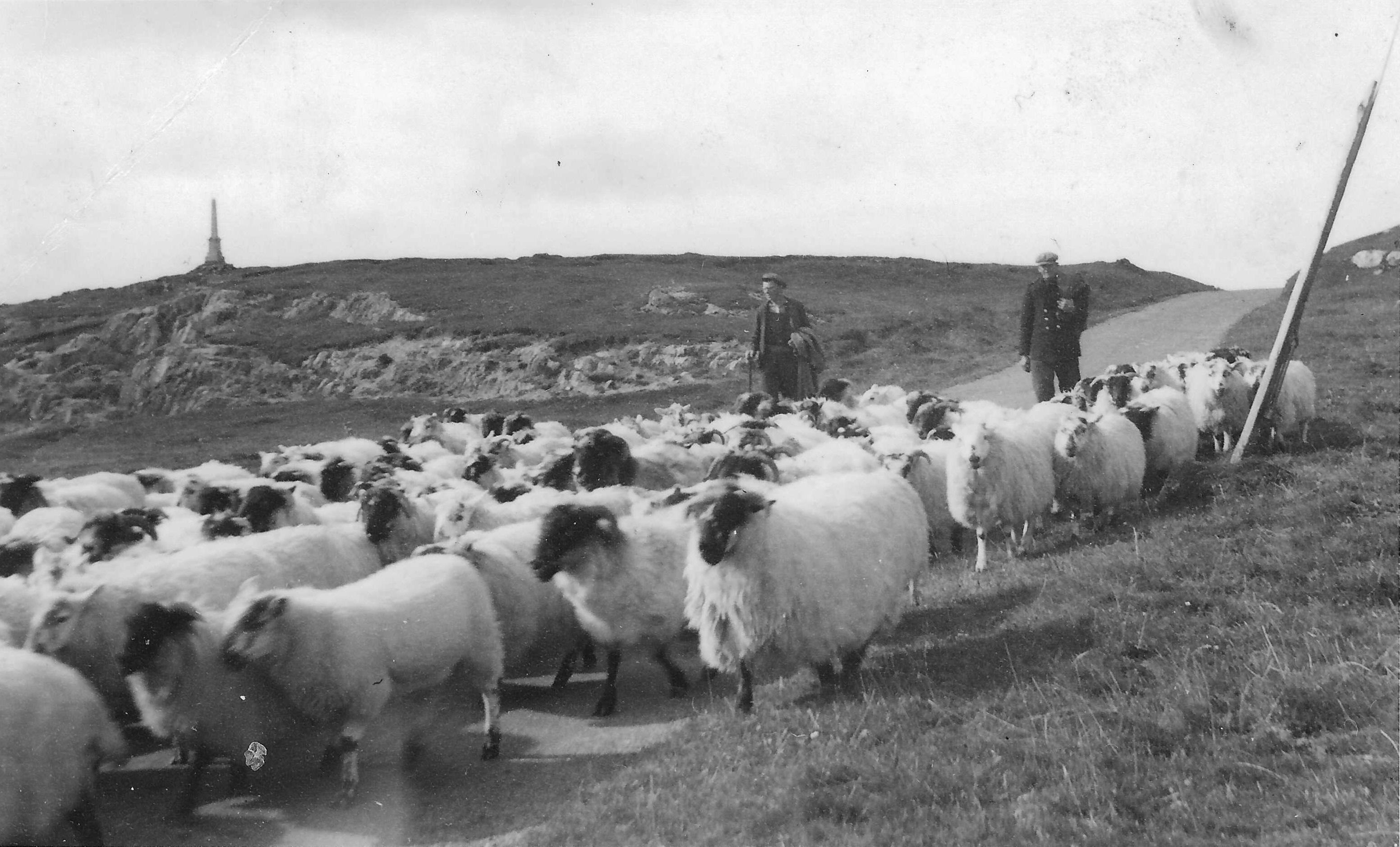
Photograph of Archie Kennedy and James MacMaster driving sheep through Baugh in the 1960s.
Courtesy of Mrs Mairi Campbell
In this photograph of the 1960s, Archie Kennedy of Crossapol and James MacMaster of Kenovay are driving sheep through Baugh on their way to the ferry after lamb sales at Crossapol. The monument to Dr Buchanan can be seen on the hill to the left.
Sheep are generally kept on common grazings; each croft has a souming, the right of grazing on common land, which varies according to township. For instance, in Barrapol each croft has the right to graze five cows and fourteen sheep, whereas in Balephuil the crofts have different soumings.
In the second half of the 19th century, there were between four to five thousand sheep and lambs on the island. Today they number over thirteen thousand.
Black and white photograph of a flock of sheep at Baugh in the 1960s.
Archie Kennedy of Crossapol and James MacMaster of Kenovay herding sheep past the Baugh monument on the way to the ferry after lamb sales in the 1960s.
Bell gun with firing mallet used as a humane killer for slaughtering cattle and sheep. Originally used by Tiree butcher, Donald Archie MacLean, to slaughter cattle and sheep, this humane killer was given to the vetinary on the island, Robert Beck, in the 1960s. Made of cast iron, the maker’s name, W. W. Greener of Birmingham, is embossed around the rim of bell. Once loaded with a single bullet, the bell was positioned on the front of the animal’s head and the gun fired by hitting the trigger (the protruding knob) with the wooden mallet. Although very efficient and humane, it required two hands to operate and another person to steady the animal’s head. Not considered safe enough for use indoors, humane killers with captive bolts are now used instead.