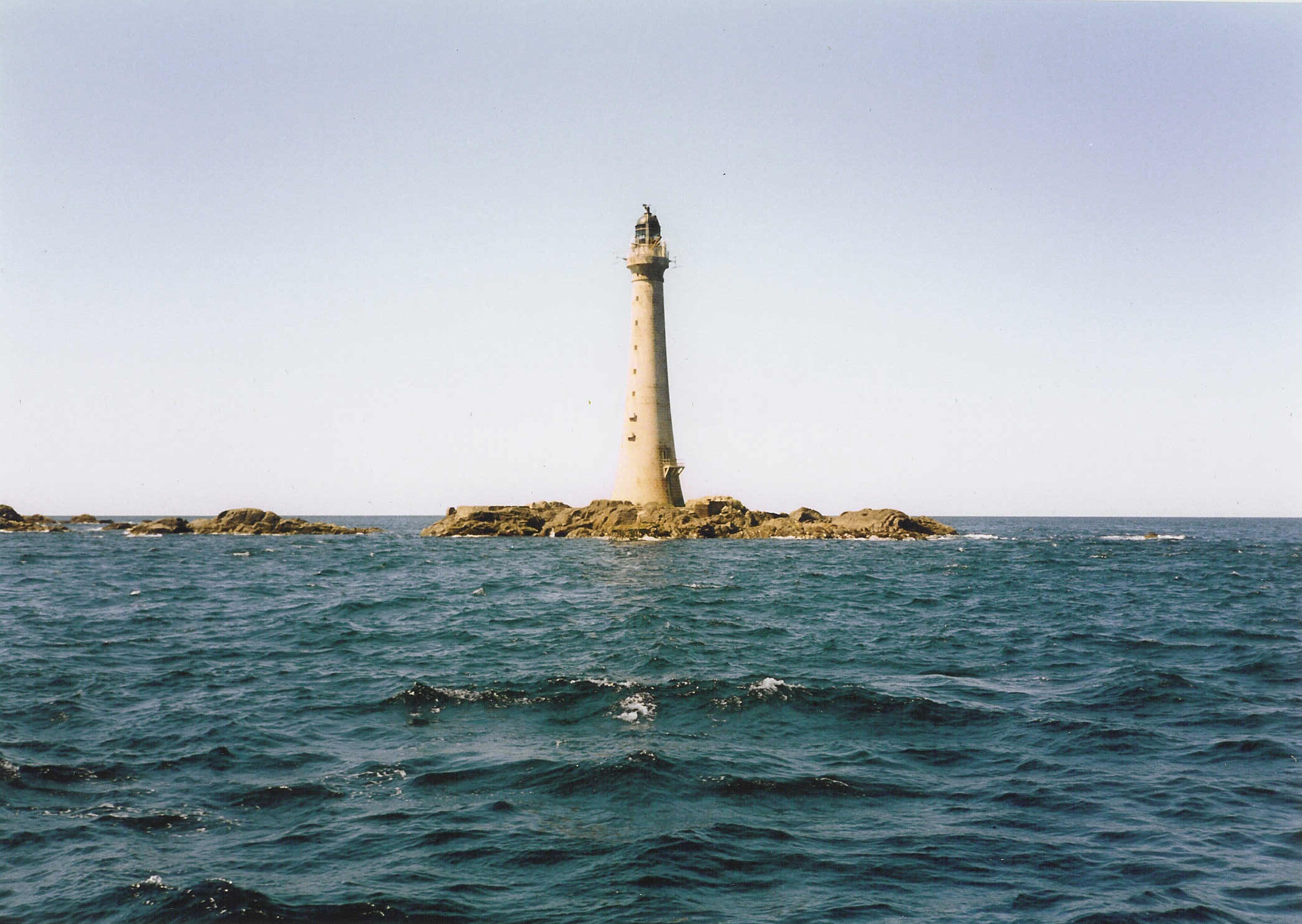
Situated 12 miles southwest of Tiree, Skerryvore lighthouse was built between 1835 and 1842 by Alan Stevenson, Clerk of Works to the Northern Lighthouse Board, on a reef that had wrecked ships over many years
The lighthouse stands 42 metes high, weighs a total of 58,580 tons and has walls 2.9 metres thick at the base. The lower four courses are built from grey Tiree granite which proved too hard and time-consuming to dress. The remainder of the tower is built from more workable pink granite shipped from the Ross of Mull.
It was described by the Institute of Civil Engineers as ‘the finest combination of mass with elegance to be met with in architectural or engineering structures’.
Colour photograph of Skerryvore lighthouse in July 2004.
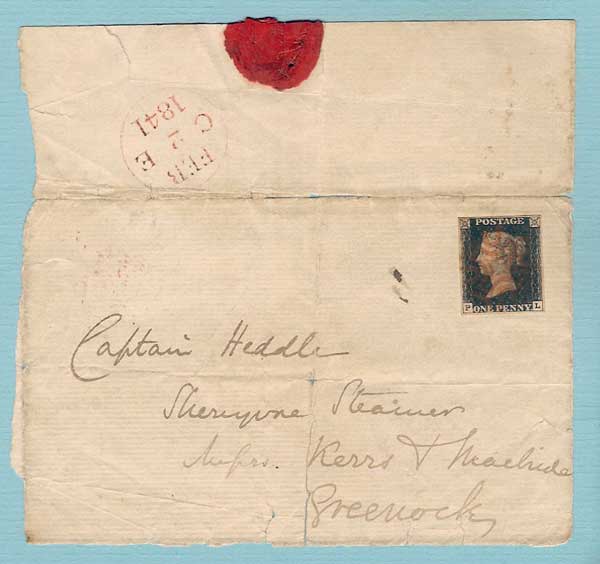
Envelope addressed to Captain Heddle of the Skerryvore steamer
Photograph of an envelope addressed to Captain Heddle of the Skerryvore steamer and date-stamped 1841.
Courtesy of Mr Alistair Morrison
Captain James Heddle was the master of the paddle steamer Skerryvore built by Menzies and Sons of Leith for the purpose of towing lighters loaded with granite blocks and other materials from the harbour at Hynish to the Skerryvore rocks during the building of the lighthouse.
The 150 ton wooden steamer was fitted with two engines of 30 horse power each at a total cost of over £6,350. Initially reluctant to embark on such an expense, the Northern Lighthouse Board eventually agreed when a suitable vessel for purchase could not be found. £1616 was recouped from the sale of the steamer in 1847.
In his Account of the Skerryvore Lighthouse Alan Stevenson highly commended Captain Heddle for ‘his unwearied exertion in the discharge of his harassing duty at Skerryvore’ which no doubt contributed to his sudden death in 1841 from tuberculosis of the lungs.
Photocopied book `Account of the Skerryvore Lighthouse` by Alan Stevenson.
Photocopied account of the building of Skerryvore lighthouse with notes on the illumination of lighthouses by Alan Stevenson, plus a chart of the position of the Skerryvore rocks and plans of the rocks themselves at high and low water and the complex at Hynish (in two folders).
Audio cassette recording of David MacClounnan of Balephuil talking to John Donald MacLean in June 1998.
David MacClounnan (Dàibhidh na Croige) of Balephuil talks to John Donald MacLean (Teòn Dòmhnall a’ Mhuilinn) of Crossapol about himself and Flòraidh Bhàird going home by bicycle, fishing, the caves around ‘cowrie shell beach’, the hanging island, a mermaid found at Diobadal in Hynish, Hynish pier and Skerryvore lighthouse, a well in Balephuil, beach-combing, forts, second sight, the first tractor in Tiree, a fairy woman, old funerals and funeral costs.
Audio cassette recording of David MacClounnan of Balephuil talking to John Donald MacLean in February 1998.
David MacClounnan (Dàibhidh na Croige) of Balephuil talks to John Donald MacLean (Teòn Dòmhnall a’ Mhuilinn) about fishing for cod and herring, drying fish, the fishing smacks of West Hynish, the construction of the thatched house in Bail’ Ur and their owners, old stories about fairies, the Old New Year, gathering seafood, the piper who went into the cave at Kennavara, a water diviner, place-names in East and West Hynish, the Norsemen, World War I and Skerryvore. Tha Dàibhidh na Croige a Baile Phuill a’ bruidhinn ri Teòn Dòmhnall a’ Mhuilinn mu iasgach truisg agus sgadan, tiormachadh èisg, bàtaichean èisg nan Cuiltean, na taighean-tugha a chaidh a thogail anns a’ Bhail’ Ùr agus na daoine a bu leis iad, seann naidheachdan mu shìthichean, an t-seann Bliadhna Ùr, a’ cruinneachadh biadh-cladaich, am pìobair a chaidh a steach don uaimh aig Ceann a’ Bhara, fàistinneach-uisge, ainmeannan-aite ann am Ear ’s ann Iar Haoidhnis, na Lochlannaich, a’ Cheud Chogadh agus an Sgeir Mhòr.