Photograph of two crofters carting marram grass from behind Ben Hough in the 1930s.
Courtesy of Mrs Grace Campbell
The two men are transporting marram grass, known locally as bent or muran, from behind Ben Hough at the west end of Tiree. The dried grass is used for thatching roofs while the roots were used as a scourer for cleaning tables and floors.
The grass is cut by sickle or scythe between September and March, outwith its growing season, and is much harder work than cutting corn or hay. The longer the stem the better, as a more waterproof roof is ensured and less work required.
Muran thrives best in shifting sand and grows stronger after cutting. There is less on Tiree today than there used to be. This may be due to the use of fertilisers which encourage the growth of other grasses and the out-wintering of cattle which shelter in the dunes and trample and eat it.
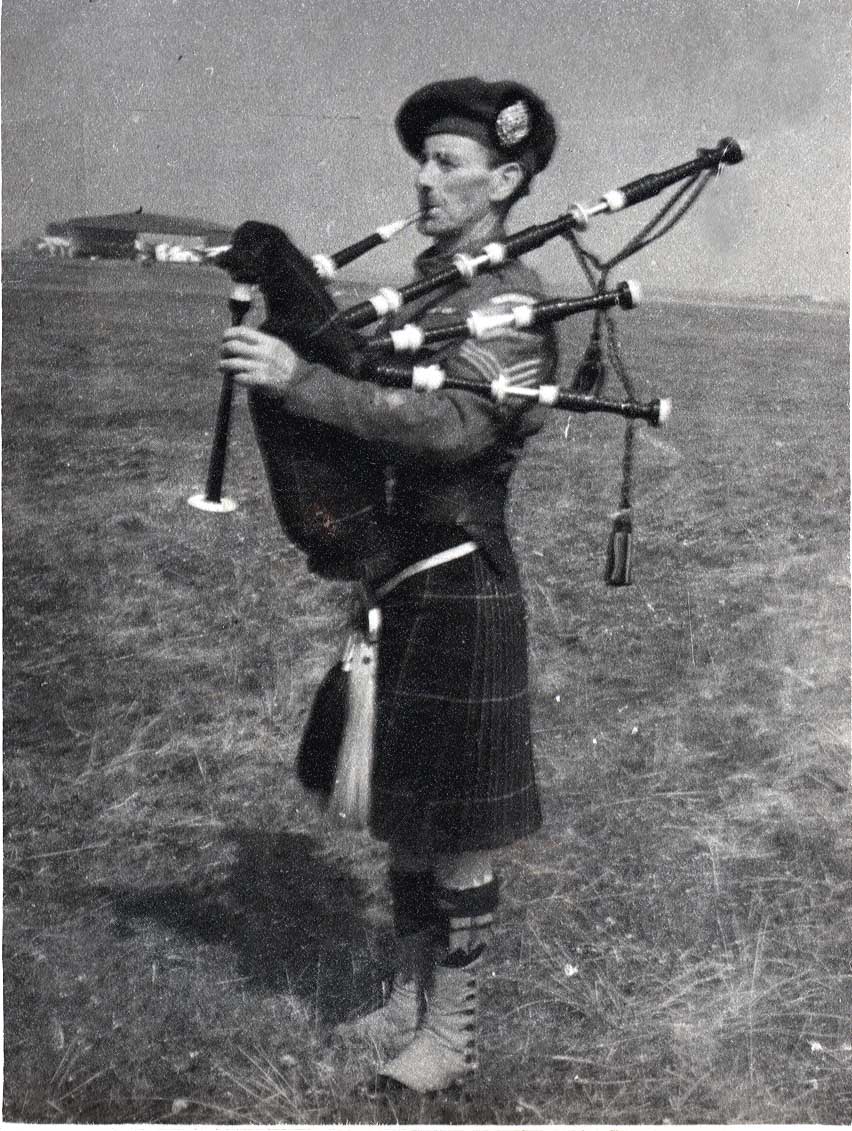
Black and white photograph of piper Hugh MacArthur in 1944.
Photograph of a pig being hoisted aboard a steamer at Gott Bay pier in the 1920s.
Courtesy of Mrs Grace Campbell
In this photograph taken in the 1920s, a pig is being hoisted by a rope sling aboard a small steamer at Gott Bay pier. Canvas slings were more commonly used, but even so the pigs used to scream most horribly while in the air.
The Statistical Account of 1845 records that ‘a great number of pigs have been reared in this parish… They are generally exported alive chiefly to Glasgow and Greenock… Last spring upwards of 500 were shipped off from this island.’
The Agricultural Statistics for Tiree show that in 1867 there were only 260 pigs on the island. In 1910, the numbers had increased to 360, half of which were breeding sows. However, after 1910 the numbers declined steadily and by the mid-1960s there were none on the island
Black and white photograph of a pig being hoisted off a boat.
A pig being hoisted on or off a boat, probably taken in the 1930s.
Murray Omand’s band consisted of local men, seen here playing at a wedding in the public hall in 1970. They are, from left to right, Gordon Connell of Crossapol, Stewart Langley of Kirkapol, Lachie MacFadyen of Kenovay and Murray Omand of Balephetrish.
Black and white photograph of the musicians at a Tiree wedding in 1970.
The musicians at a Tiree wedding in 1970. L-R: Gordon Connell, Crossapol; Stewart Langley, Kirkapol; Lachie MacFadyen, Kenovay; Murray Omand, Balephetrish.
Black and white photograph of Lady Victoria Campbell.
Lady Victoria Campbell in the door of the annexe to the Lodge, known in the family as `The Crystal Palace`, probably photographed in the 1890s or early 1900s.
Donald and Morag MacLean listening to a crystal set
Photograph of Donald and Morag MacLean listening to a crystal set in 1920.
Courtesy of Mrs Flora MacKinnon
Donald and Morag MacLean from Balevullin are listening with headphones to a crystal set at their uncle’s house on Paisley Road West in Glasgow in 1920. The set, which can be seen on the chest of drawers behind them, is the simplest type of radio receiver in existence. Requiring no external power, such apparatus was in widespread use in the early days of radio.
The set consisted of an aerial attached to a coil of wire, a crystal fixed in a brass cup and the ‘cat’s whisker’, a thin wire which the operator touched to various points on the surface of the crystal to find the loudest signal.
Because there was no electrical amplification, earphones were required and there was no way to control the audio volume. Different stations could be found by moving a slider along the coil, but in the 1920s the choice was very limited.
Black and white photograph of Donald and Morag MacLean in 1920.
Donald and Morag MacLean listening to a crystal radio set in 1920.
Photograph of whalebone post sockets from the broch at Vaul.
Courtesy of Mr Nicholas Redman
These whale vertebrae, photographed by Nicholas Redman in 2003, are two of the four excavated from Dùn Mòr at Vaul by Dr. Euan Mackie in the early 1960s and now stored at the Hunterian Museum in Glasgow.
The vertebrae were positioned two on each side of the rectangular hearth set in the centre of the floor of the broch. They had been perforated in the middle and doubtless used as post sockets. The best preserved vertebrae would have held an 8 cm thick post.
Situated too close to the hearth to be roof supports, the posts were probably used to support some sort of roasting spit or a frame for a cooking cauldron.
Three black and white photographs of whale vertebrae from Dun Mor, Vaul.
Whalebone post sockets excavated from Dun Mor, Vaul, by Dr Euan MacKie in the 1960s and now stored at the Hunterian Museum in Glasgow. (2 photographs not displayed in Filing Cabinet 8 drawer 2)
Photograph of WAAFs on the steamer ‘Lochearn’ in 1945.
Courtesy of Mrs Jean Inglis
The Women’s Auxiliary Air Force (WAAF) was created in 1939. Although WAAFs did not serve as aircrew, they played a vital role in transport, communications, meteorology, aircraft control and intelligence.
The group of WAAFs in this photo were leaving Tiree on the steamer ‘Lochearn’. Jean Inglis née Davies from Edinburgh (back row, extreme right) spent two years underground at 18 Group HQ, Coastal Command at Rosyth before being posted to Tiree in May 1945.
Jean was a wireless operator and, with her team, made contact with aircraft in the area, on one occasion helping to guide a damaged plane to a safe landing on the island.
Black and white photograph of WAAFs on `Lochearn` during WWII.
WAAFs on the `Lochearn` during WWII. L-R: (back) Joy Pearce, London; Nan Hogarth, Whitby; unknown; Jean Inglis nee Davies, Edinburgh; (front) Flora Semple, Aberdeen; Marjorie Pollard, Burnley; Jean Hind, England. Jean Inglis spent two years underground at 18 Group HQ, Coastal Command at Rosyth before being posted to Tiree on 27/5/1945. LACW (leading aircraft woman) Jean Hind was a Wireless Operator who met Wing Commander Bryn Lewis while both serving on Tiree on 8 July 1944). They married on 9 July 1950. Nan Hogarth was also a LACW Wireless Operator.