


Colour photograph of Alasdair MacDonald, Kilmoluaig.
Alasdair MacDonald, Kilmoluaig milking a cow into a `tanger`, used to milk cows that kicked and to measure feed for calves.


Colour photograph of Alasdair MacDonald, Kilmoluaig.
Alasdair MacDonald, Kilmoluaig milking a cow into a `tanger`, used to milk cows that kicked and to measure feed for calves.
WAAFs on the steamer ‘Lochearn’ in 1945
Photograph of WAAFs on the steamer ‘Lochearn’ in 1945.

Courtesy of Mrs Jean Inglis
The Women’s Auxiliary Air Force (WAAF) was created in 1939. Although WAAFs did not serve as aircrew, they played a vital role in transport, communications, meteorology, aircraft control and intelligence.
The group of WAAFs in this photo were leaving Tiree on the steamer ‘Lochearn’. Jean Inglis née Davies from Edinburgh (back row, extreme right) spent two years underground at 18 Group HQ, Coastal Command at Rosyth before being posted to Tiree in May 1945.
Jean was a wireless operator and, with her team, made contact with aircraft in the area, on one occasion helping to guide a damaged plane to a safe landing on the island.
Black and white photograph of WAAFs on `Lochearn` during WWII.
WAAFs on the `Lochearn` during WWII. L-R: (back) Joy Pearce, London; Nan Hogarth, Whitby; unknown; Jean Inglis nee Davies, Edinburgh; (front) Flora Semple, Aberdeen; Marjorie Pollard, Burnley; Jean Hind, England. Jean Inglis spent two years underground at 18 Group HQ, Coastal Command at Rosyth before being posted to Tiree on 27/5/1945. LACW (leading aircraft woman) Jean Hind was a Wireless Operator who met Wing Commander Bryn Lewis while both serving on Tiree on 8 July 1944). They married on 9 July 1950. Nan Hogarth was also a LACW Wireless Operator.
Roadmen in Baugh
Photograph of roadmen working in Baugh.

Courtesy of Mr Angus Munn
A Balemartine man remarked during World War II that ‘Hitler was the best local councillor that Tiree ever had!’ By this he meant that the arrival of the RAF in 1941 brought a remarkable improvement in the infrastructure of the island.
A three-runway airport was constructed, as well as hundreds of Nissen huts and two NAAFIs selling alcohol and showing films. In addition, the road network was upgraded to cope with the lorries carrying supplies between the pier, the RAF station at Crossapol and the radar base at Hough.
The main road to the east end of the island used to be along the sandy expanse of Tràigh Ghott, the beach along Gott Bay; the tarred road around the bay was laid in 1931. This photograph shows workmen gravelling the road up to the doctor’s surgery at Baugh.
Black and white photograph of road-building during WWII.
Road-building during World War II.
Thomas Barr, tenant of Balephetrish Farm 1864-1912
Photograph of Thomas Barr, tenant of Balephetrish Farm 1864-1912.

Courtesy of Mr Angus Munn
In the mid-19th century, the 8th Duke of Argyll was keen to modernise Tiree’s agriculture and introduce dairy farming which he thought admirably suited to island’s pasturage. In 1864 he signed a 19-year lease for £400 a year with Robert Barr, a farmer from Dalry in Ayrshire.
So keen was the Duke for his new tenant to be successful he amalgamated the farms of Vaul, Balephetrish, the Reef, Kenovay and Crossapol to make a sizeable holding of over 3,000 acres. He also repaired the farmhouse and erected byres, stables, cart sheds and other outhouses.
Robert Barr sent his son Thomas to the island to establish the farm. Some cheese was made, but Tom Barr soon found that breeding beef cattle and horses was more lucrative. He introduced the first Clydesdale stallions to Tiree and also introduced the first mechanised hay rake.
Black and white photograph of Thomas Barr of Balephetrish Farm.
Thomas Barr who farmed in Balephetrish from 1864 to 1912.
Black and white photograph of Balephetrish pier.
Balephetrish pier constructed during WWII so that barges could unload materials for the aerodrome.

Andrew Young of Balephuil
Photograph of Andrew Young of Balephuil in his RAF uniform.

Courtesy of Mrs Mabel MacArthur
Originally from Glasgow, Andrew Young, his sister Mabel and brother William were brought up by the MacNeills of Main Road Farm in Balephuil.
Andrew had an unlucky war. As an RAF mechanic he was stationed in Burma and Kenya where he contracted malaria and typhoid. The troopship in which he was sent home was sunk off the African coast and he spent ten days in an open lifeboat. He was then picked up by a German U-boat and was confined for the rest of the war in a POW camp in Casablanca.
After the war Andrew died on Kennavara while out shooting.
Black and white photograph of Andrew Young during WWII.
Andrew Young, Balephuil, the brother of Mabel Kennedy, Sandaig. As an RAF mechanic he was stationed in Burma and India, where he contracted malaria and typhoid. The troopship in which he was sent home was sunk off the African coast and he was in an open lifeboat for ten days. He was then picked up by a German U-boat and spent the rest of the war in a POW camp in Casablanca. After the war he died on Kenavara while shooting.
Kilkenneth smiddy
Photograph of the smiddy at Kilkenneth in the early 20th century.

Courtesy of Mr Sandy MacKinnon
In the Highlands and Islands, horses were used for transport and agricultural work, unlike the Lowlands where oxen were used as draught animals. Of great value to the local people, native ponies fetched £3 to £9 at the end of the 18th century.
The numbers of horses on the island between 1870 and 1945 varied from 400 to 550, enough to support at least nine smiddies which were situated at Kilkenneth, Kilmoluaig, Balephetrish, Gott, Caoles, Balinoe, Hynish and Cornaigbeg, where there were two.
In addition to shoeing horses, blacksmiths repaired agricultural implements such as ploughs and harrows, made hinges and latches for wooden gates, hand tools like sickles and pitchforks, and other metal objects like swees for hanging cooking pots over a fire.
Black and white of the smiddy at Kilkenneth in the early 20th century,
The smiddy at Kilkenneth in the late 19th early 20th century. The blacksmith on the right is the father of Sandy MacKinnon (Sandaidh a` Ghobhainn).
Photograph of Mary MacPhee, her baby, and a friend outside the old telephone exchange at Scarinish in 1949.
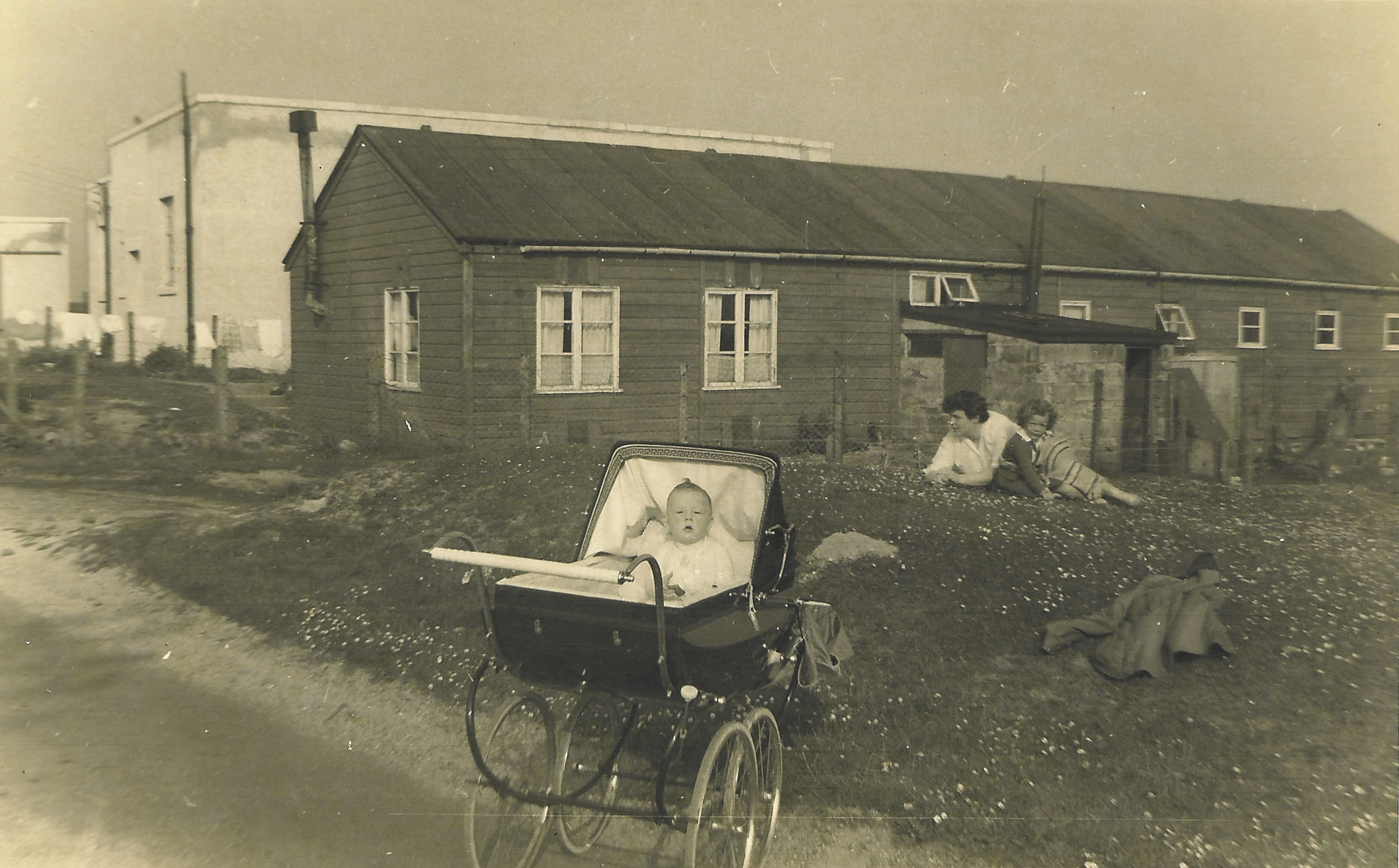
Courtesy of Mrs Mary MacPhee
Mary T. MacPhee, a friend and Mary’s son, either Christopher or Neil Urquhart in the pram, pictured outside the old telephone exchange in Scarinish in 1949. Mary had previously worked shifts at the Pitt Street exchange in Glasgow which had around two hundred operators.
In Scarinish, Mary worked twenty-four hours a day. The building had three bedrooms, a bathroom, a kitchen and a sitting room which contained the switchboard. The operator had to connect all calls by hand. If a call came in at night an alarm bell rang in the operator’s bedroom.
Mary recalls there being only around five private telephones on the island in 1949. Calls cost one penny, sixpence or a shilling and all were monitored. The operator would interrupt to advise when the time was nearly up.
Alick MacNeill’s turn-out at a 1950s Agricultural Show
Photograph of Alick MacNeill, Donald MacLean and Donald MacIntyre at an Agricultural Show at Crossapol in the early 1950s.

Courtesy of Mr Donald MacIntyre
The Tiree Agricultural Show was started in the 1880s by Tom Barr, the tenant of Balephetrish farm, to encourage local crofters to improve their stock of breeding horses and their income. Around 1900, a stirk (one-year-old calf) would fetch £4 to £5 whereas a good year-old filly foal would fetch £25 to £30.
At the Shows in the 1950s prizes were given for the best horse in a number of classes: Clydesdale geldings and mares, Highland ponies, cross geldings, mares, fillies or colts and any breed of foal. There was also a special prize for the best horse, cart and harness.
Alick MacNeill of Main Road Farm in Balephuil, Donald MacLean of Vaul and Donald MacIntyre of Gott are pictured at a Show at Crossapol in the early 1950s. By this time tractors had replaced the horse and Alick’s turn-out was the only entrant in its class.
Black and white photograph of Alick MacNeill, Donald MacLean and Donald MacIntyre.
Agricultural show at Crossapol in 1951 or 52. L-R: Alick MacNeill, Main Road Farm, Balephuill; Donald MacLean, Vaul; Donald MacIntyre, Gott.
Black and white photograph of Taigh Alasdair in Baugh.
Taigh Alasdair and the stackyard in Baugh, photographed by Morton Boyd in the 1940s or 1950s.
