


Black and white postcard of Tiree Lodge postmarked 1908.
Postcard of Tiree Lodge postmarked 1908.


Black and white postcard of Tiree Lodge postmarked 1908.
Postcard of Tiree Lodge postmarked 1908.
Thatched house in Salum
Photograph of John Lachie MacInnes’ thatched house in Salum.

Courtesy of Mr Alan Boyd
J. Morton Boyd photographed John Lachie MacInnes’ house in Salum in the 1960s. This was the last house in Tiree to have its thatch held down by sìoman-ruadh or coir rope. Straw rope was used until the mid-19th century; nowadays chicken wire or plastic netting is used instead.
Tiree houses were made as far as possible from local materials – stone, lime, clay, straw rope and the thatch. Only glass and wood for the roof timbers, doors and windows were imported. They look utterly immovable but nothing could be further from the truth.
Islanders moved around a great deal, either by choice or because the factor gave them no option. The thatch had to be discarded but the turfs and roof timbers were taken down and put into the back of a cart and the stones moved on sledges, load by load, to the new site.
Colour photograph of John Lachie MacInnes`s house in Salum.
John Lachie MacInnes`s house in Salum photographed by Morton Boyd in the 1940s or 1950s.
Black and white photograph of the Mary Stewart.
The interior of the Mary Stewart in Scarinish harbour photographed by Morton Boyd in the 1940s or 50s.

Johnny MacKay of Balephuil
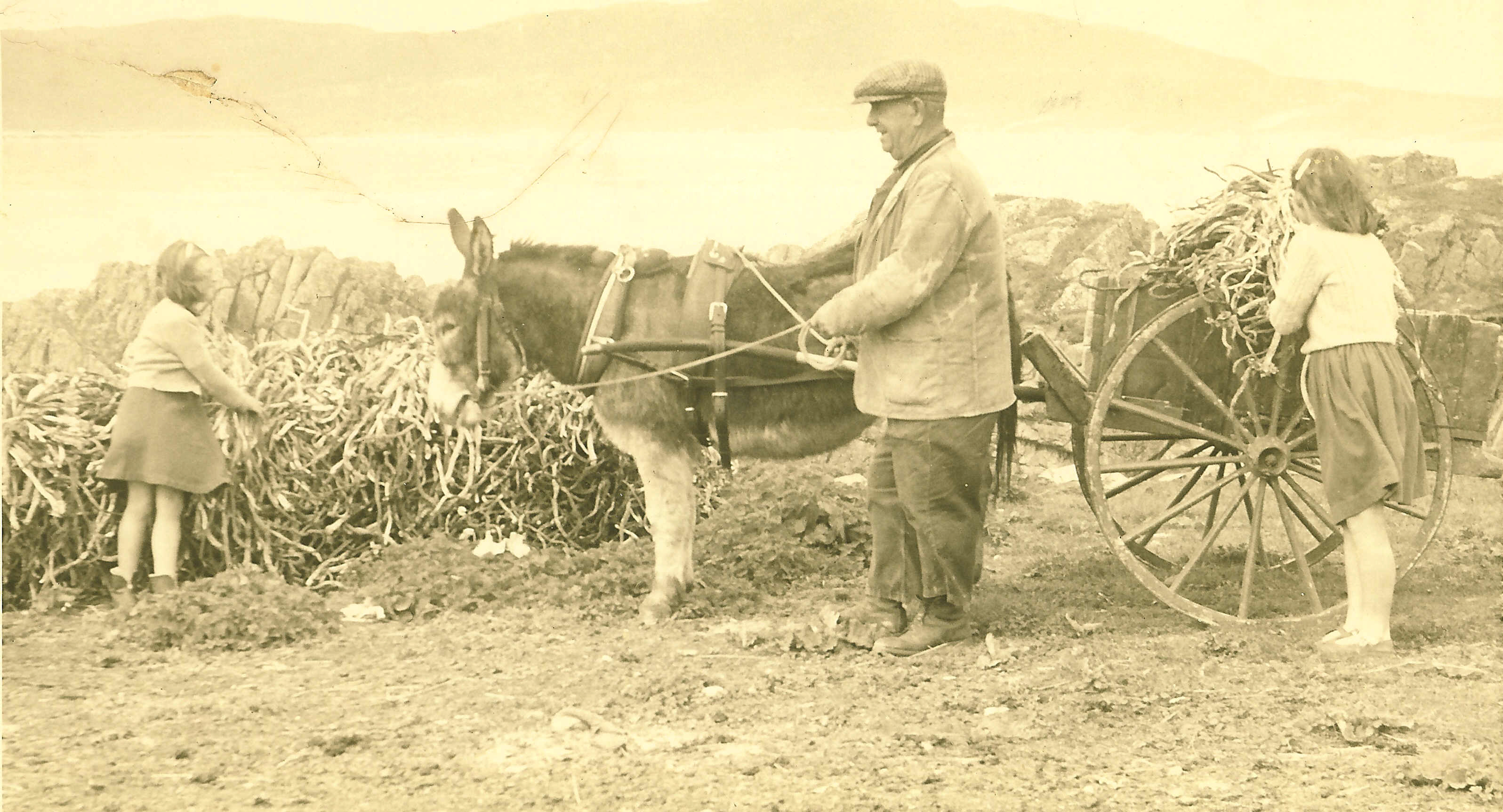
Photograph of Johnny MacKay of Balephuil transporting tangles with a donkey and cart in 1957.
Courtesy of Mr Alan Boyd
Morton Boyd photographed Johnny MacKay of Am Bail’ Ur in Balephuil in 1957 transporting dried kelp, known as tangles, with a donkey and cart. The tangles would be sent each year to the mainland for processing into alginates which are widely used to thicken food and size cloth.
Seaweed has also been used from the earliest times as animal fodder, for medicinal use, for human consumption – a milk pudding made from carrageen is still widely eaten on Tiree – and as a fertiliser for hay meadows and particularly for potatoes.
Crofters collecting seaweed divided the shoreline between them but occasionally disputes arose. As late as 1914 the Land Court had to adjudicate between crofters in Caoles, one of whom was ‘only allowed to take seaweed from the boundary of Ruaig to Ardeas until Old St. Patrick’s Day’ while his neighbour had free access to the beaches.
Black and white photograph of Johnny MacKay in 1957.
Johnny MacKay of Bail` Ur, Balephuill, collecting dry tangles in 1957.
The view from Balephetrish Hill by Robert Bruce Webster
Photograph of a watercolour painting of the view from Balephetrish Hill in 1928 by Robert Bruce Webster, D.A.

Born in Edinburgh in 1892, Robert Bruce Webster was a Scottish watercolourist whose principle productive period lay between the early 1920s and 1950s. He trained at Edinburgh College of Art and served throughout World War I.
Subsequently he taught professionally at Barnstable Grammar School in Devon, and at Dollar Academy and Edinburgh Ladies College. He exhibited regularly at the Royal Scottish Academy, the Royal Society of Watercolourists, the Society of Scottish Artists and Glasgow Fine Arts Society.
He visited Tiree with his wife and children in 1928, during which time he painted several views of the island including this one looking north-east from Balephetrish Hill towards Rum and Skye. He died in Fife in 1959.
Colour photograph of a painting of the view from Balephetrish Hill by Robert Bruce Webster.
Watercolour painting of the view from Balephetrish Hill in 1928 by Robert Bruce Webster.
Black and white photograph of Donald Archie MacLean of Lochside, Kilmoluaig, building a haystack.
Donald Archie MacLean of Lochside, Kilmoluaig, building a haystack in the early 1950s. Donald Archie worked on fishery cruisers and later captained ships to Arran. On top of the haystack is one of the Millhouse boys, either Archie Dubh or Teon.

Black and white photograph of postman Lachie MacPhail in the 1930s.
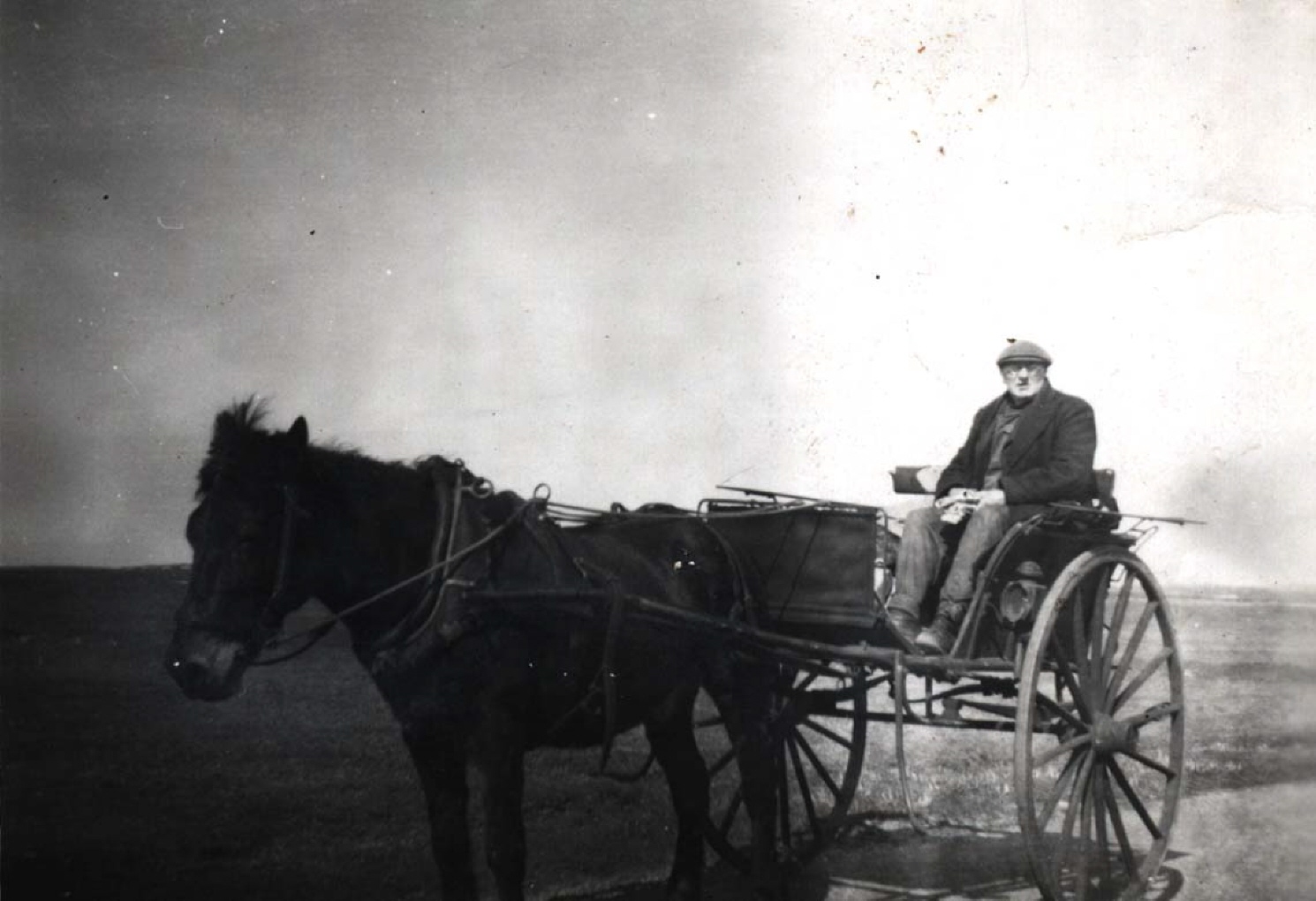
Postman Lachie MacPhail (Lachlan Iain) from Clachan, Cornaigmore on the horse and cart he used to deliver the mail in the 1930s.
Alick MacNeill of Balephuil
Photograph of Alick MacNeill of Balephuil at an Agricultural Show in the 1950s.

Courtesy of Mrs Doris MacLean
Alick MacNeill of Main Road Farm, Balephuil is pictured at an Agricultural Show in Crossapol in the 1950s. A prize was awarded for the best horse, cart and harness. Tractors became more common after World War II, before which crofters depended on draught horses for ploughing and transporting crops.
Note the tractor wheels on the cart. Although not a large as the old iron wheels, the rubber tyres made travelling quieter and more comfortable. It was also considerably easier for the horses pulling the cart. Young horses in particular were alarmed by the noise of the old iron wheels.
One of the major events in the local calendar since the 1880s, the Show was originally held in Scarinish, moved to Crossapol in the 1940s and then to Whitehouse at Cornaig in 1996. Since 2004 it has been located at the new Rural Centre at Crossapol.
Black and white photograph of Alex MacNeill, Balephuil, at aTiree Agricultural Show in the 1950s.
Alex MacNeill of Main Road Farm, Balephuil at an Agricultural Show in Crossapol in the 1950s. Note the tractor wheels on the cart. Although not a large as the old iron wheels (see cart in the background on the right), the rubber tyres made travelling quieter and more comfortable and made pulling the cart considerably easier for the horses. Young horses in particular were alarmed by the noise of the old iron wheels.
Black and white photograph of Alasdair Brown, Balephuil, at a Tiree Agricultural Show in the 1950s.
Alasdair Brown, Balephuil, with a prize Clydesdale at an Agricultural Show held at Crossapol in the 1950s.

Cutting hay at Cornaig in the 1920s
Photograph of hay-makers at Cornaig in 1920s.

Courtesy of Mrs Doris MacLean
Archibald MacLean, the last miller at Cornaig (on the extreme left), is pictured here with his family and neighbours cutting hay with a horse-drawn reaper in the 1920s. The reaper worked non-stop round the field until the patch of growing hay was all cut.
Alasdair MacLean from Kilmoluaig is sitting holding a scythe which was used to deal with problem patches. It was also used when work commenced to open up a pathway inside the gate for the reaper to begin.
The woman is the miller’s sister, Flora, who is using a three-pronged fork made in the local smiddy. She followed the reaper to keep the pathway clear for the next time it came round.
Black and white photograph of haycutters at Cornaig in the 1920s or 1930s.
Cutting hay at Cornaig in the 1920s or 30s. L-R: Archibald MacLean, the miller at Cornaig; the miller`s sister Flora (Floraidh Ruadh) who had a shop in Cornaig; (seated on the ground) Alasdair MacLean from Lochside; unknown; Donald MacLean, son of the miller. This is a reaper cutting hay. It worked non-stop round the field until the patch of growing hay disappeared. The seated worker is holding a scythe which was used to deal with problem patches. It was also used when work commenced to open up a pathway for the reaper to begin. The female used a three-pronged fork made in the smiddy. She followed the reaper to keep the pathway clear for the next time it came round.