Two postmen in the late 19th century
Photograph of two postmen in the late 19th century.
Courtesy of Mr Alasdair Sinclair
This photograph taken the late 19th century shows two unknown postmen from the east end of Tiree. In the 1880s the first internal posts were delivered on foot from the main post office in Scarinish to Middleton, Island House and Gott.
In the 1890s these three foot posts were upgraded to horse posts and a further four horse posts were established from Scarinish to Balemartine, Cornaig and Ruaig and from Crossapol to Kenovay. The foot posts were extended to Vaul, Hough and Odhrasgair and in 1906 to Hynish and Caoles.
After World War II the network of foot and horse posts were gradually replaced with the familiar red post vans.
Black and white photograph of two east end postmen.
Two unknown postmen from the east end of Tiree, possibly Brock, taken in the late 19th century.
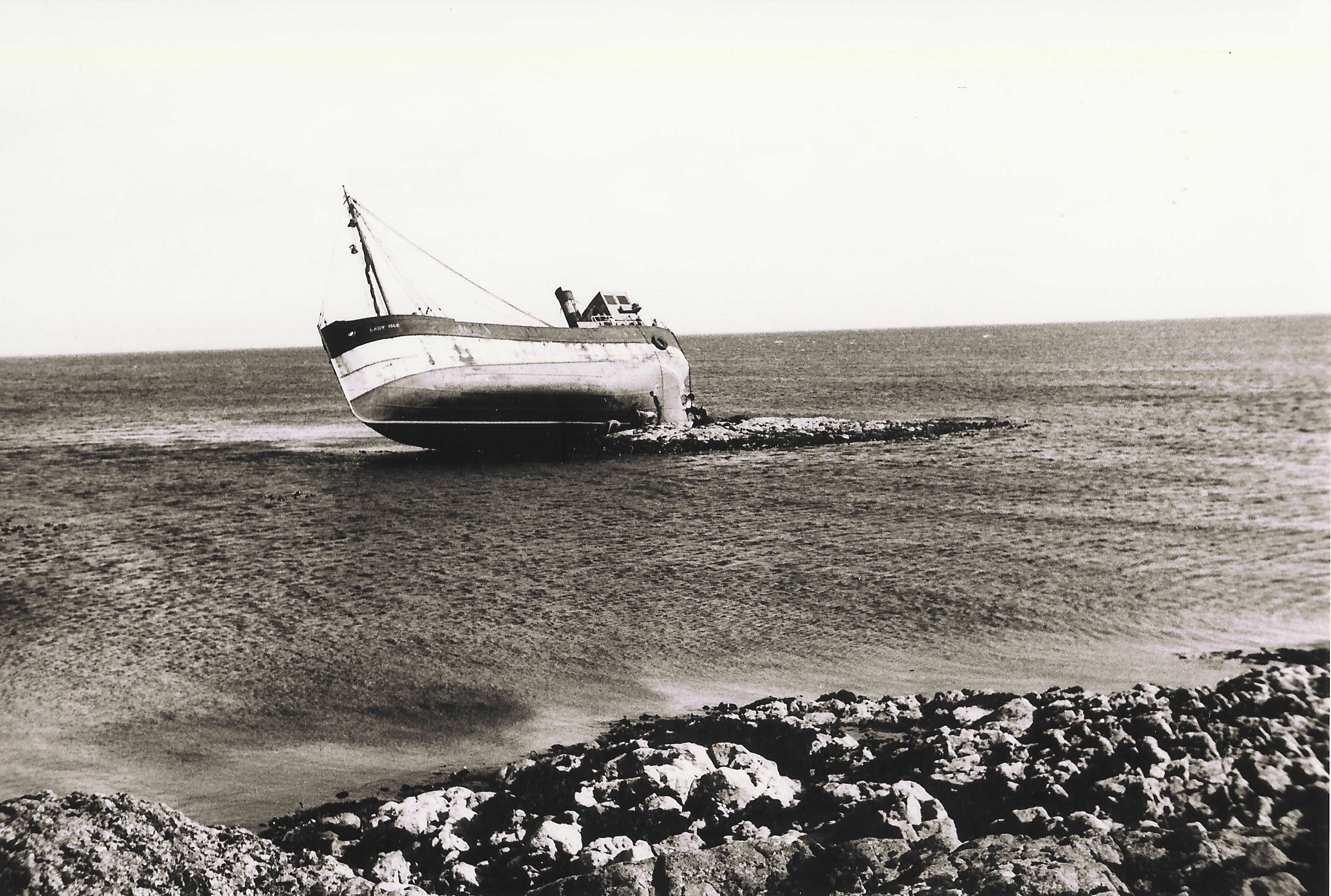
SS ‘Lady Isle’ aground off Scarinish harbour in 1956
Photograph of the SS ‘Lady Isle’ aground off Scarinish harbour in 1956.
Courtesy of Mr Richard MacCrory
The steam puffer ‘Lady Isle’ ran aground in August 1956 while attempting to enter Scarinish harbour. The crew immediately abandoned ship and scrambled ashore.
It was thought at first that she would be easily re-floated as she was upright in a relatively sheltered position. However, six weeks later, when an attempt to pump out the water on board failed, it was discovered that she was more seriously damaged than first thought and she was abandoned as a wreck.
Little remains of the wreckage other than metal plates and girders, which lie in six metres of water to the north of the harbour entrance.
Black and white photograph of the wreck of the `Lady Isle` off Scarinish in 1956.
The wreck of the `Lady Isle` off Scarinish in 1956.
Thatched house in Kilmoluaig
Photograph of a thatched house in Kilmoluaig in 1990.
Tiree’s thatched houses have immensely thick double walls, around five feet thick and six to seven feet high, filled with sand and rubble known as ‘glutadh’. They were built without mortar and with hip ends as opposed to the more usual gable ends seen on the mainland.
The older houses, pre-1850, were built using un-dressed stones found in the fields and at the shore. Their walls are rougher and the corners rounded. The roof rests on the inner wall, the stones of which are tilted downwards so that rainwater drains away from the rooms inside.
The ground at the back of the house is usually higher than at the front. If built on a slope, they would be slightly dug in at the back to give them greater shelter.
Colour photograph of the Alasdair MacDonald`s thatched house in Kilmoluaig in 1990.
Alasdair MacDonald`s thatched house in Kilmoluaig in 1990. (Original in Filing Cabinet 8 drawer 2)
Kenovay thatched house
Photograph of a thatched house in Kenovay in 1990.
The beautiful thatched houses of Tiree (known as ‘taighean-tugha’) are one of the island’s most distinctive features. They are simple buildings with no unnecessary, fussy details. Before 1900 almost all the buildings on the island, at least three to four hundred of them, were thatched.
After 1900, however, many traditional houses changed their roofing from thatch to tarred felt and larger, two-storey stone built or poured concrete houses funded by the Board of Agriculture became popular after the World War I.
Numbers of the traditional thatched houses have steadily declined over the last hundred years. An Argyll and Bute Council survey in 1985 found twenty-three thatched buildings on the island and today there are only ten.
Colour photograph of the thatched house in Kenovay in 1990.
Thatched house in Kenovay in 1990. (Original in Filing Cabinet 8 drawer 2)
Cornaig Post Office
Photograph of the post office at Cornaigmore.
Courtesy of Mr Hector MacPhail
The sub-post office at Cornaigmore was opened in 1896. The GPO brought in a telegraph line in the 1920s and installed a telephone in the nearby school when the Met Office opened a weather station there.
After the death of the postmaster in the mid-1950s, the office moved to Balevullin for some twenty-five years. It was re-opened on the original site in Cornaig in 1972 along with a general store and a popular restaurant called the Cèilidh Café. Two years later, they were all destroyed by fire.
In 1979 the post office was re-opened in Kilmoluaig. The Cornaig buildings were renovated in the 1980s as a single dwelling which for a few years also housed the Gaelic Playgroup. It was bought by the local council in the 1990s and converted into two council houses.
Black and white postcard of Cornaigmore Post Office.
Cornaigmore Post Office, probably between the World Wars.
Black and white photograph of Druimfraoich, Kenovay.
Druimfraoich, Kenovay.
Black and white photograph of the old mill at Cornaig.
The old mill at Cornaig.
Black and white photograph of crofters carting marram grass for thatching.
Two crofters carting marram grass for thatching behind Ben Hough in the 1930s or 1940s.
Cross-incised stone at St Patrick’s Chapel
Photograph of a cross-incised stone at St Patrick’s Chapel on Kennavara.
Courtesy of Mrs Grace Campbell
Up on Kennavara for a picnic, the young man in this photograph of 1920 is hiding behind the smaller of two incised stones at St Patrick’s Chapel which bear Latin crosses on both faces. Another cross is carved into a boulder to the south-east of the chapel.
On the shoreline below the chapel is a naturally formed swallow-hole sixty centimetres in diameter and over one metre deep which is known locally as St Patrick’s Vat or Well. It is traditionally regarded as a baptismal font.
There is no evidence that St Patrick ever came to Tiree but there is a Tiree tale that St Comgall, the founder of Bangor Abbey in Northern Ireland and a contemporary of St Columba, founded a monastery on Kennavara.
Black and white photograph of St Patrick`s Chapel on Kennavara in 1920.
The cross-marked stone at St Patrick`s Chapel on Kennavara in 1920.
Black and white photograph of Gott Bay pier under construction.
Gott Bay pier under construction in the 1910s.