Township: kilkenneth

2003.35.2

Seven O/S maps with hand-drawn croft numbers and boundaries, 1977

Seven O/S maps with croft numbers and boundaries drawn in by donor`s sister, Mary Robertson: (1) sheet NL 93 NE Hynish and West Hynish, (2) sheet NL 94 NE Hough, Balevullin, Kilmoluaig, Cornaigmore, Cornaigbeg and Kenovay and boundaries of Croish, Cornaigmore Farm and Kilmoluaig common grazing, (3) sheet NL 94 SE Moss, Barrapol, Balephuil, Balemartine, Balinoe, Heylipol and Crossapol and boundaries of Kilmoluaig common grazing, Barrapol Farm and Heylipol Farm, (4) sheet NL 94 NW Hough and Balevullin, (5) sheet NL 94 SW Middleton, Sandaig and Kilkenneth, (6) sheet NM 04 NW Balephetrish, Scarinish, Gott, Kirkapol and Vaul and boundaries of Scarinish Farm and Balephetrish special common, (7) sheet NM 04 SW Baugh and Scarinish.

1997.173.1

Kilkenneth smiddy

Photograph of the smiddy at Kilkenneth in the early 20th century.

e2.jpg

Courtesy of Mr Sandy MacKinnon

In the Highlands and Islands, horses were used for transport and agricultural work, unlike the Lowlands where oxen were used as draught animals. Of great value to the local people, native ponies fetched £3 to £9 at the end of the 18th century.

The numbers of horses on the island between 1870 and 1945 varied from 400 to 550, enough to support at least nine smiddies which were situated at Kilkenneth, Kilmoluaig, Balephetrish, Gott, Caoles, Balinoe, Hynish and Cornaigbeg, where there were two.

In addition to shoeing horses, blacksmiths repaired agricultural implements such as ploughs and harrows, made hinges and latches for wooden gates, hand tools like sickles and pitchforks, and other metal objects like swees for hanging cooking pots over a fire.

Black and white of the smiddy at Kilkenneth in the early 20th century,

The smiddy at Kilkenneth in the late 19th early 20th century. The blacksmith on the right is the father of Sandy MacKinnon (Sandaidh a` Ghobhainn).

1997.228.1

Audio cassette recording of a 1997 Feis lecture about St Columba by Professor Donald Meek.

Professor Meek talks about the life of St Columba, Tiree`s monastic history and chapels. In English with a Gaelic introduction.

1997.229.1

Tiree blacksmiths in the 20th century

Sound clip in English of retired vet Robert Beck talking about the blacksmiths on Tiree in the 20th century.

Courtesy of Mr Robert Beck

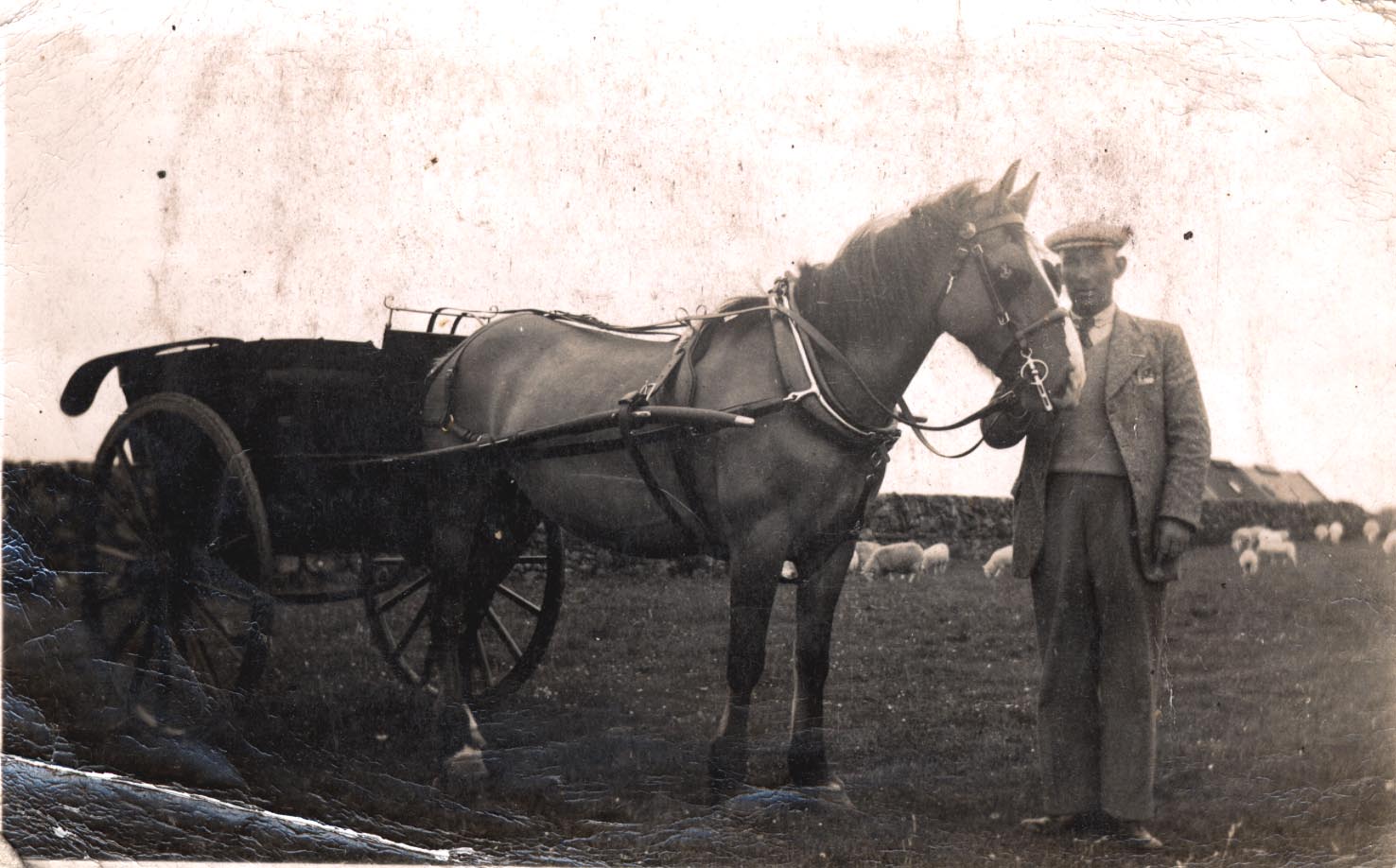
Retired veterinary surgeon Robert Beck talks about the number of blacksmiths on Tiree within living memory during a public talk on the subject of Scotland’s native horse given at the 1997 Feis Thiriodh. In 1945 there were over four hundred working horses on the island providing ample work for eight smiddies.

The Tiree Clydesdale was in great demand in the early 20th century especially for work in the towns. Derived from cross-breeding a superior type of native pony introduced to Tiree in the early 1800s with Clydesdales brought in by Tom Barr in the 1870s, they were tougher and faster than mainland-bred draught horses.

Many crofters kept one or two brood mares which were also worked. Three stallions, two Clydesdale and one Highland pony, ‘walked’ the island, kept by Hector Campbell of Cornaigmore, John MacLean of the Brae, Cornaigbeg and Donald MacIntyre of Gott.

1999.12.1.1

Booklet titled `Isle of Tiree` edited by Mona MacDonald, with photocopy.

Guide to townships on Tiree, local advertising and map. Accession includes photocopy of same.

1997.221.12

Ordnance Survey map, sheet NL94SW, 1:10,000.

Map of Kilkenneth, Greenhill, Sandaig, Middleton, Barrapol and Ceann a` Bhara showing contour lines, roads and paths, boundaries, townships and buildings, bridges and cattle grids, rivers and drains, sites of antiquities, vegetation and rock features.

1997.215.7

Ordnance Survey map sheet LXIV.

Map of the north-west and central areas of Tiree from Greenhill in the west to Baugh in the east, at a scale of 6 inches to the mile (1:10,560).