


Information leaflet for the Scarinish Hotel 2003-4.
Information leaflet for the Scarinish Hotel with two colour photographs: Scarinish harbour and an aerial view of Tiree.

12074 Results Found
Displaying page 733 of 1208 pages of results:
Information leaflet for the Scarinish Hotel 2003-4.
Information leaflet for the Scarinish Hotel with two colour photographs: Scarinish harbour and an aerial view of Tiree.
Dan MacLeod’s practical joke
Sound clip in English of Duncan Grant of Ruaig talking about a practical joke involving a lobster.
Courtesy of Mr Duncan Grant
In a conversation with Alasdair Sinclair of Brock recorded in January 2004, Duncan Grant of Ruaig tells a humorous story about his relative, Dan MacLeod, who played a practical joke on Alasdair’s great-uncles, William, Donald and Neil MacKinnon.
In the days before television, neighbours would regularly visit each other ‘air chèilidh’- for the ‘crack’. Alasdair’s Uncle William was a great story-teller and would entertain the township children with ghost stories.
Duncan’s mother, Mary Flora MacLeod, remembered a particularly scary story about ‘cròg mòr fada liath, liath le aois’ (a long grey claw-like hand, grey with age). She and her sister would be so scared of leaving in the dark they would race the twenty yards home.
Minidisk recording of Alasdair Sinclair and Duncan Grant talking to Dr John Holliday in An Iodhlann on 21/1/2004.
Alasdair Sinclair of Brock and Duncan Grant of Ruaig talk to Dr John Holliday in January 2004 about their Tiree connections and early memories of Ruaig, Brock and Soa, about Hugh Lamont (Eòghann Iain) from Ruaig, the postal service, Brock ceilidh house, thatched houses, quarrying stones at Brock and the tools used, handmade lintels, and collecting seaweed and birds’ eggs from Soa.
Poem by the Rev Hector Cameron.
Poem about Tiree by the Rev Hector Cameron and taught to the children of Cornaigmore around 1935.
Colour photograph of Grace Baxter and John Neil Brown in the mid-60s.
Grace Baxter and her nephew John Neil Brown haymaking at Cornaigbeg in the mid-60s.

Black and white photograph of the stackyard at Corrairigh, Cornaigbeg.
The stackyard and new steadings at Corrairigh, Cornaigbeg in the 1930s.

The Paterson family of Crossapol in 1937
Photograph of the Paterson family of Crossapol in 1937.
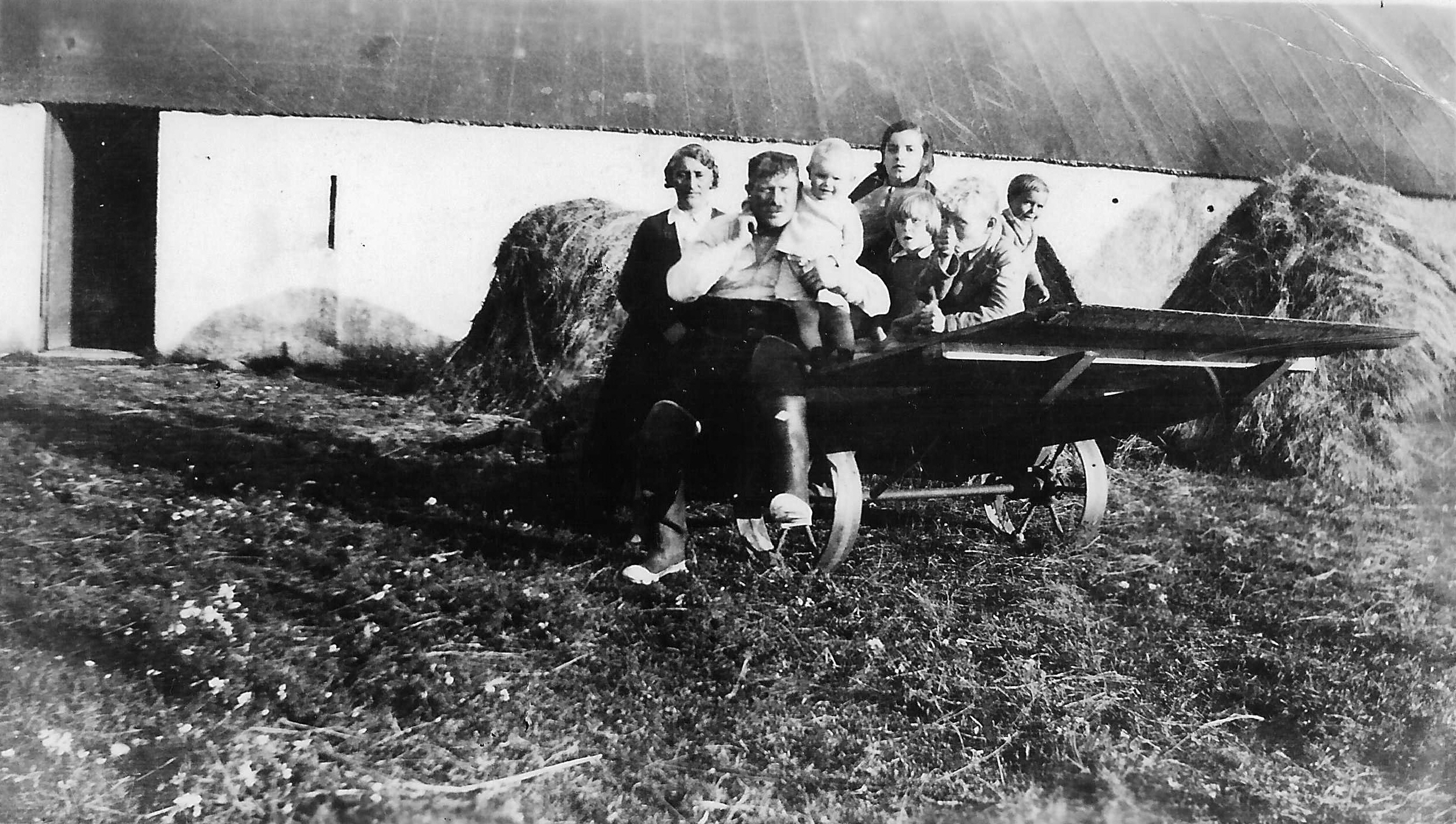
Courtesy of Mrs Mairi Campbell
The Paterson family are pictured in 1937 sitting on a rick-lifter outside their steadings at Crossapol. The cart was used to move stùcanan (small stacks of corn) from the fields to an iodhlann, the stackyard behind the house, where about six to eight of them were carefully built into a mulan (corn stack).
Initially the cut corn was bound into sguaban (sheaves), eight to ten of which were lined up into an adag. Once the seed had hardened, after about ten days if the weather was good, the adagan would be put into a stùc which can stand up to the winds that are common at that time of year.
Stùcanan could be left out if the weather deteriorated. If there was a dry spell, however, the adagan could be taken straight to the stackyard, as every time the corn was handled some grain was lost.
Black and white photograph of the Paterson family of Crossapol in 1937.
The steadings at 6 Crossapol in 1937. The cart was used to move ricks from the fields to the stackyard. L-R: Sarah MacPhee née Paterson (George’s sister); George Paterson with his son Angus; Betty MacLean née MacPhee, Sarah’s daughter (at back); George and Meta’s children, Mairi and Iain; Hamish MacPhee, Sarah’s son.
Photograph of George Paterson and his family in the stackyard of his farm at 6 Crossapol in 1937. L-R: (back) Sarah MacPhee née Paterson (George’s sister); George Paterson; his wife Margaret (Meta) with baby Angus; (front) Hamish MacPhee, Sarah’s son; George and Meta’s children, Iain and Mairi.
 Courtesy of Mrs Mairi Campbell
George’s father, Donald Paterson of Balinoe, emmigrated to Pategonia in the 1880s. Patagonia, in the south of Argentina and Chile, was cleared of its indigenous people in the 1880s to make way for large sheep farms. Many men from the Hebrides went out to share in the bonanza.
In 1885 Donald wrote to his brother asking him to send out his birth certificate and baptismal record so he could take possession of twelve square miles of land. He found the native Indians very kind and friendly and recommended shepherding in Patagonia where the pay was good.
Donald married in Patagonia and had a family. He brought his two sons George and John home to Tiree. George was seven years old at the time and could speak Gaelic and Spanish but not a word of English.
Audio cassette recording of Iain MacLeod of Cornaigbeg talking to Maggie Campbell in May 2001.
Iain MacLeod of Kilmoluaig talks to Maggie Campbell in May 2001 about leaving school aged 15, his days in the Army, coming with his wife Fiona in 1975 to work at Brown’s shop in Balemartine, his 15 years as shop manager when the petrol came in barrels and the sugar and oatmeal in cwt bags, lessons at Heylipol School for decimal conversion, their purchase of Brown’s shop at Crossapol and its refurbishment. Tha Iain Mhic Leòid a Cilmoluaig a’ bruidhinn ri Magaidh Chaimbeul anns a’ Chèitean 2001, ag ìnnseadh mar a dh’ fhàg e an sgoil air còig bliadhna deug a dh’ aois, a laithean ’s an Airm, a’ tighinn do Thiriodh còmhla ri Fionnghal, a’ bhean, ann an 1975, ag obair ann am bùth Bhrùnaich ann am Baile Mhàrtainn, na còig bliadhna deug a bha e na cheannard bùtha ’s an àm a bha peatral a’ tighinn ann am baraillean agus siùcar agus min-choirce ann am poca bolla, mar a cheannaich iad bùth Bhrùnaich ann an Crossabal agus mar a chaidh a nuadhachadh.
Audio cassette recording of Ishbel MacArthur of Barrapol talking to Maggie Campbell in March 2001.
Ishbel MacArthur of Barrapol talks to Maggie Campbell in March 2001 about childbirth and childcare, the comparison between bringing up her five children in the 1960s and 1970s and the easier methods of today, e.g. car seats, baby alarms and walkers, playgroups, disposable nappies and baby clinics; Ishbel also talks about her schooldays in Balemartine. Tha Iseabail Nic Artair a Goirtean Dhòmhnaill a’ bruidhinn ri Magaidh Chaimbeul ann an Mart 2001 mu aisead agus cùram cloinne, an t-eadar dhealachadh air a bhi togail còignear de theaghlaich eadar 1960 agus 1980, ’s ach na dòighean furasda ’s na laithean an diugh, cathairean carbad, sanas naoidhean agus taic coisiche, cròileaganan, foichein pàipear, leighis-lann naoidhean; tha Iseabail a’ bruidhinn cuideachd mu a laithean sgoile ann am Baile Mhàrtainn.
