Newspaper article about the Tiree seaweed industry
Laminated newspaper article about pioneer Edward Charles Cortis-Stanford and the Tiree seaweed industry, including photographs of the ruins of Stanford`s kelp factory at Middleton, and seaweed collection on Uist. Unknown publication details.
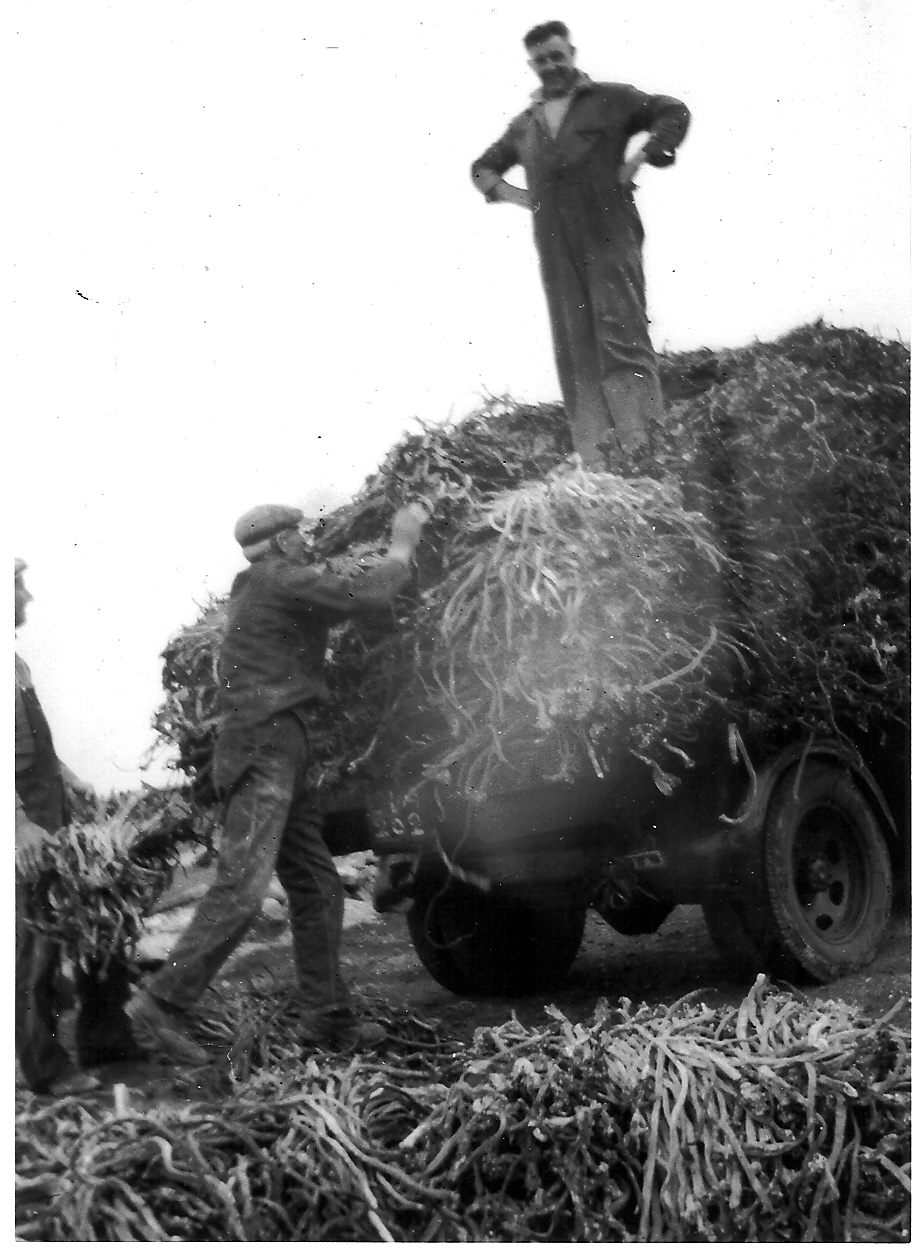
Photograph of men loading tangle onto a lorry at Scarinish pier ca 1960
Black & white photograph of men loading tangle (kelp stalks) onto a lorry at Scarinish pier ca 1960. L-R: Hector Brown, Balevullin, Hugh MacDonald, Mannal House, John Neil MacPhail, piermaster standing on the lorry.
Appendix H: Evidence to the Napier Commission, from “Tiree – an unauthorised biography”
Printout of Appendix H: Evidence to the Napier Commission, from “Tiree – an unauthorised biography”. Report by Edward Charles Stanford to the Napier Commission regarding the profitability of the kelp industry on Tiree around 1870.
Photocopy of page from photo album with old Tiree photos
Photocopied page from unknown photo album. Five poor quality images entitled (1) The Old Habour, Scarinish, Tiree, (2) The ??? Schoolhouse of Ruaig and some of the gardners at work, (3) A Kelp-Gatherer, Tiree. This is the last ???? ???? left on the island, (4) School Children, Tiree, (5) The Cottage where Neal? Died and which he refused to leave for a Glasgow Hospital.
Articles about sheep and farming in Coll in 1764, livestock on the island between 1940 and 1981, peat-cutting, lazy beds, local man Neillie John MacLean, the Free Church in Coll, early travellers to Coll, bird-watching and gardening, carrrageen and wild flowers, and other local news.
Audio cassette recording of Donald MacArthur, Middleton talking to Maggie Campbell in December 1999.
Donald MacArthur of Middleton talks to Maggie Campbell in December 1999 about crofting today compared to how it was when he started, how the wetter weather, subsidies for late cutting and fewer people working the land have contributed to the change from hay-making to silage, about using fertilisers rather than seaweed, keeping cattle outside because of SEPA rules, the changes in cattle transportation and the paperwork involved, changing prices, the effects of BSE, a strong pound and subsidies; he gives his thoughts about the future of crofting in Tiree, diversification, the need for community spirit and religious faith.
Video recording of an unknown TV programme about local council services.
Programme about local council services featuring Mabel MacArthur of Sandaig, Gaelic teacher Margaret MacKay, Lachie MacArthur of Mannal, deputy headmaster Donnie Campbell of Kilmoluaig, Alasdair MacArthur of Balemartine, Murdina MacLean of Kilmoluaig, Allan MacFadyen, Maggie Campbell of Kilmoluaig and Hector MacPhail of Ruaig.
Transcription of an extract from ‘Tirey’ in ‘The Rev. Dr. John Walker’s Report on the Hebrides of 1764 and 1771’ edited by Margaret M. MacKay.
Courtesy of John Donald Publishers
The Rev Dr John Walker, minister of Moffat and a pioneer of scientific botany and geology, was sent to the Hebrides in 1764 and 1771 by the Commission for Annexed Estates to report on the social conditions, population and the state of manufacture, agriculture and fisheries.
He found the waters round Tiree teeming with fish but no fishing equipment on the island. In 1792, Rev Archibald McColl lamented that the local fishermen seemed unable to compete with those from other islands or the east coast who were taking full advantage of the nearby fishing banks.
The reasons for this he attributed to the daily involvement of crofters with their land and animals and to their poverty which disinclined them to risk what little savings they had purchasing equipment easily lost in bad weather.