Booklet `Sìl an Eòrna – Children of the Barley` 2006
Booklet about the circumstances and fates of people who left Tiree en masse, sailing to Canada, Australia, New Zealand, Patagonia and USA during the mid 1800s to early 1900s. Researched by Dr John Holliday for a summer exhibition at An Iodhlann.
Photocopies of 8 academic papers about seaweed with particular reference to ethnobotany, and a covering letter about the papers from Harry Powel to Nicola Pilkington 5/7/2011. (1) A study of certain British seaweed and their utilisation in the preparation of Agar. Marshall, Newton and Orr 1949; (2) Teachers` Notes – kelp burning. c. 1999; (3) The study of certain Red Seaweeds in relation to their use in Agar production. Newton 1947; (3b) A seaweed survey of Scotland – Fucaceae, 1945-1946. Walker 1947; (4) Distribution of Laminariaceae around Scotland. Walker 1954; (5) extract from Cast weed survey, Part 1. Survey of certain Orkney, Lewis, north Uist, Barra and Tiree beaches, 1945/1946. Scottish Seaweed Research Association 1947; (6) extract from Cast weed survey, Part 2. 1946-7. Walker 1948. (7) Seaweeds and rocky shores of the Outer Hebrides. Norton & Powell 1979.
Mounted news article about Edward Charles Cortis-Stanford – pioneer of the Scottish seaweed industry
Laminated and mounted newspaper article regarding Edward Cortis-Stanford`s seaweed industry in the Scottish islands, including Tiree, in the 1800s. Was on display in the Thatched Cottage Museum, Sandaig, until its closure and sale in 2010. In two panels with copper hanging wire.
Newspaper article about the Tiree seaweed industry
Laminated newspaper article about pioneer Edward Charles Cortis-Stanford and the Tiree seaweed industry, including photographs of the ruins of Stanford`s kelp factory at Middleton, and seaweed collection on Uist. Unknown publication details.
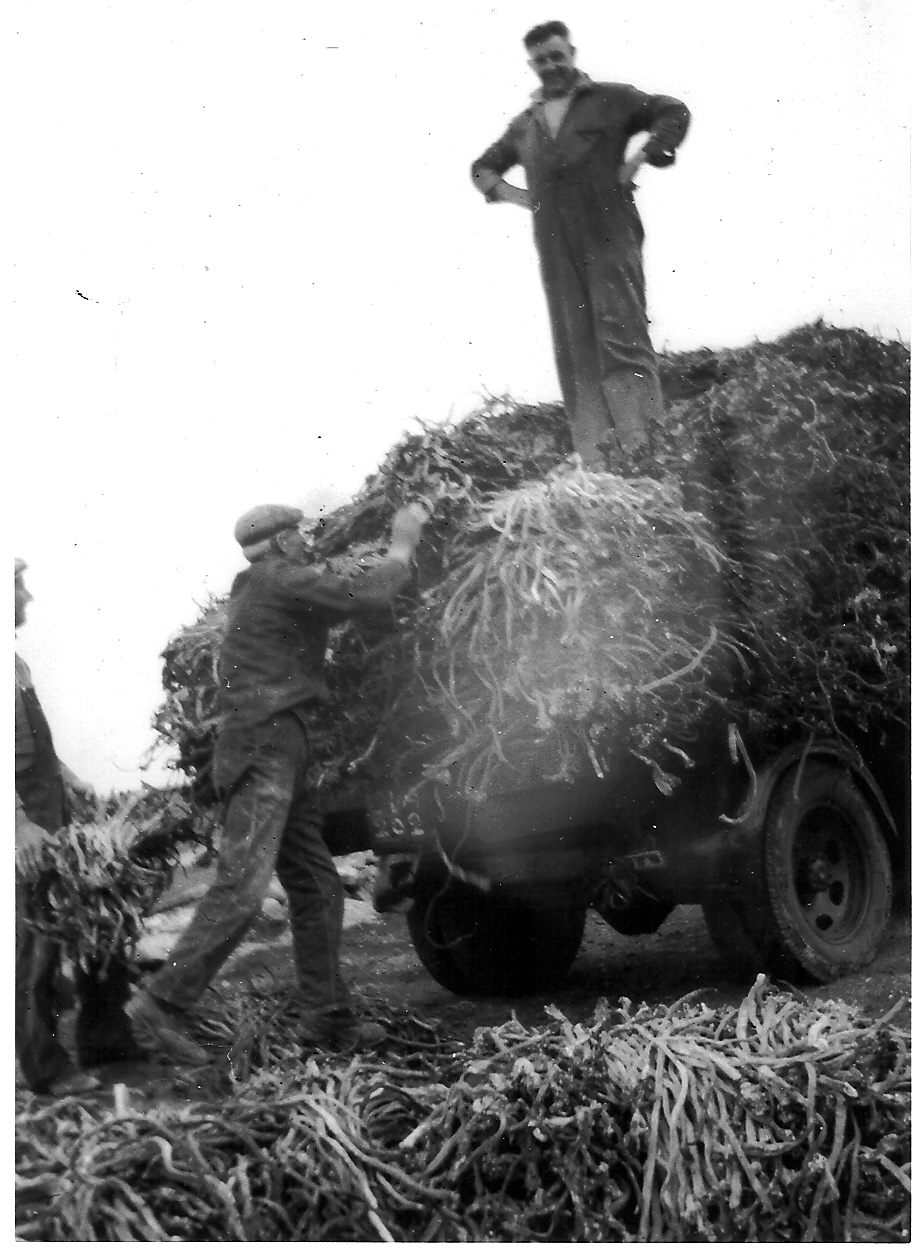
Photograph of men loading tangle onto a lorry at Scarinish pier ca 1960
Black & white photograph of men loading tangle (kelp stalks) onto a lorry at Scarinish pier ca 1960. L-R: Hector Brown, Balevullin, Hugh MacDonald, Mannal House, John Neil MacPhail, piermaster standing on the lorry.
Appendix H: Evidence to the Napier Commission, from “Tiree – an unauthorised biography”
Printout of Appendix H: Evidence to the Napier Commission, from “Tiree – an unauthorised biography”. Report by Edward Charles Stanford to the Napier Commission regarding the profitability of the kelp industry on Tiree around 1870.
Photocopy of page from photo album with old Tiree photos
Photocopied page from unknown photo album. Five poor quality images entitled (1) The Old Habour, Scarinish, Tiree, (2) The ??? Schoolhouse of Ruaig and some of the gardners at work, (3) A Kelp-Gatherer, Tiree. This is the last ???? ???? left on the island, (4) School Children, Tiree, (5) The Cottage where Neal? Died and which he refused to leave for a Glasgow Hospital.
Hector Kennedy of Kilkenneth talks about the death by fever of Rev. Duncan MacDougall’s wife and two children, house improvements, exchanging crofts, the kelp factory, the MacDonalds, tells a story about Niall Eachann, talks about the shop at Bail’ Ùr, shopkeeper Duncan MacKinnon, the ditches around Mannal, Balemartine, Loch a’ Phuill and Loch Bhasapol, John MacMillan shepherd to farmer Donald Campbell (Dòmhnall a’ Ruighe) at Baugh and the Reef, the Hendersons of Balemartine who lived for a while under an upturned boat, John MacNeill, tenants’ rent and the Campbells of Kilmoluaig who emigrated to Canada.
Hector Kennedy of Kilkenneth talks about the first electric torch on the island, weather forecasting, using burning peat as a torch, Donald Kennedy – Rìgh na Mòintich, Land Leagues, Rev. MacNiven, the occupations of his family, crofting, kelp, food, the shops, Anna Dhuireach and describes two farmers.
Hector Kennedy of Kilkenneth talks about the first electric torch on the island, weather forecasting, using burning peat as a torch, Donald Kennedy – Rìgh na Mòintich, Land Leagues, Rev. MacNiven, the occupations of his family, crofting, kelp, food, the shops, Anna Dhuireach and describes two farmers.