


Colour photograph of a burnt fishing boat at Milton taken in April 2004.
The burnt remains of one of the six fishing boats destroyed by fire at Milton harbour on 20/3/2004 photographed by Dr John Holliday in April 2004.


Colour photograph of a burnt fishing boat at Milton taken in April 2004.
The burnt remains of one of the six fishing boats destroyed by fire at Milton harbour on 20/3/2004 photographed by Dr John Holliday in April 2004.
The Signalling Tower at Hynish
Photograph of the Signalling Tower at Hynish in the 1930s.

Alan Stevenson, Clerk of Works to the Northern Lighthouse Board, chose Hynish as the site of the work yard for Skerryvore lighthouse because, at twelve miles distant, it was the closest suitable land to the skerries. The Signalling Tower afforded a clear view of the reef and was used to exchange signals by semaphore and lamp.
Preliminary arrangements included constructing a pier, dock and sluice system and building work sheds and accommodation for the numerous workers required for the lighthouse such as masons, quarriers, smiths, foremen, carpenters and joiners.
Work on the lighthouse was completed in 1842. The sheds now house the Alan Stevenson Centre and a museum dedicated to the building of Skerryvore lighthouse, both administered by the Hebridean Trust.
Black and white photograph of the Signalling Tower at Hynish.
The Signalling Tower at Hynish around 1930, from a small album from Silversands. (1997.176.10)
Nurse Catherine MacAllister
Photograph of Nurse Catherine MacAllister.
Courtesy of Mrs Mairi Campbell
Catherine McAllister was the nurse on Tiree from 1930-36. From Bruichladdich on Islay, she was the first nurse to use a motor bike and sidecar on her rounds. Before her the nurses walked or bicycled to see their patients.
Poultices were much used in those days. An islander, who was a young child with pneumonia in the 1930s, remembers the nurse coming in every day, making up oatmeal porridge on the stove and plastering it on his chest under a bandage.
She left Tiree to work as a nurse in Dalmally but returned to marry Alex MacLean from Balevullin, Argyll Estate’s Ground Officer. Sadly, she was drowned in Glasgow in July 1950 and is buried in Soroby cemetery. Her husband died a few months later in the dentist’s chair in Oban.
Black and white photograph of nurse Catherine MacAllister in the 1930s.
Catherine MacAllister from Bruichcladdich, Islay, nurse on Tiree from 1930-36. She was the first to use a motorbike and sidecar on her rounds.
Black and white photograph of Scarinish.
View of Scarinish from outside the harbour. The building in the middle was originally a church, then used intermittently as a prison and latterly as a store by the owners of the Mary Stewart. It was pulled down to make roads during World War II. The Scarinish Hotel is on the extreme right.

Clydesdale horses at Scarinish harbour
Photograph of Clydesdale horses at Scarinish harbour in the late 19th or early 20th century.

Courtesy of Mr Angus Munn
This photograph, taken before Gott Bay pier was finished in 1913 shows Clydesdale horses from Tom Barr’s farm at Balephetrish being loaded on to a lighter at Scarinish for transportation to the steamer standing off in deeper water outside the harbour.
The horses would be loaded by ramp on to the main deck of the steamer, an operation that could only be attempted in calm weather. Passengers were likewise ferried to and from the steamer by lighter, sometimes sharing the boat with livestock.
Tom Barr, the son of an Ayrshire farmer and the tenant of Balephetrish farm from 1864 to 1913, introduced the first Clydesdale stallions to Tiree in the 1870s. Cross-bred with native ponies, the Tiree Clydesdale was in great demand in the early 20th century.
Black and white photograph of horses being loaded into a lighter at Scarinish harbour.
Horses from Tom Barr`s farm at Balephetrish being loaded into a lighter at Scarinish pier for transportation to the ferry in the early 20th century.
Heylipol Church
Postcard of Heylipol Church

Courtesy of Mr Angus Munn
Known locally as ‘Eaglais na Mòintich’ (Moss Church), the church was built in 1902, replacing a former church building erected on the site in the 19th century. The name Heylipol is derived from the Norse for Holy Town suggesting early Christian settlement in the area.
Designed by William MacKenzie, the church is of cruciform Gothic design with a bell tower over the entrance porch. Externally it is faced with dressed granite from a local quarry. The pews can accommodate 365 worshippers.
The pulpit has wooden panels carved by boys from a woodwork class organised by Lady Victoria Campbell, daughter of the 8th Duke of Argyll, a benefactress to the people of Tiree in the late 19th and early 20th centuries.
Black and white postcard of Heylipol Church.
Heylipol Church.
Black and white photograph of a postcard of Salum.
Postcard of Salum House with cattle on the shore.

The ‘Mary Stewart’ in Scarinish harbour.
Photograph of the schooner ‘Mary Stewart’ in Scarinish harbour in the early 20th century.

Courtesy of Mr Angus Munn
This photograph taken in the 1920s or 1930s shows the ‘Mary Stewart’ in Scarinish harbour with the Temperance Hotel on the right and MacArthurs’ general store on the left. Built by Barclay in Ardrossan in 1868, the sixty-four foot long ‘Mary Stewart’ was rigged as double-topsail schooner and had a tonnage of sixty-five.
Originally trading on the Irish coast, she was bought in 1908 for Donald MacLean of Scarinish by his relation, Dugald MacKinnon. Dugald was known as Dùghall an Òir (Dugald of the gold) because he had had been successful in the Australian Gold Rush.
Donald MacLean, with his sons as crew, traded up and down the West Coast of Scotland carrying coal and other cargo until the late 1930s when steam superseded sail. The remains of the ‘Mary Stewart’ can still be seen in Scarinish harbour.
Black and white photograph of the Mary Stewart in Scarinish harbour.
The Mary Stewart in Scarinish harbour with MacArthur`s Store in the background at the left and the Scarinish Hotel on the right, photographed in the early 20th century.
Black and white photograph of Baugh in the early 20th century.
Baugh in the early 20th century. On the extreme left is Baugh Farmhouse with Port a` Mhuilinn in the centre and the guest-house on the extreme right.

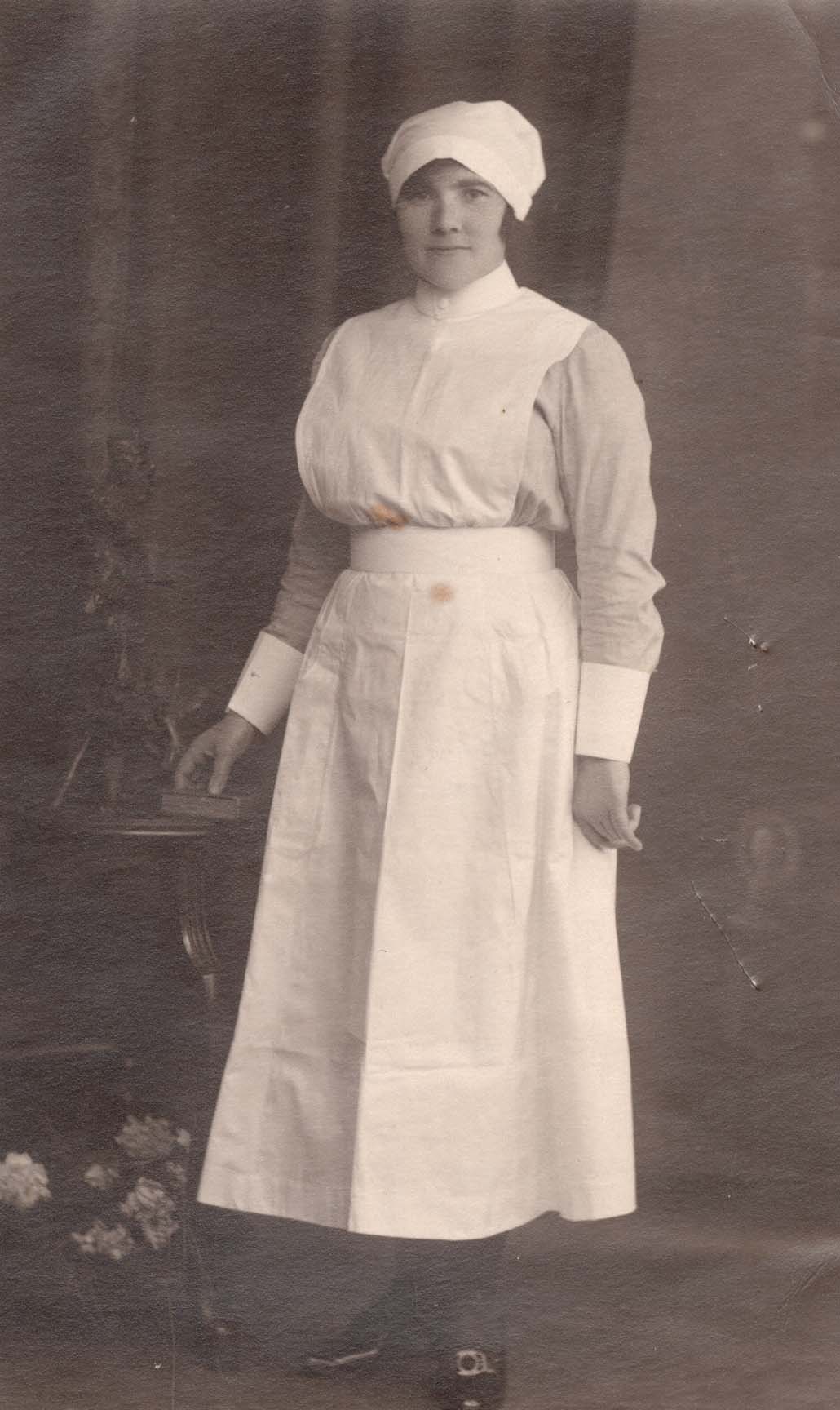
Nurse Flora MacLean of Balevullin
Photograph of Nurse Flora MacLean of Balevullin.

Courtesy of Mrs Flora MacKinnon
Flora MacLean of Balevullin was a nurse in Glasgow at the beginning of the 20th century. While working with children in the city she contracted tuberculosis. Her career finished, she left the pollution of the city for the sunshine and fresh air of her native island.
At the back of her thatched house in Balevullin she set up a tent where she lived much of the year. Her house was one of the few on Tiree with a back door which faces west, the direction of the prevailing wind. Most Tiree houses, until recently, have been built ‘back to the wind, face to the sun’.
She died in 1918 and is buried at Soroby. Her niece, Flora MacKinnon, also lives in Balevullin and is one of the island’s district nurses.
Black and white photograph of nurse Flora MacLean of Balevullin.
Nurse Flora MacLean of Balevullin who died in the 1920s, an aunt of nurse Flora MacKinnon of Balevullin.