Record Type: review

1 … 9 10 11 12 13 … 42

2000.202.2

Willie Bunting of Balemartine

Photograph of Willie Bunting during World War II.

l41.jpg

The first Tiree man to enlist after the outbreak of World War II was Willie Bunting of Balemartine. He is pictured in this photograph (second right in the front row) after completing his training at Newcastle. Prior to this, he worked for Johnny Brown at the Scarinish Hotel as a motor mechanic and taxi driver.

In 1939 he asked Johnny for a couple of days off work and went to Stirling Castle where he joined the army. On his return in 1945, Johnny handed him a large brown envelope containing his wages for the time he was away.

After the war Willie worked on Tiree as a haulier, then left for Glasgow in the early 1950s to work as a mechanic. He returned to the island in 1969 to work as an engineer in the power house in Crossapol.

Black and white photograph of Willi Bunting at start of WWII.

Willie Bunting (2nd right front) after training at Newcastle in 1939-40.

2001.57.2

Colina Campbell in Caoles House, Coll

Photograph of Colina Campbell in Caoles House, Coll.

m59.jpg

Courtesy of Mr Hugh MacKinnon

Colina Campbell was the wife of Dr Alexander Buchanan and the daughter of Colin Campbell and his wife Mary Ann MacLean. Her father, a landed proprietor who owned the estates of Cornaig and Caoles on the Isle of Coll, was also the tenant of Balephetrish farm for some twenty years from the 1840s to the 1860s.

In 1856 Colonel Hugh MacLean lost his estates on Coll. Five years later several families evicted from the centre of Coll were given sanctuary on the Campbell estates in the east end of the island. Some fifteen families removed their cattle and effects to their new home on the same day.

According to a Gaelic poem in the ‘Handbook to the islands of Coll and Tiree’, it was Colina herself who offered them aid, although she was barely twenty years old at the time. She died in 1930 aged eighty-nine.

Black and white photograph taken in Caoles, Coll.

Colina Campbell (1841-1930), wife of Dr Alexander Buchanan, Medical Officer for Tiree, photographed in Caoles, Coll.

2001.46.2

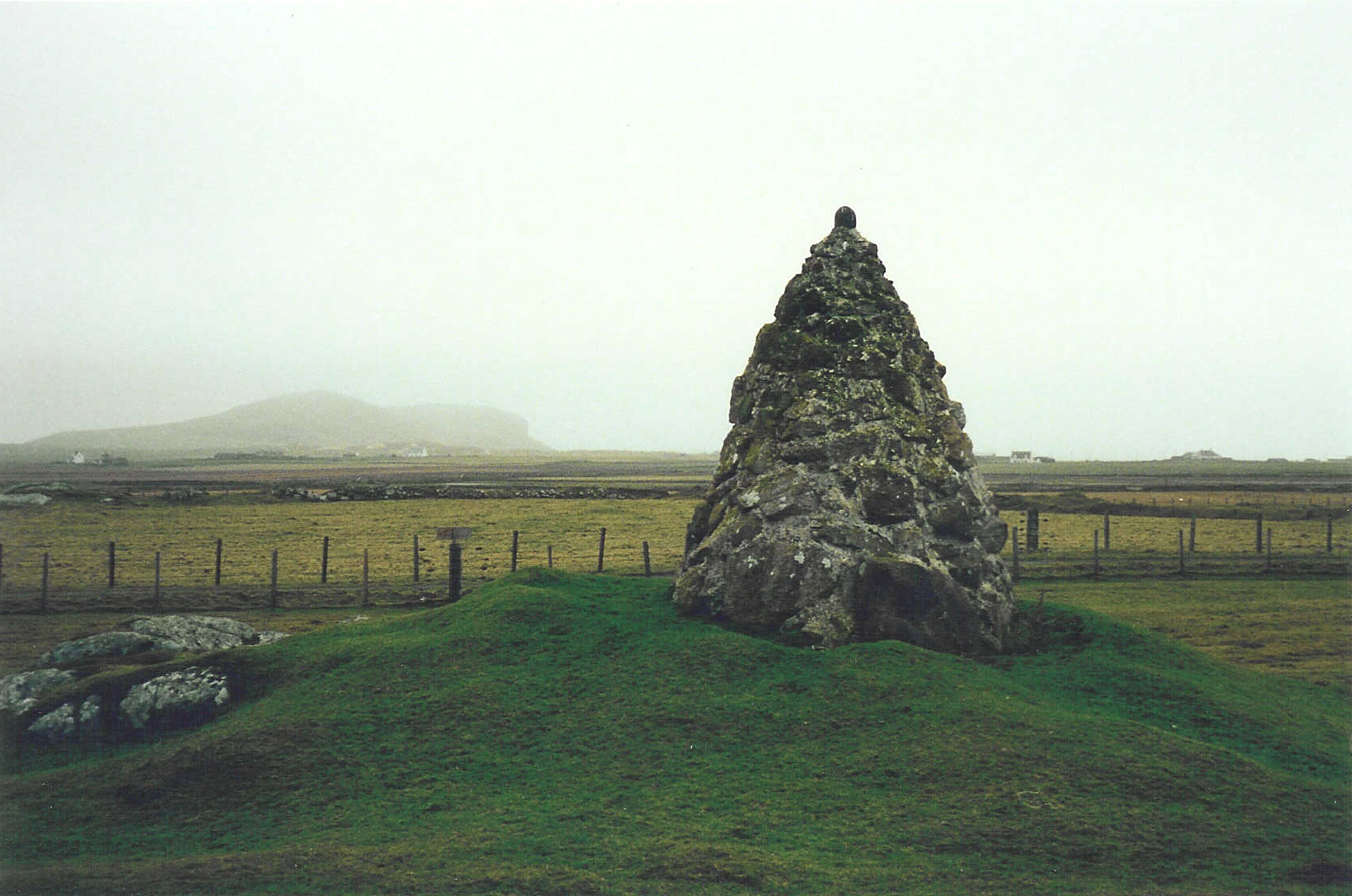
Tùr Mhic Chaluim at Kilkenneth

Photograph of Tùr Mhic Chaluim at Kilkenneth in 2001

e191.jpg

Born in Argyll in 1849, the Reverend Donald MacCallum was radicalised by what he saw of the Clearances and became the crofters’ and cottars’ champion. This was a rare stand for a minister at that time dependant as they were on their landlord for manse, glebe and living.

He served in Loch Geàrr, Arisaig and Skye, where he became the only Highland minister of that era to be imprisoned for his political beliefs. He came to Tiree in 1887 but was forced out after 18 months by the Argyll family who refused to support him.

The crofters of Tiree erected the cairn in his honour. The inscription read: ‘Tùr McCallum, 1st July 1889. Bas no Buaidh. Death or Victory.’

Colour photograph of Tur Mhic Chaluim in Kilkenneth in 2001.

Tur Mhic Chaluim in Kilkenneth photographed in February 2001 by Catriona Hunter. The memorial was erected in honour of the Reverend Donald MacCallum who was born in Argyll in 1849. He was radicalised by what he saw of the Clearances and became the crofters’ and cottars’ champion. This was a rare stand for a minister at that time dependant as they were on their landlord for manse, glebe and living. He served in Loch Geàrr, Arisaig and Skye (where he became the only Highland minister of that era to be imprisoned for his political beliefs), then came to Tiree in 1887. He was forced out after 18 months by the Argyll family who refused to support him. The inscription reads: ‘Tùr McCallum, 1st July 1889. Bas na Buaidh. Death or Victory.’

2001.46.1

Dùn Mòr at Vaul in 2001

Photograph of the broch at Vaul in 2001.

e190.jpg

Excavated by Dr Euan MacKie in the 1960s, the broch measures 9.2 metres in internal diameter with dry-stone walls up to 4.5 metres thick and was once probably 8 metres high. Built around the middle of the 1st century AD, the absence of a permanent central hearth suggests it was used originally as a temporary refuge.

The upper storeys of the broch were subsequently dismantled and a round-house, possibly an aisled wheel-house, may have been constructed in the interior. It housed a flourishing community engaged in mixed farming, iron-working and bronze-casting.

Radiocarbon dating of organic material indicates that the site was inhabited from the late 6th or 5th century BC to the 2nd or 3rd century AD, though perhaps not continuously.

Colour photograph of the interior of the Vaul broch in 2001.

The interior of the broch at Vaul photographed by Catriona Hunter in February 2001. Excavated by Dr Euan MacKie in the 1960s, the broch measures 9.2 m in internal diameter with dry-stone walls up to 4.5 m thick and once probably 8 m high. Built around the middle of the 1st century AD, the absence of a permanent central hearth suggests it was used originally as a temporary refuge. The upper storeys of the broch were subsequently dismantled and a round-house, possibly an aisled wheel-house, constructed in the interior. It housed a flourishing community engaged in mixed farming, iron-working and bronze-casting. Radiocarbon dating of organic material indicates that the site was inhabited from the late 6th or 5th century BC to the 2nd or 3rd century AD, though perhaps not continuously.

2001.158.5

Dr Alexander Buchanan’s memorial

Photograph of the memorial at Baugh to Dr Alexander Buchanan, Medical Officer for Tiree 1860-1911.

q40.jpg

Dr Buchanan was Tiree’s Medical Officer from 1860 to 1911. Although he was wealthy by island standards, an indication of the importance people of the time placed on medical treatment can be seen by the fact that in 1880 there was no nurse, one doctor and four ministers.

As well as payment for smallpox vaccinations and looking after those on the Poor Roll, Dr Buchanan had the income from one of the best farms on the island at Baugh. He died in 1911 aged 75, leaving an estate valued at £3,750.

On his death a monument was erected on Cnoc Eibrig in Baugh to a ‘Medical officer and loved and valued friend of the islanders’. This monument was damaged during World War II by blasting from the nearby quarry, despite the erection of a wooden shield.

Colour photograph of Dr Buchanan`s memorial at Baugh.

Memorial to Dr Buchanan (1835 – 1911) at Baugh, Tiree`s Medical Officer from 1860 until his death.

2000.37.35

Tiree regatta in the 1980s

Photograph of a Tiree regatta in the 1980s.

j90.jpg

Courtesy of Mr Gavin MacIntyre

The Tiree regatta was started by Peter MacNeill, a travelling salesman from Colonsay, who visited Tiree before World War I. Fishermen on Tiree had always raced back from the fishing banks and the regatta grew out of this rivalry.

The classic Tiree skiff was between 20 and 26 feet long and pointed at both ends. Some of the larger boats were half-decked but all were rigged as dipping lugs. As outboard engines came into use in the 1930s and 1940s, flat transom sterns became popular.

In the early regattas, up to thirty boats would take part in sailing and rowing races. The mid-1990s saw as many as ten Tiree boats competing regularly. Sadly in 2003 there was only one regatta with two boats and in 2004 no regatta at all.

Colour photograph of a regatta in the 1980s.

Tiree regatta in the 1980s.

2000.37.47

Regatta prize-winner Duncan MacPhee of Scarinish

Photograph of Duncan MacPhee of Scarinish during a regatta prize-giving in 1984.

k42.jpg

Courtesy of Mr Gavin MacIntyre

Fishing was an important part of Tiree’s economy from the early 19th century to the 1930s. The boat used by the local fishermen was an open skiff, sixteen to twenty-two feet long and rigged with a dipping lug.

This had a short mast and a sail on a yard with an open foot. When the boat tacked, the sail had to be ‘dipped’ around the mast, a difficult manoeuvre. However, the rig was well-suited to the long runs out to the fishing banks several miles distant from the island.

Tiree is one of the last places in Britain where dipping lugs are raced in a summer regatta. The late Duncan MacPhee, one of the older generation of sailors, is seen in this picture receiving his prize from the Regatta Queen, Lorna MacDonald, outside the Scarinish Hotel in 1984.

Colour photograph of prize-giving at a Tiree regatta in 1984.

Regatta prize-giving outside the Scarinish Hotel in 1984. L-R: Donald MacArthur, Balinoe; Duncan MacArthur, Balinoe (brother of 1); Gordon Straker, Crossapol; Duncan MacPhee, Scarinish; Duncan MacInnes, Ruaig; Sharon MacKinnon née MacAllister; Kevin Boyd, BT, Ruaig; Regatta Queen Lorna MacDonald, Crossapol/Balevullin; Donald Farquhar, Balemartine; Johnny Johnson, Milton; Donald MacKinnon, Sandaig; two unknown children.

2004.137.18

M.V. ‘Clansman’

Photograph of the Caledonian MacBrayne ferry ‘Clansman’ leaving Tiree in 2001.

f168.jpg

Courtesy of Mr Alasdair Sinclair

Ninety-nine metres in length, M.V. ‘Clansman’ is the largest vessel that can safely navigate the numerous channels at places like Gott Bay on Tiree and Arinagour on Coll. Built by Appledore Shipbuilders of North Devon in 1998, she is the fifth vessel to carry that name in the fleet.

Carrying 638 passengers and up to a hundred cars, she replaced ‘Lord of the Isles’ on the busy Coll-Tiree and Barra-South Uist routes. Calls at Tobermory on the Tiree sailings ceased as she is too large to berth at the pier there.

Although somewhat lacking in open deck space and with no overnight berths, the passenger facilities set new standards with a series of lounges, a children’s play area, room for dogs, a shop, a bar and a cafeteria and, on the top deck, an observation lounge.

Colour panoramic photograph of the M.V. Clansman in 2001.

Panoramic view of the M.V. Clansman approaching Gott Bay pier in 2001.

2004.137.1

Captain Charles MacKinnon (1838-1926)

Photograph of Captain Charles MacKinnon of Ruaig.

f151.jpg

Courtesy of Mr Alasdair Sinclair

Born in Ruaig in 1838, Charles MacKinnon embarked on a career as a young man that eventually included almost every kind of sailing ship service. In 1862 he shipped as an ordinary seaman on the tug ‘Bungaree’ which reached Sydney after six months.

The day after docking in Australia he signed on with a local barque, the ‘Woodbine’, and within four years he was its master and part-owner. He then bought the first iron vessel in Australia, the barque ‘Melrose’. He ceased sea-faring in 1882 on accepting an appointment as first Foreman of Magazines, Middle Harbour in Sydney.

Charles was a fluent Gaelic speaker and a founder of the Highland Society of New South Wales. On a trip home in 1901 he remarked to neighbour looking out to sea, ‘Dh’ atharraich a h-uile rud ann an Rubhaig ach Sgeir an Duilsg!’ (Everything in Ruaig has changed except Dulse Rock!)

Black and white photograph of Captain Charles Alfred MacKinnon 1838-1926.

Captain Charles Alfred MacKinnon 1838-1926.Born in Ruaig in 8/3/1838 the son of Archibald and Catherine MacKinnon. Married twice to (1) Christina Isabella MacKinnon and (2) Catherine Elizabeth Eglington. He joined the Scottish fishing fleet, voyaged to North and South America and then Australia. In 1862 he shipped as a seaman on the `Bungaree` voyaging to Australian ports. He then signed articles on the barque `Woodbine` which he later became master of and part-owner. At the end of 1882 he left the sea on accepting an appointment as first Foreman of Magazines, Middle Harbour, which he resigned in 1901 to visit Europe, the USA and Japan. He was a fluent Gaelic speaker, was one of the founders of the Highland Society of New South Wales and was a prominent member of the League of Ancient Mariners. He died in Sydney, new South Wales on 16/3/1926.

1 … 9 10 11 12 13 … 42