Record Type: review

1 … 8 9 10 11 12 … 42

2005.23.1

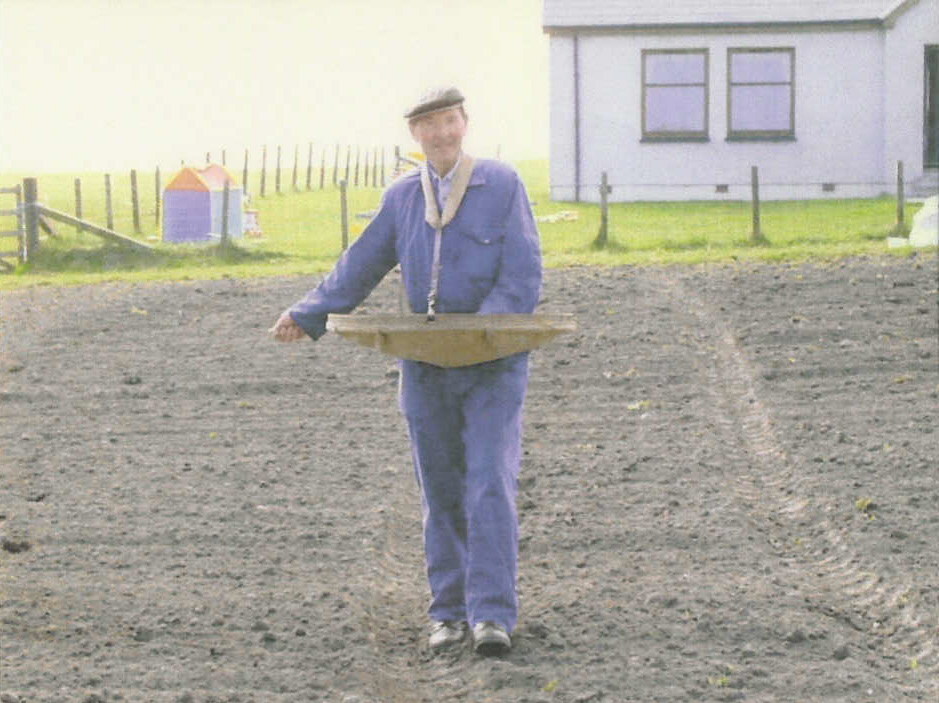
Lachie MacLean of Kenovay sowing seed using a ‘basgaid churachd’

Photograph of Lachie MacLean sowing seed using a ‘basgaid churachd’.
g155.jpg

Courtesy of Mr George Campbell

Lachie MacLean of Kenovay demonstrates in 2003 how seed was sown using a ‘basgaid churachd’. Sowing was a skilled job and not everyone could produce an even spread of seed. Unlike walking, the right arm is flung out as the right foot goes forward.

Allowance had to be made for the direction of the wind, and the seed was easier to cast if this was at your back. It had to be particularly calm for sowing grass seed as it was so light. Barley, being a heavier seed, was easier to throw

The ground was harrowed before sowing and again afterwards to hide the seed from birds. It was then rolled when the shoots were about two inches high.

Copied colour photograph of Lachie MacLean of Kenovay sowing seed using a sowing basket in 2003.

Lachie MacLean of Kenovay sowing seed using a sowing basket in 2003.
2005.22.1

Bàrr a’ chinn

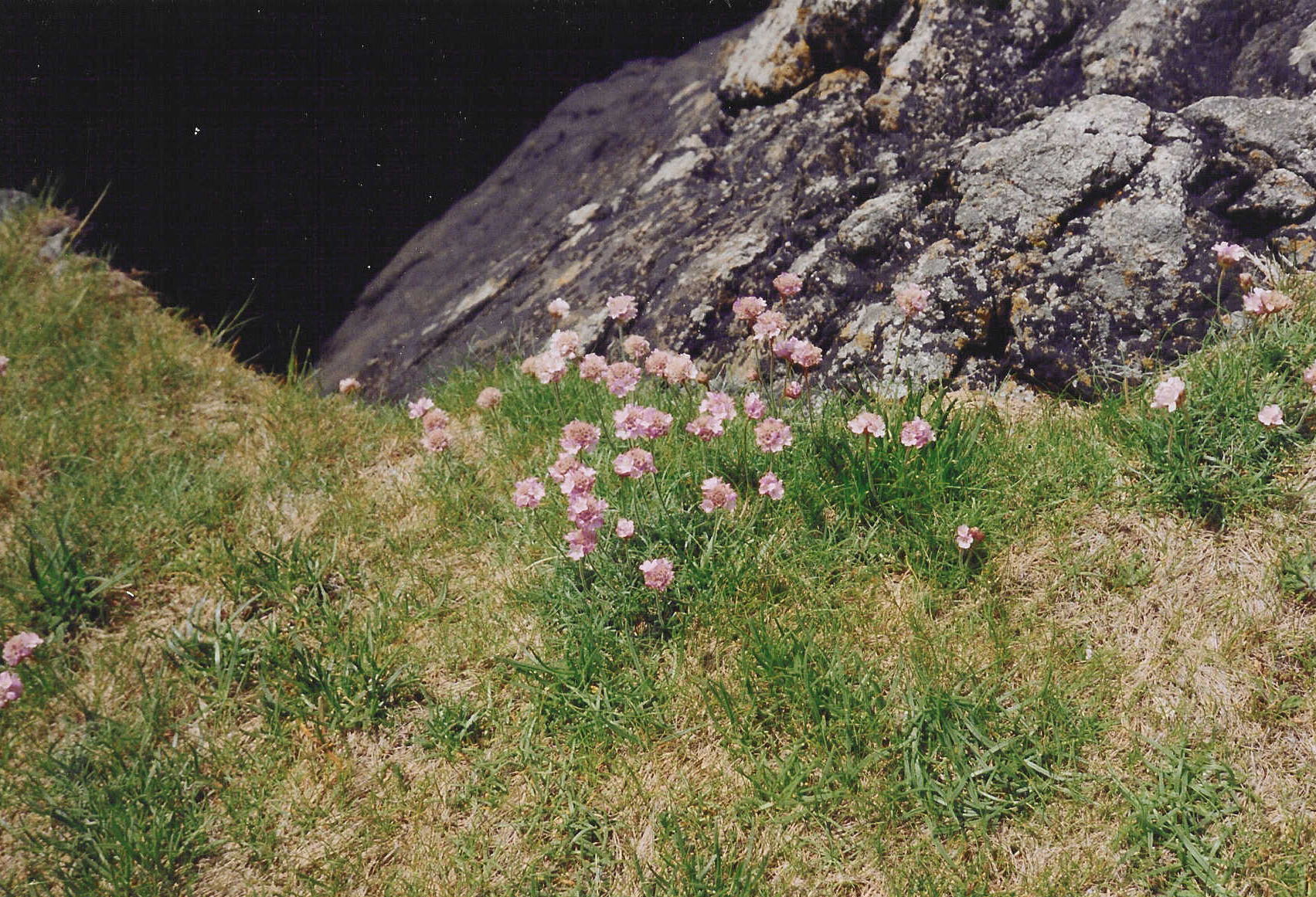
Photograph of sea pinks.

g154.jpg

‘Barr a’ chinn’ (top of the head) was a common disease affecting children on Tiree, although not found elsewhere, and was usually caused by a fright. The child would become pale, listless and lose his or her appetite. It was said the condition was caused by the descent of two bones in the roof of the mouth.

There were two cures, physical and herbal. In the physical cure, the healer’s index and middle finger or thumb were pressed against the roof of the mouth, pushing the ‘bones’ back. This is remembered as being quite painful.

The herbal treatment used the plant sea pink, known locally as ‘barr a’ chinn’. This was collected on the day of the treatment, dried by the fire then put into a small cotton or linen bag which was sewn onto the patient’s vest. Both treatments were accompanied by a rhyme.

Colour photograph of sea pinks.

Clump of thrift or sea pink, known locally as bàrr a’ chinn, photographed by Dr John Holliday in 2000. It was used in a traditional cure for a disease affecting children on Tiree, also known as bàrr a’ chinn, which was not found elsewhere. The child would become pale, listless and lose their appetite, usually after a fright. It was believed that the condition was caused by the descent of two bones in the roof of the mouth.

2004.194.8

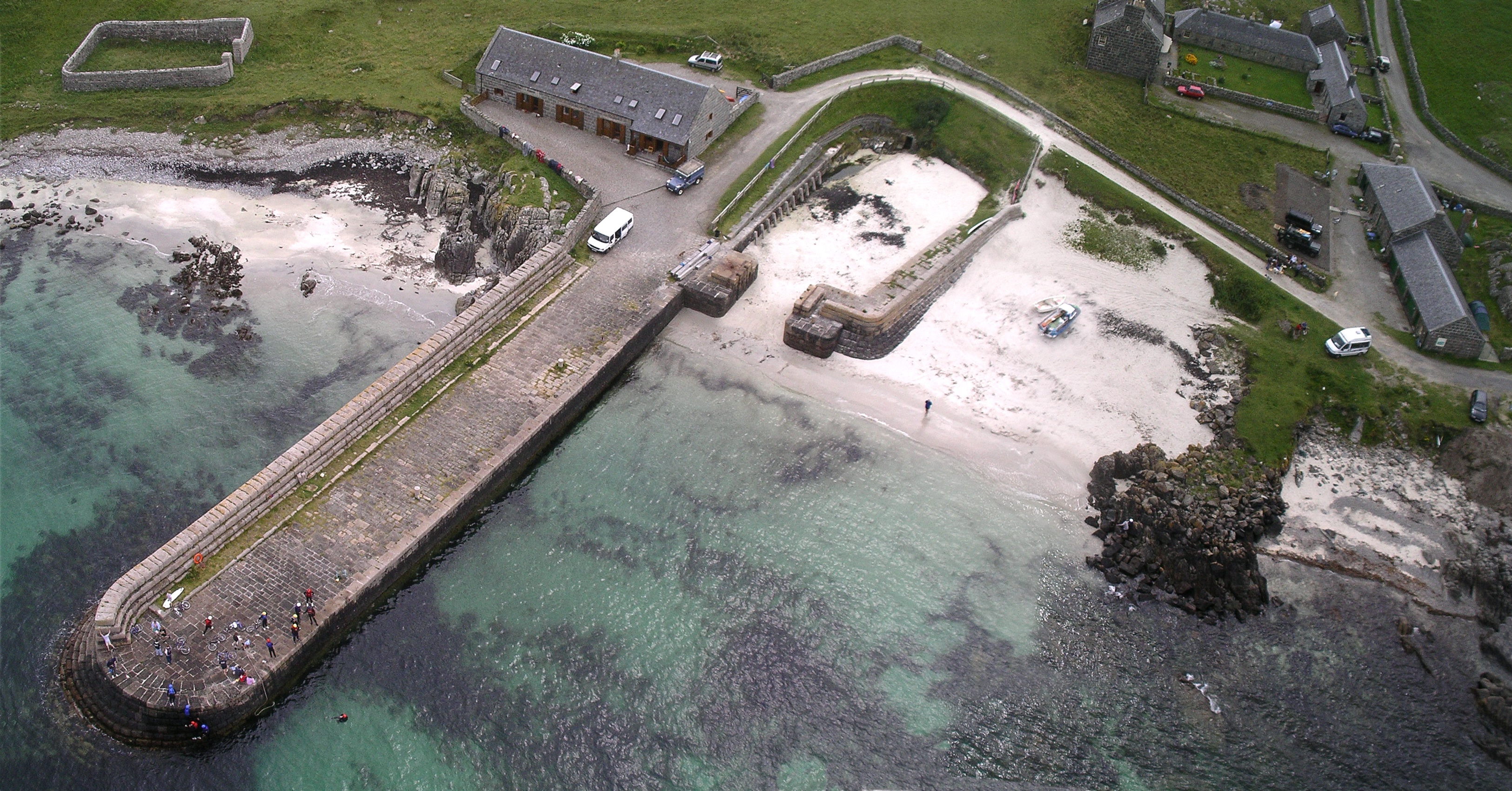
Hynish pier and dock

Photograph of the pier and dock at Hynish in 2004.

g107.jpg

Courtesy of Mr James Gentles ©

Hynish, the closest land to Skerryvore, was chosen by Alan Stevenson, Engineer to the Northern Lighthouse Board, as the site of the harbour and work yards. Unfortunately the harbour was prone to such bad swells in the winter that it was unusable and, on an island without a safe harbour, its location rankled.

The traffic at the pier was so great that in 1840 another 11 metres was added to its length of 79 metres. Not only was granite landed from the Ross of Mull before being dressed at Hynish and transported to Skerryvore, ballast was required for the lighters and copious amounts of coal for the steamer and forges.

Because the dock tended to silt up with sand, an ingenious flushing system was devised using water from a small reservoir in a nearby hill. The complex, a heritage site of European importance, has been renovated by the Hebridean Trust.

Aerial photograph of Hynish pier and dock taken by James Gentles in July 2003.

Hynish pier and dock photographed by James Gentles in July 2003 using a remote controlled camera on a kite.

2004.194.2

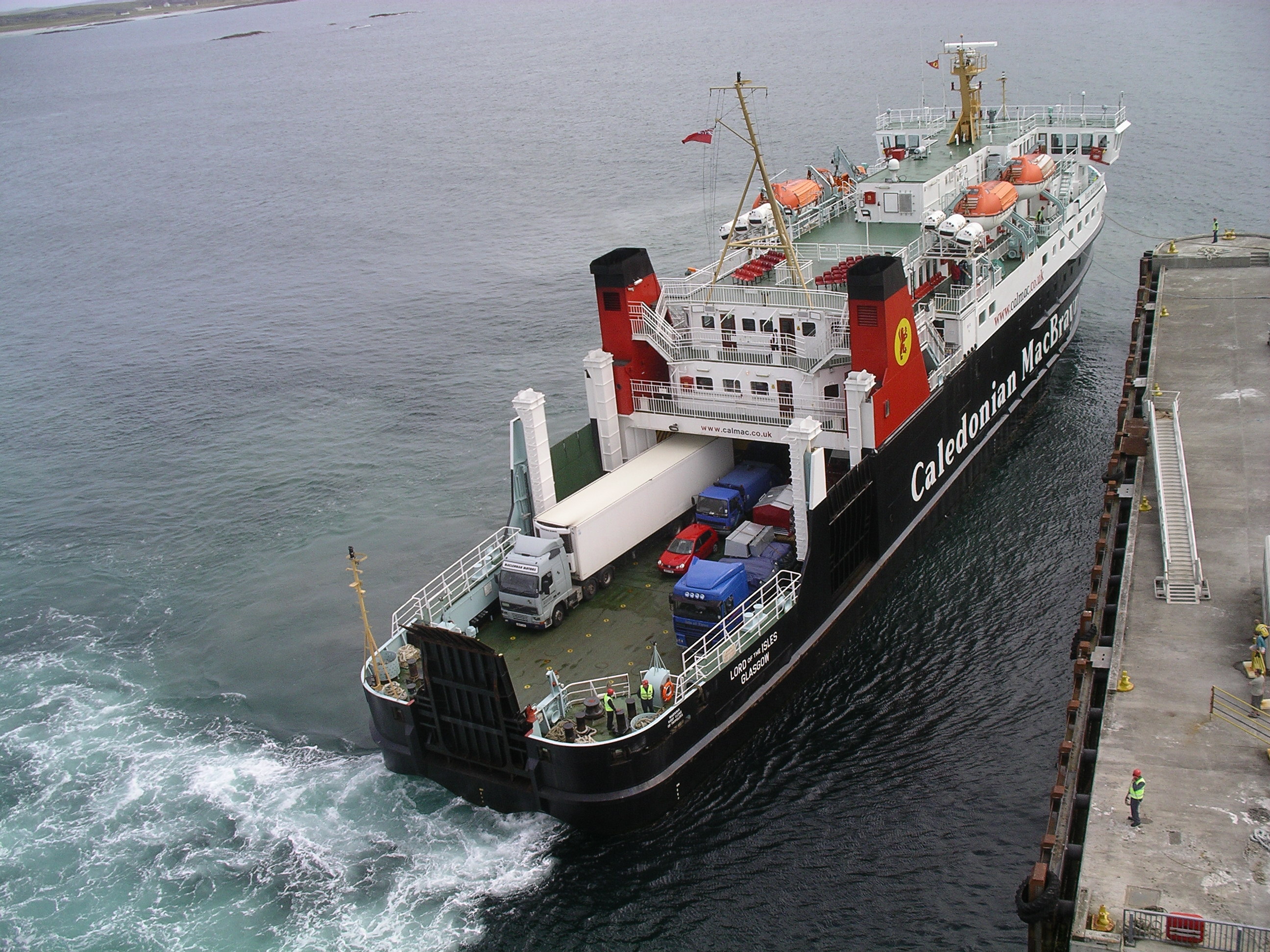
M.V. ‘Lord of the Isles’

Photograph of M.V. ‘Lord of the Isles’ docking at Gott Bay pier in 2003.

g101.jpg

Courtesy of Mr James Gentles ©

The Caledonian MacBrayne ferry ‘Lord of the Isles’, known affectionately as Lottie from the initial letters of her name, was built by Ferguson Shipbuilders of Port Glasgow in 1989. She replaced the ‘Columba’ and ‘Claymore’ on the Coll-Tiree and Barra-South Uist routes.

After only nine years in service, it was decided that a larger vessel was required on these routes and she was replaced by the ‘Clansman’ which carries twice as many vehicles. She still provides additional and relief sailings to Tiree and the Outer Isles.

This photograph of ‘Lord of the Isles’ docking at Gott Bay pier was taken by James Gentles in July 2003 using a remote-controlled camera on a kite.

Aerial photograph of the ferry `Lord of the Isles` at Gott Bay pier taken by James Gentles in July 2003.

`Lord of the Isles` docking at Gott Bay pier photographed by James Gentles in July 2003 using a remote controlled camera on a kite.

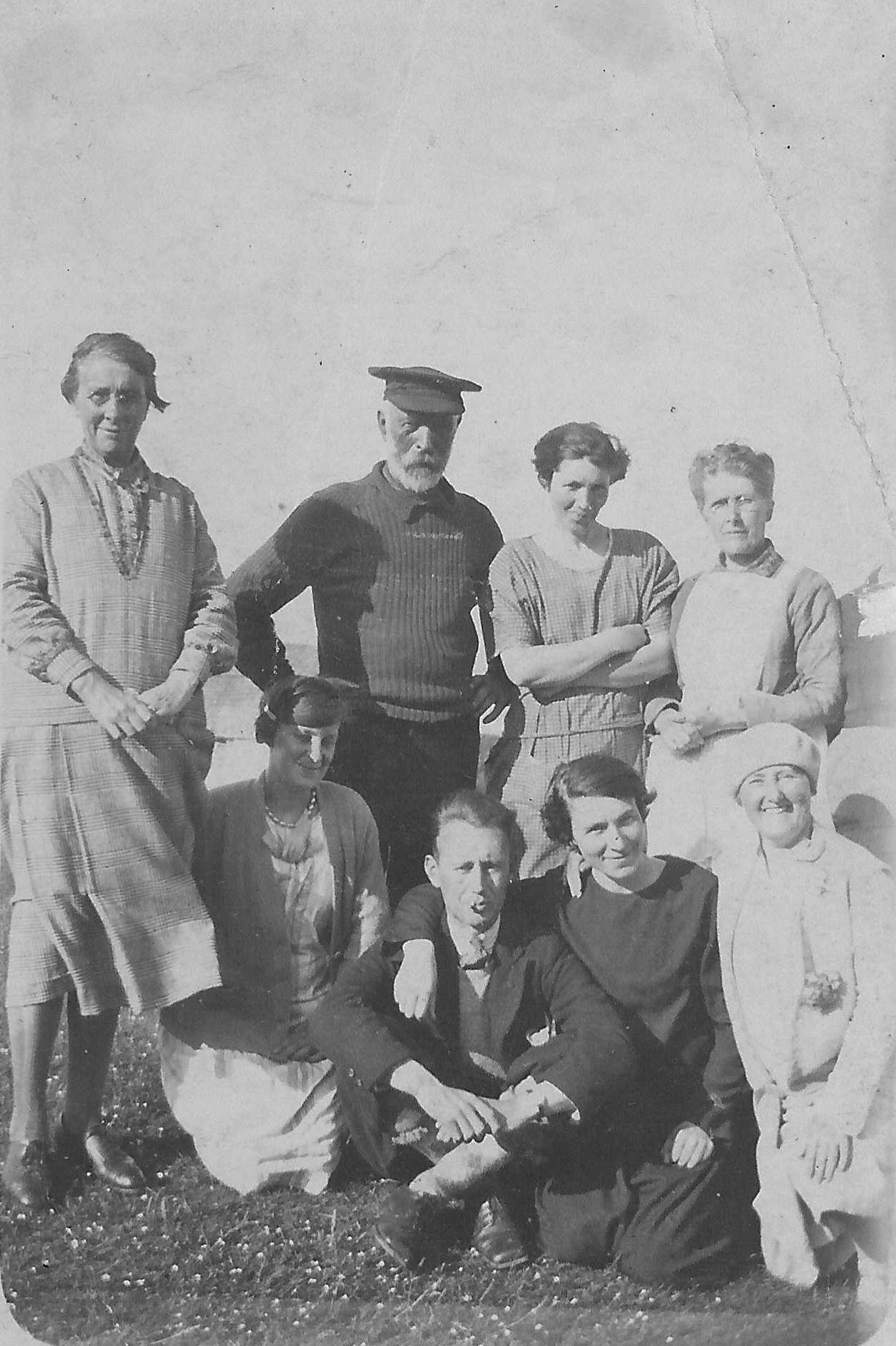
2004.192.1

Black and white photograph of the MacLean family of Croish, Caoles around 1905.

The MacLeans of Croish House, Caoles in 1904 or 1905.
L-R (back row) 1. Margaret (Maggie) MacLean, wife of John MacKinnon, Hillcrest and daughter of Alexander (3) and Ishbel (6); 2. Hugh MacLean, son of Alexander (3) and Ishbel (6), father of Hugh Archie, Salum; 3. Alexander MacLean (1853-1930), son of Hugh MacLean (1816-1905) of Croish, Caoles and his wife Marion MacFadyen, sister-in-law of Margaret (5); (middle row) 4. Catriona (An Auntie Bheag), spinster sister or sister-in-law of Margaret (5); 5. Margaret MacDonald (1835-1927), widow of Charles MacFadyen (1829-1901) and mother of Ishbel (6) and Marion (7) – three other daughters died in the diphtheria epidemic of 1881 – Maggie aged 17, Mary Flora aged 7 and Catherine aged 3; 6. Ishbel MacLean née MacFadyen (1871-1956), wife of Alexander (3), her first cousin, and daughter of Margaret (5), holding her son Charles (Charlie Croish); 7. Marion Cameron née MacFadyen, daughter of Margaret (5) and wife of Donald Cameron from Mull, holding her daughter Margaret (married surname Gillespie) – the family emigrated to Canada and Margaret grew up in New Deer, Alberta; (front row) 8. Hugh Hector MacArthur, Caoles House, cousin of Maggie, Hugh, Charlie, Donald (9) Catherine and Morag, and grandfather of Hugh (Dudan) MacArthur; 9. Donald MacLean, son of Alexander (3) and Ishbel (6); 10. Donald Cameron, son Marion (7), later a senator in Canada and founder of Banff School; 11. Catherine (Katie Rosigeal), daughter of Alexander (2) and Ishbel (6) and mother of Alasdair Rosigeal; 12. Morag MacLean (married surname Paton), daughter of Alexander (2) and Ishbel (6).

f188.jpg

2004.190.4

Johnny Brown at the wheel of his car in Scarinish

Photograph of Johnny Brown at the wheel of his car in Scarinish.

e183.jpg

Courtesy of Ms Janet Martin

Johnny Brown, the tenant of Scarinish Farm and hotel in the 1930s and 1940s, was photographed in front of Scarinish harbour at the wheel of his car, one of the first on the island. The women in the car are staff from the hotel; Johnny’s uncle Colin Brown is sitting on the running board.

Johnny was also a County Councillor. His father was a Baptist minister from Mannal who eventually settled in Taynuilt. His bother Murdoch was a Surgeon Captain in the Royal Navy, which, in recognition of his services, promoted him to Honorary Physician to the Queen. Another brother Dugald was a vet.

His sister Catherine was Deputy Medical Officer for Argyll County Council from 1929 until her retirement in 1965. As County School Medical Officer, she was well-known and well-loved throughout Argyll.

Black and white photograph of the staff of the Scarinish Hotel.

The staff of the Scarinish Hotel with the Mary Stewart in the harbour in the background. L-R (back seat) Annie MacDonald, Jessie Campbell, unknown, (front seat) Johnny Brown, Cìorstaidh Ghobhainn, (running board) Colin Brown, Johnny`s uncle.

2004.190.1

Donald MacLean (Dòmhnall Òg) of Scarinish with his family

Photograph of Donald MacLean (Dòmhnall Òg) of Scarinish with some of his family in the 1930s or early 1940s.

e180.jpg

Courtesy of Ms Janet Martin

Donald MacLean of Scarinish (Dòmhnall Òg) was born in 1859. He sailed all over the world, first in sailing vessels and later in steamships. For some time he skippered the gabbert ‘Primrose’ for MacQuarrie the shopkeeper.

In 1886 Donald married Catherine MacFadyen of Kirkapol and the couple had six sons and four daughters. After acquiring the schooner ‘Mary Stewart’ in 1908, he and his sons worked the vessel until the late 1930s.

Not the man to retire, Donald made use of the Mary Stewart’s jolly-boat to fish for lobsters. He worked productively until his death at the age of eighty-six in 1945, shortly after which a cheque arrived from Billingsgate Fish Market in London for winkles he had shipped off a few days earlier.

Black and white group photograph with Donald Og taken in the 1930 or 1940s.

Scarinish in the 1930 or 1940s. L-R: (back) Marion Livingston née MacLean; Donald MacLean (Dòmhnall Òg) of Scarinish, owner of the Mary Stewart; his daughter Hughina (m.s. MacCallum); (front) Chrissie, Marion’s daughter; unknown; Donald`s daughter Mary Anne MacLean; unknown.

2000.92.1

Kirkapol Church

Postcard of Kirkapol Church

k94.jpg

Courtesy of Mrs Ishobel MacDonald

Built in 1842, Kirkapol Church serves the eastern half of Tiree. It is almost square and resembles a typical non-conformist chapel in design. The masonry is local rubble with sandstone dressings and quoins of pink granite brought from the Ross of Mull.

The church contains a memorial to the Rev. Hector MacKinnon, a native of Tiree, who began his ministry here (1892-94) and later became so powerful a preacher he was called the ‘Spurgeon of the North’.

Nearby are the remains of a former parish church dating from the 14th century dedicated to St Columba and a smaller 13th century chapel, both probably built on the sites of earlier churches. The name Kirkapol derives from the Norse for Church Town.

Black and white postcard of Kirkapol Church.

Postcard of Kirkapol Church in the 1950s. (Original in Filing Cabinet 5 drawer 1)

1 … 8 9 10 11 12 … 42