Record Type: review

1 … 6 7 8 9 10 … 42

2006.87.3

James MacIntyre’s shop in Gott

Photograph of the site of James MacIntyre’s shop in Gott taken in 2002.

j161.jpg

James MacIntyre (Seumas a’ Ghobhainn) started a shop in his house in Gott around 1937. He sold everything, ‘from a needle to an anchor’, and often bought eggs from his customers at 6d per dozen in exchange for groceries.

He was a very kindly man, and is remembered walking on a drenching evening from his shop to a house in Ruaig with a jar of paraffin because the housewife had run out. He used to tease the children visiting the shop for sweets, saying, “Bhasaich bodach Rowntree!” (Mr Rowntree has died!)

The shop often looked somewhat disorganised to the casual visitor with boxes seemingly everywhere, but his wife was a shrewd businesswoman and knew exactly where everything was. James also operated a van (or rather a converted car), selling goods around the island.

Colour photograph of the site of James MacIntyre`s shop in Gott taken in 2002.

The house in Gott once owned by James MacIntyre who ran a shop there, photographed by John Holliday in 2002.

2006.39.2

Kincardine School in 1897

Photograph of School Section 11 in Kincardine Township, Ontario in 1897.

j137.jpg

Courtesy of Mr Archie MacKinnon

This photograph of 1897 shows the sons and daughters of pioneers from Tiree in School Section 11 of Kincardine Township, Ontario. The wooden school behind them was built in 1871 on land donated by Archibald MacKinnon.

Archibald’s parents, Fingon MacKinnon and his wife Christena MacLean, emigrated from Salum to Canada in 1851 with their seven sons then aged between five and nineteen. Fingon first worked as a labourer in Brock Township where the youngest son died of typhoid in 1854. The family then moved to Kincardine Township and settled on Lot 29 Concession 11. Fingon died there in 1859.

By 1861 the family had cleared sixty of their hundred acres. Their crops included spring wheat, oats, potatoes and turnips and, as well as two oxen, they had three steers or heifers, four milk cows and seven pigs. They continued the Tiree tradition of combining farming and other trades, e.g. carpentry.

Printout of a black and white photograph of Kincardine township school in 1897.

The sons and daughters of Tiree pioneers at Kincardine Township school in 1897. The school was built on land donated by Archibald MacKinnon originally from Salum.

2006.37.1

The mill lade at Cornaig

Photograph of the mill lade at Cornaig.

j135.jpg

The mill at Cornaig was powered by water from Loch Bhasapol. Drainage into the loch from Kilmoluaig sliabh was controlled by the miller using a small dam. He could also control the level of the loch by using a sluice-gate at the top of the mill lade.

The water was led down a sluice to the vertical wheel, which was ‘breast-driven’, hitting the wheel halfway down. This was less efficient that an overshot wheel where the water hit the wheel higher up but was the best that could be achieved as the loch level is only slightly higher than the mill.

The amount of water hitting the wheel determined the speed at which it turned. The miller could vary this by raising or lowering a flap at the bottom of the lade, which directed more or less water on to the wheel.

Colour photograph of the mill lade at Cornaigmore.

The mill lade at Cornaigmore taken by Dr John Holliday in 2003.

2005.162.5

Colour photograph of Sandaig from an unknown publication.

The Glassary restaurant and guest house at Sandaig copied from an unknown publication. (Original page in Filing Cabinet 8 drawer 4)

j102.jpg

2005.138.1

Neil and Donald MacKinnon of Brock in their skiff, the ‘Tunnag’

Photograph of Neil and Donald MacKinnon of Brock in their skiff, the ‘Tunnag’, in the 1930s.

g191.jpg

Courtesy of Mr Alasdair Sinclair

Neil MacKinnon, holding aloft a lobster, and his brother Donald, both from Brock, are pictured in their skiff, the ‘Tunnag’, in the early 1930s. The old men were very fussy about placing the single-entrance creels precisely so that the entrance faced the rocks where the lobsters were hiding.

Their great-nephew Alasdair Sinclair remembers, as a ten year old boy, having the job of rowing the boat while Neil placed the creels. The ‘Tunnag’ was eight feet wide with long, narrow-bladed oars. While he was trying to manoeuvre the boat, the pernickety old man would be saying, ‘Chan eil sin ceart idir. Feuch a-rithist e!’ (That’s not right at all. Do it again!)

Lobsters often hide inshore at low tide in small crevices in the rocks called ‘faichean’. Knowledge of their whereabouts were kept secret and passed down through the family.

Black and white photograph of Neil and Donald MacKinnon of Brock in the early 1930s.

L-R: Neil MacKinnon of Brock, holding aloft a lobster, and his brother Donald, both from Brock, in the skiff `Tunnag` in the early 1930s. (Neil and Donald were brothers of Alasdair Sinclair`s grandmother.)

2005.138.3

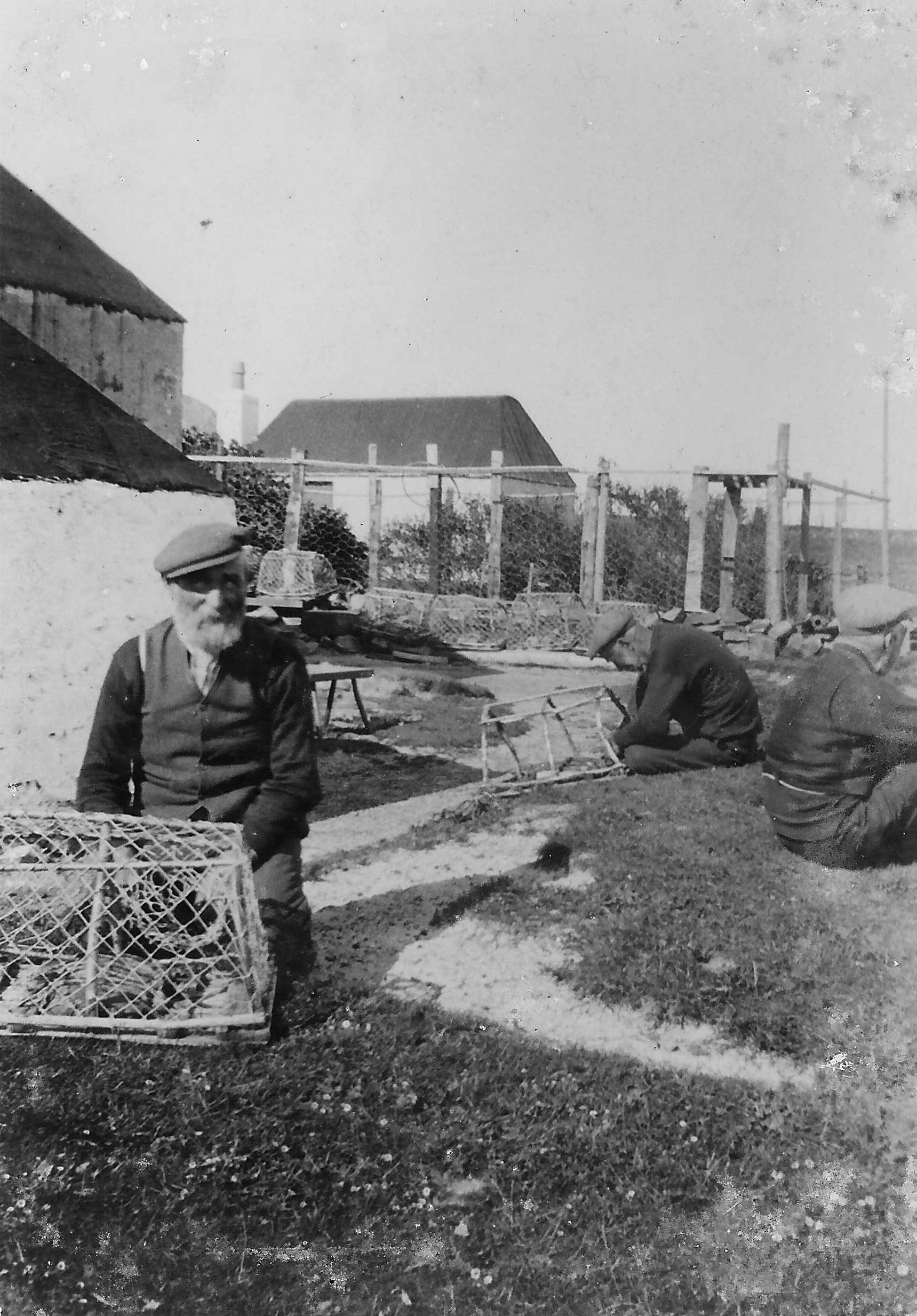
Making lobster creels at Brock

Photograph of William and Neil MacKinnon and Archibald MacLeod making lobsters creels at Brock.

g193.jpg

Courtesy of Mr Alasdair Sinclair

Brothers William and Neil MacKinnon and their neighbour Archibald MacLeod (Èairdsidh Nèill) are pictured making lobster creels at Brock in the late 1920s or early 1930s. They would make about twenty creels each winter.

The base was made from old bits of wood and the ribs, known as ‘staingean’, from hazel branches brought from Mull. These were soaked in water for up to a week then passed through a fire to soften them before being bent to form the frame.

The net was hand knitted from manilla twine using a net needle and a wooden gauge to control the mesh size. A flat stone to keep the creel on the bottom was put in before the net was laced up. The entrance was formed over a ring made from galvanised fence wire.

Black and white photograph of William and Neil MacKinnon and Archibald MacLeod of Brock in the early 1930s.

Making lobsters creels at Brock in the late 1920s or early1930s. L-R: William MacKinnon, his brother Neil and Archibald MacLeod (Èairdsidh Nèill). William and Neil were brothers of Alasdair Sinclair’s grandmother and Archibald was Duncan Grant’s great-uncle.

2005.115.2

Cornaig mill in 1962

Photograph of the interior of Cornaig mill in 1962.

h187.jpg

Courtesy of Dr Euan Mackie

This photograph of the interior of Cornaig mill was taken in 1962 by Dr Euan Mackie of the Hunterian Museum in Glasgow. The shaft from the water wheel which turned the grinding stones can be seen protruding through the wall.

The other end of the mill was taken up with the ‘àth’, or drying kiln, which was fired with coal and driftwood washed ashore during the winter. Grain had to be dried before milling and great skill was needed in making sure it did not toast too fast or the flour would be left with a bitter taste.

The grain was poured on to slotted iron sheets above the kiln and two men, with white cloths tied over their boots, turned the grain at intervals with wooden shovels until it was toasted brown.

Black and white photograph of the interior of Cornaig mill in 1962.

The interior of Cornaig mill showing the millstone, photographed Dr Euan Mackie in 1962. (Original in Filing Cabinet 8 drawer 4)

2005.98.4

Communication Officer John MacLeod

Photograph of John MacLeod at the radio station on Ben Hough in the late 1950s.

g133.jpg

Courtesy of Mr Andrew MacLeod

A Communication Officer with Ministry of Civil Aviation, John MacLeod came to Tiree in the late 1940s. Initially he was based in the wartime Control Tower at the airport but subsequently relocated to a building at the top of Ben Hough.

The purpose of the station was to provide radio communications and position fixing services to aircraft flying over the West of Scotland and the Hebrides. In those days air to ground communications were by Morse code and all aircraft carried a radio officer.

If there was an ambulance flight to Tiree or one of the other islands, John would be called out, even in the middle of the night, and would have to climb the steps to the top of Ben Hough, in darkness and often rain and gales.

Black and white photograph of Communications Officer John MacLeod at the Hough radio station.

John MacLeod at the radio station at the top of Ben Hough in the late 1950s. A Communication Officer with Ministry of Civil Aviation, John came to Tiree in 1947 or 1948. The station provided radio communications and position fixing services to aircraft flying over the West of Scotland and the Hebrides.

1 … 6 7 8 9 10 … 42