Because thatching is so labour intensive, islanders have experimented with different roofing materials as they became available. The most popular has been a layer of felt laid on wooden sarking which is then tarred every other year.
The roof timbers were largely retained so that the shape of the new black roofs resembled that of the thatch. This design allowed small windows to be put into the roof space which give a more usable upper floor.
Putting a modern roof on to old walls has given the traditional houses a new life to an extent not seen anywhere else in Scotland. This was helped by a Housing Action Scheme run by the local authority in the 1980s which encouraged the renovation of existing houses rather than the building of new ‘kit’ houses.
Colour photograph of Taigh Raonaild in Brock in 2003.
Taigh Raonaild in Brock photographed by Dr John Holliday in 2003.
Effy Thomson and her daughter Cathie pumping water from a well at Ruaig
Photograph of Euphemia Thomson with her daughter Catherine pumping water from a well at Ruaig in 1944.
Courtesy of Ms Cathie Thomson
In this photograph taken in 1944, Cathie Thomson is watching her mother Effie pump water from a well at Ruaig. Before the mains water supply became generally available in the 1950s, most houses had their own well.
Wells were made by lowering open-ended concrete boxes about one metre square into a suitable hole dug in the ground. The sand or soil would then be dug out from the bottom of the box and another box laid on top until the well was around three to four metres deep.
The well would be covered with a slab and a hand pump installed. Before the days of concrete, wells would be lined with stones, a dangerous job as the water-logged soil was liable to collapse.
Black and white photograph of Euphemia Clark of Ruaig and her daughter Catherine Ann Thomson.
Euphemia Thomson nee Clark of Ruaig with her daughter Catherine Ann drawing water from the pump in Ruaig in 1944. (Original in Filing Cabinet 8 drawer 3)
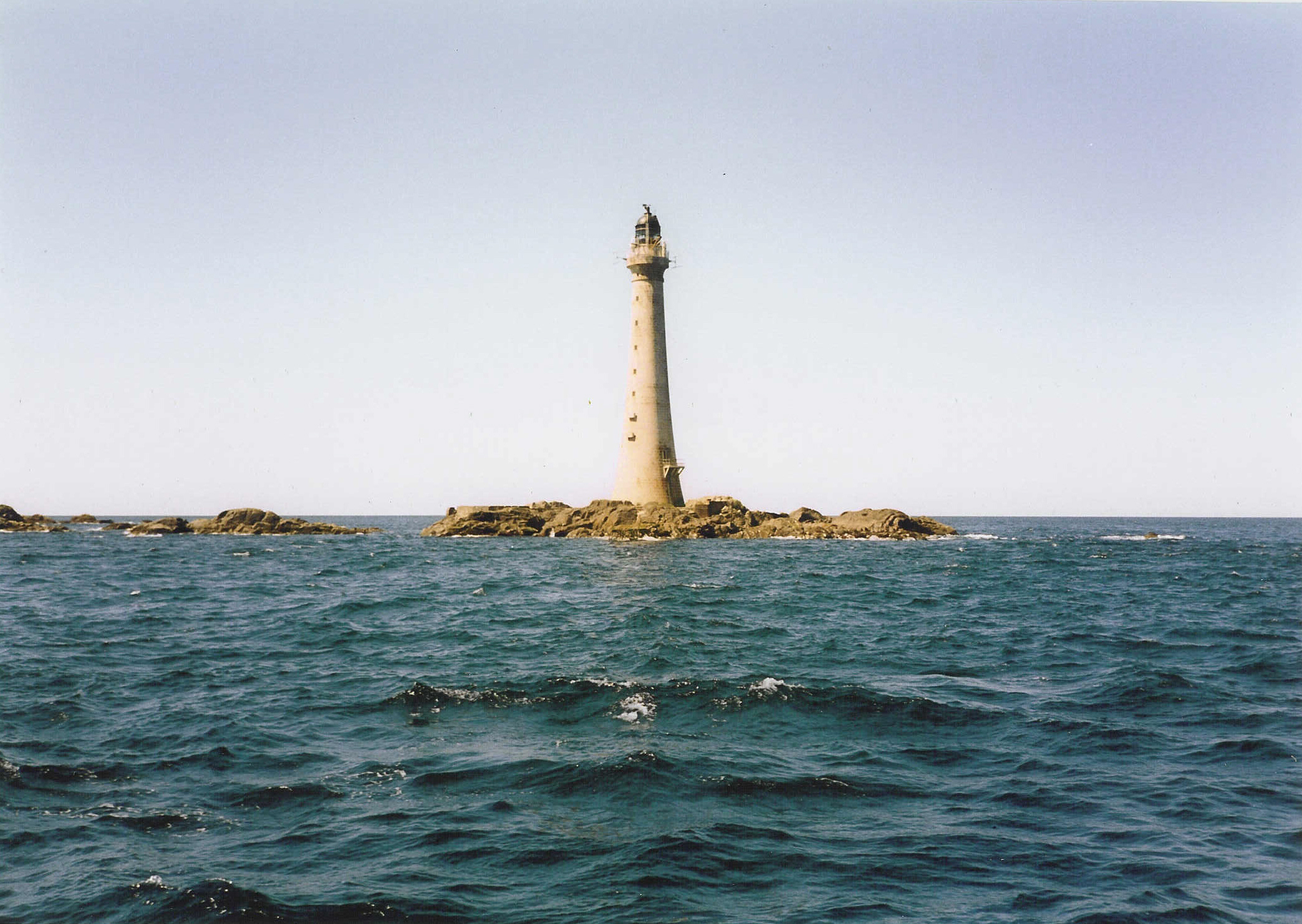
Situated 12 miles southwest of Tiree, Skerryvore lighthouse was built between 1835 and 1842 by Alan Stevenson, Clerk of Works to the Northern Lighthouse Board, on a reef that had wrecked ships over many years
The lighthouse stands 42 metes high, weighs a total of 58,580 tons and has walls 2.9 metres thick at the base. The lower four courses are built from grey Tiree granite which proved too hard and time-consuming to dress. The remainder of the tower is built from more workable pink granite shipped from the Ross of Mull.
It was described by the Institute of Civil Engineers as ‘the finest combination of mass with elegance to be met with in architectural or engineering structures’.
Colour photograph of Skerryvore lighthouse in July 2004.
Margaret Padbury with her grandfather’s travelling desk
Photograph of Margaret Padbury of Kojonup, Western Australia with her grand-father’s travelling desk.
Courtesy of Mrs Margaret Padbury
Donald MacKinnon, a miller in Balevullin, was one of twelve men arrested in 1886 after a period of land agitation on the island. Four of the ringleaders, including Donald and the Land League Chairman, were released without charge.
However, Donald’s prospects on the island were blighted and he decided to emigrate. He was presented with a travelling desk with an inscription which read: ‘Presented to Donald MacKinnon Balevullin by friends of Tiree on his leaving for New Zealand in recognition of his services in advocating their rights to the people and as a token of their respect and regards 16th March 1888.’
Donald eventually settled in Western Australia where he worked on the railway and raised a family. His grand-daughter, Margaret Padbury of Kojonup, described him as ‘a man of the highest principles, who lived by the word of God and brought up his family the same way.’
Colour photograph of Margaret Padbury in Western Australia in March 2004.
Margaret Padbury of Kojonup, Western Australia with the desk presented to her grandfather Donald MacKinnon of Balevullin who was involved in the Greenhill ‘riot’ of 1886. The inscription reads: Presented to Donald MacKinnon Balevullin by friends of Tiree on his leaving for New Zealand in recognition of his services in advocating their rights to the people and as a token of their respect and regards 16th March 1888.
Black and white photograph of Balemartine School 1945-6.
Balemartine School, 1945-6. L-R: (back row) Helen MacPhee, Balinoe; Ishbel Bunting, Balephuil; Janet MacKinnon, Balemartine; Janet Wilkie, Balinoe; Georgina MacGregor, Balemartine; Patsy MacPhee, Balinoe; Marion Eadie, Balemartine; Agnes MacDonald, Balemartine; Colina MacDonald, Mannal; Helen Penman, Balephuil; Mary Woole, Balephuil; Lachie MacArthur, Balemartine; Alistair Straker, Balinoe; Ross Downie, Balemartine; Donald Downie, Balemartine; Frank Conway, Balemartine; Tommy Doctor, Balephuil; Joe MacLeod, Balemartine; Sydney Hamilton, Balephuil; Willie MacCreadie, West Hynish; Billy Penman, West Hynish; (2nd back row) Chrissie MacLelland, Balemartine; Lena MacDonald, Balemartine; Cathy Conway, Balephuil; Ina Brown, Balephuil; Agnes Armstrong, Balephuil; Margaret Carter, Balephuil; Charlotte MacDowall, Balemartine; Duncan MacPhail, Balephuil; John MacNeill, Hynish; Angus Paterson, Crossapol; Donald Archie MacFadyen, Balemartine; Willie Brodie, Balephuil; Donald MacKay, Balephuil; John MacKinnon, Balemartine; Neil Sinclair, Balephuil; (middle row) Isabella MacArthur, Balinoe; Nellie MacDonald, Mannal; Peggy MacLean, Mannal; Ruby Collins, Balephuil; Margaret Doctor, Balephuil; Janette Hendry, Balemartine; John Carter, Balephuil; Mary Catherine MacArthur, Balemartine; Sara MacDonald, Balemartine; George Miller, Balemartine; Murdoch MacArthur, Balemartine; Gordon Doctor, Balephuil; Jimmy Doctor, Balephuil; John Neil MacKinnon, Balemartine; Donald Archie MacPhail, Balephuil; (2nd front row) James MacArthur, Balemartine; Bertie MacLean, Balephuil; Jenny Penman, Balephuil; Mary MacKinnon, Balemartine; John Fletcher, Balemartine; Alistair MacNeill, Hynish; Neil MacKinnon, Balephuil; John MacLeod, Balemartine; Duncan MacKinnon, Balephuil; James MacDonald, Mannal; Donald Brown, Balephuil; Stuart Doctor, Balephuil; (5 in front row) Margo MacKinnon, Balemartine; Alistair MacDonald, Balephuil; James MacDowall, Balemartine; Jean Fletcher, Balemartine; Tina MacLean, Mannal.
Bill Weatherston, former President of the British Orthodontic Society
Photograph of Bill Weatherston, former President of the British Orthodontic Society.
Courtesy of Mrs Isobel Weatherston
Born in Glasgow in 1906, Bill Weatherston had originally wanted to train as a chef. He qualified in dentistry instead, training at Glasgow and Edinburgh dental schools, and won the gold medal in his year for prothesis work.
He worked in Yorkshire, Inverness and Glasgow and, during WW2, in the Army Dental Corps. One of his patients in Glasgow was working on Tiree, and on his recommendation, the family started to take their holidays in Vaul.
He bought the Reading Room in Scarinish where he set up a dental practice in 1968 and, a year later, took over the Barra practice as well, spending one week a month there. He worked until he became ill in 1983 and used to say as he looked at the view from his surgery window, “All this and a little dentistry too!”
Black and white photograph of Bill Weatherston, Scarinish.
Bill Weatherston of Scarinish, President of the British Orthodontic Society.
Photograph of a leatherback turtle at Sandaig in the 1990s.
Courtesy of Mr Eric Brown
The leatherback is the world’s largest turtle. It is so named because it lacks the typical bony plates on its carapace; instead its shell is flexible and covered with a thin layer of leathery skin. It has the widest distribution of all turtles and is found throughout the world’s oceans.
Adults feed mainly on jellyfish and often undertake long-distance migrations between feeding grounds in temperate waters and nesting beaches in the tropics. Their biology is unique amongst turtles enabling them to maintain an elevated body temperature.
The leatherback is a critically endangered species. Threats to their existence include habitat loss, over-harvesting of eggs, accidental capture in fisheries, and ingestion of plastic bags mistaken for jellyfish. The turtle is this photograph died shortly after it was found.
Colour photograph of a leatherback turtle around 1990.
Latherback turtle washed ashore at Sandaig around 1990.
This photograph of Dr John Holliday, used with kind permission of D.C. Thomson & Co Ltd, was taken outside the surgery at Baugh in 1988 for an article in the ‘Sunday Post’ about Tiree’s GP. The island is just over eleven miles long and he very rarely used his bicycle to visit patients!
Dr. Holliday came to Tiree in 1986 from Kintore, a remote Aboriginal community in the Western Desert of Australia where he was the only doctor in an area the size of Germany. The Pintupi Homeland Health Service was controlled by the local people, and the doctor and local healer, or ngangkari, worked closely together.
As in other remote areas in Scotland, Tiree’s GPs have also worked single-handedly. A new surgery was built at Baugh in 2000 and a second half-time doctor was appointed in 2004 to help care for the island’s seven hundred and twenty patients.
Black and white photograph of Dr John Holliday in 1988 by the Sunday Post.
Dr John Holliday with his bicycle photographed outside the surgery at Baugh in 1988 by the Sunday Post.
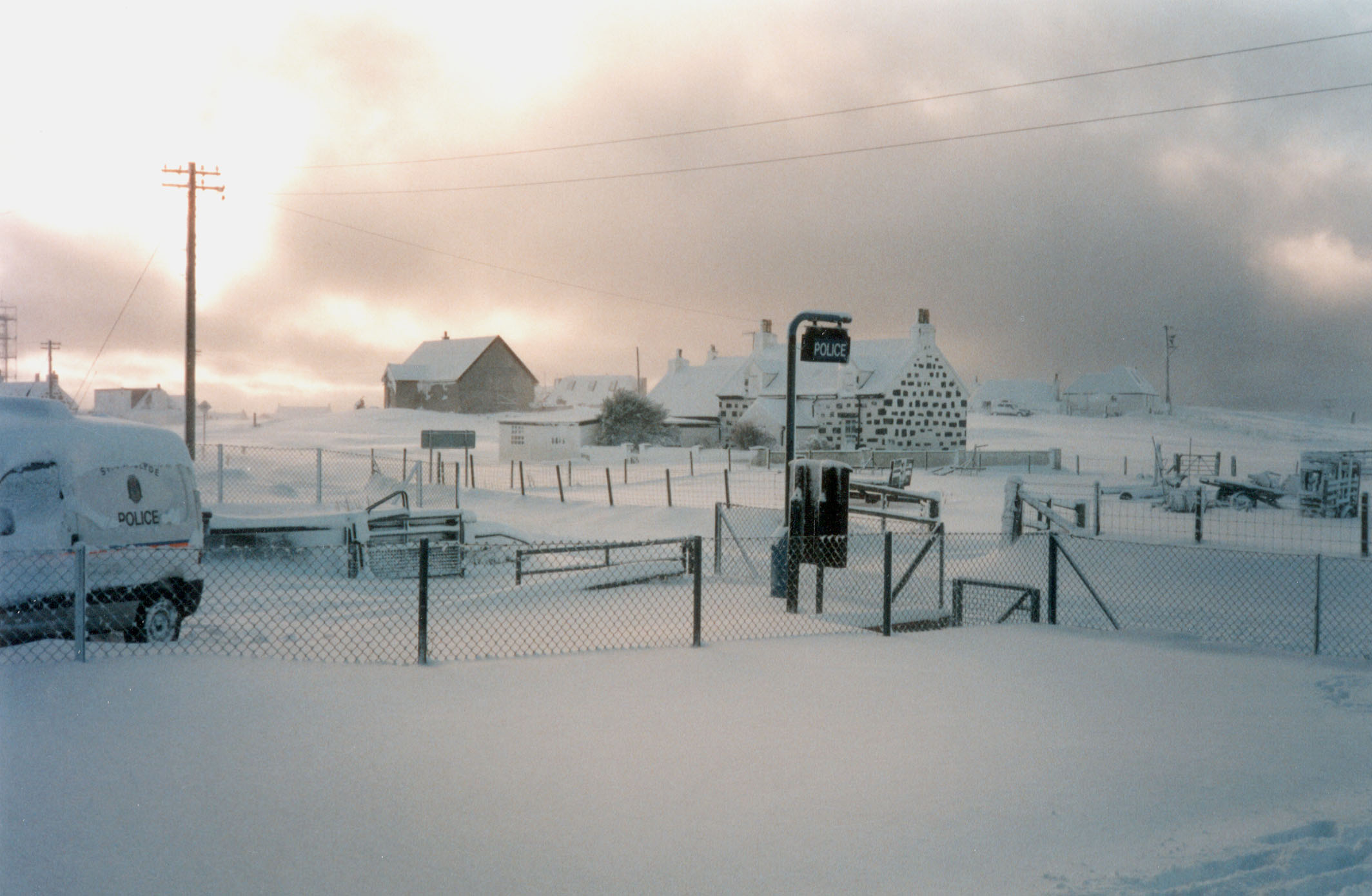
This photograph was taken by Tiree’s policeman Danny Lapsley from the front of the Police Station in Scarinish during the last week of December 2000. Not since 1953 had Tiree experienced such a heavy fall of snow.
Many roads were blocked for several days; the ice and the lack of salt made for treacherous driving conditions on the few roads that were open. Snow drifts closed the runways at the airport which, together with the planned holiday cancellations, resulted in one of the longest known periods without a service aircraft.
The island’s children took full advantage of the weather to build snowmen and indulge in snowball fights. Normally falls of snow are light and melt away within a few hours.
Colour photograph of Scarinish in the snow in 2000.
Scarinish in the snow in December 2000 viewed from the police station.