Nurse Flora MacLean of Balevullin
Photograph of Nurse Flora MacLean of Balevullin.
Courtesy of Mrs Flora MacKinnon
Flora MacLean of Balevullin was a nurse in Glasgow at the beginning of the 20th century. While working with children in the city she contracted tuberculosis. Her career finished, she left the pollution of the city for the sunshine and fresh air of her native island.
At the back of her thatched house in Balevullin she set up a tent where she lived much of the year. Her house was one of the few on Tiree with a back door which faces west, the direction of the prevailing wind. Most Tiree houses, until recently, have been built ‘back to the wind, face to the sun’.
She died in 1918 and is buried at Soroby. Her niece, Flora MacKinnon, also lives in Balevullin and is one of the island’s district nurses.
Black and white photograph of nurse Flora MacLean of Balevullin.
Nurse Flora MacLean of Balevullin who died in the 1920s, an aunt of nurse Flora MacKinnon of Balevullin.
Black and white photograph of vet Duncan MacLean with a pony and trap taken in the 1930s.
Veterinary Duncan MacLean of Balevullin driving a horse and trap in the 1930s.
Beachcombers on Balevullin beach in the 1960s
Photograph of Ernest Richardson and Mary MacLean beachcombing at Balevullin.
Courtesy of Mrs Flora MacKinnon
Ernest Richardson and his sister-in-law Mary MacLean are pictured here beachcombing at Balevullin in the 1960s. Mary is carrying a basket used for measuring herring. Four of these baskets made one cran.
The unwritten local rules allow everything below the high water mark on the beach to be taken. On an island with no trees, the most valuable find was wood. It was common for skippers to carry an extra deck load of timber to sell on the west coast and this was often lost in storms or gales.
During World War II, goods washed up on Tiree’s shores included boxes of lard from the USA, fruit such as bananas and grapefruit, export cigarettes in tins, bales of coarse crepe rubber and, after the ‘Empress of Britain’ sank off Ireland, five gallon drums of turpentine.
Black and white photograph of Ernest Richardson and Mary MacLean in the 1960s.
Beachcombers on Balevullin beach in the 1960s. L-R: Ernest Richardson and his sister-in-law Mary MacLean.
Black and white photograph of the Coastguard Hut in Balevullin with Mary MacLean and Maggie Richardson.
The Coastguard Hut in Balevullin in the 1930s or 40s. L-R: Sisters Mary and Maggie MacLean of Balevullin with Toby the dog.
Vet Duncan MacLean of Balevullin with his mother
Photograph of vet Duncan MacLean of Balevullin with his mother.
Courtesy of Mrs Flora MacKinnon
Duncan MacLean of Balevullin was the first veterinary surgeon on Tiree. Educated at Cornaig School, the headmaster of the time, Donald O. MacLean, recognised his potential and recommended to his family that he study at Glasgow University.
Back on Tiree after qualifying, he worked from a surgery next to the family thatched house in Balevullin. He was the first to do TB testing on the island and he introduced cobalt licks to prevent ‘pine’ in sheep grazing on the sandy, mineral-deficient machair.
He is remembered as a brilliant vet and a character. Many patients would prefer to see him than the doctor! Duncan never married and is pictured here with his mother. He died in 1955.
Black and white photograph of vet Duncan MacLean of Balevullin with an unknown woman.
Vet Duncan MacLean (1904-1958) of Balevullin on the right with an unknown woman, possibly his mother, taken in the 1930s.
Black and white photograph of teacher Maggie Richardson nee MacLean in the 1930s.
Maggie (Magaidh Dhòmhnaill ’ic Neilidh) Richardson née MacLean, 1907-1997, teacher at Ruaig School. She was the first woman in Tiree with a car.
The United Free Church at Kirkapol
Photograph of the United Free Church at Kirkapol.
The Free Church at Kirkapol was built in 1880 and the manse at Scarinish in 1884. At that time the members and adherents numbered 182. Twelve years later, the Free Church in Tiree combined with the United Presbyterians to form the United Free Church.
In 1929 the majority of the United Free Churches voted to rejoin the Church of Scotland, with the minority including the Tiree congregation becoming the United Free Continuing Church. In 1963 the few remaining members agreed to sell the manse to the County Council for use as an old people’s home.
A session meeting in 1966 decided to dissolve the congregation. The pulpit and pews were offered to the church at Ruaig. A knitwear factory was temporarily housed in the building in the early 1970s. It is now a guest house.
Colour photograph of the old Free Church at Kirkapol.
The old Free Church at Kirkapol now Kirkapol Guest House.
Unloading petrol drums off the M.V. ‘Loch Carron’ at Gott Bay pier
Photograph of petrol drums being unloaded from the M.V. ‘Loch Carron’ at Gott Bay pier.
Courtesy of Mrs Maggie Campbell
This photographs shows 44-gallon drums of petrol and diesel being unloaded from the M.V. ‘Loch Carron’ at Gott Bay pier. There were two petrol outlets on the island in the late 1970s: one at the pier-head owned by the West Highland Crofters & Farmers and the other at Browns’ shop in Balemartine.
Petrol was sold in Scarinish at a number of sites from the late 1920s onwards. The first pumps in the west end were installed in 1947 by Chrissie MacArthur who then owned the shop in Balemartine. There were also pumps in Balephuil between 1960 and 1972.
In 1991 the island faced a fuel crisis when the shop in Balemartine was sold to the Baptist Church and the ‘Crofters’ went into liquidation. In spring 1992 pumps were installed at the pier-head garage and the following year at the garage in Crossapol. Fuel is now delivered by bowser.
Colour photograph of the MV Loch Carron.
Loading petrol drums on the MV Loch Carron at Gott Bay pier.
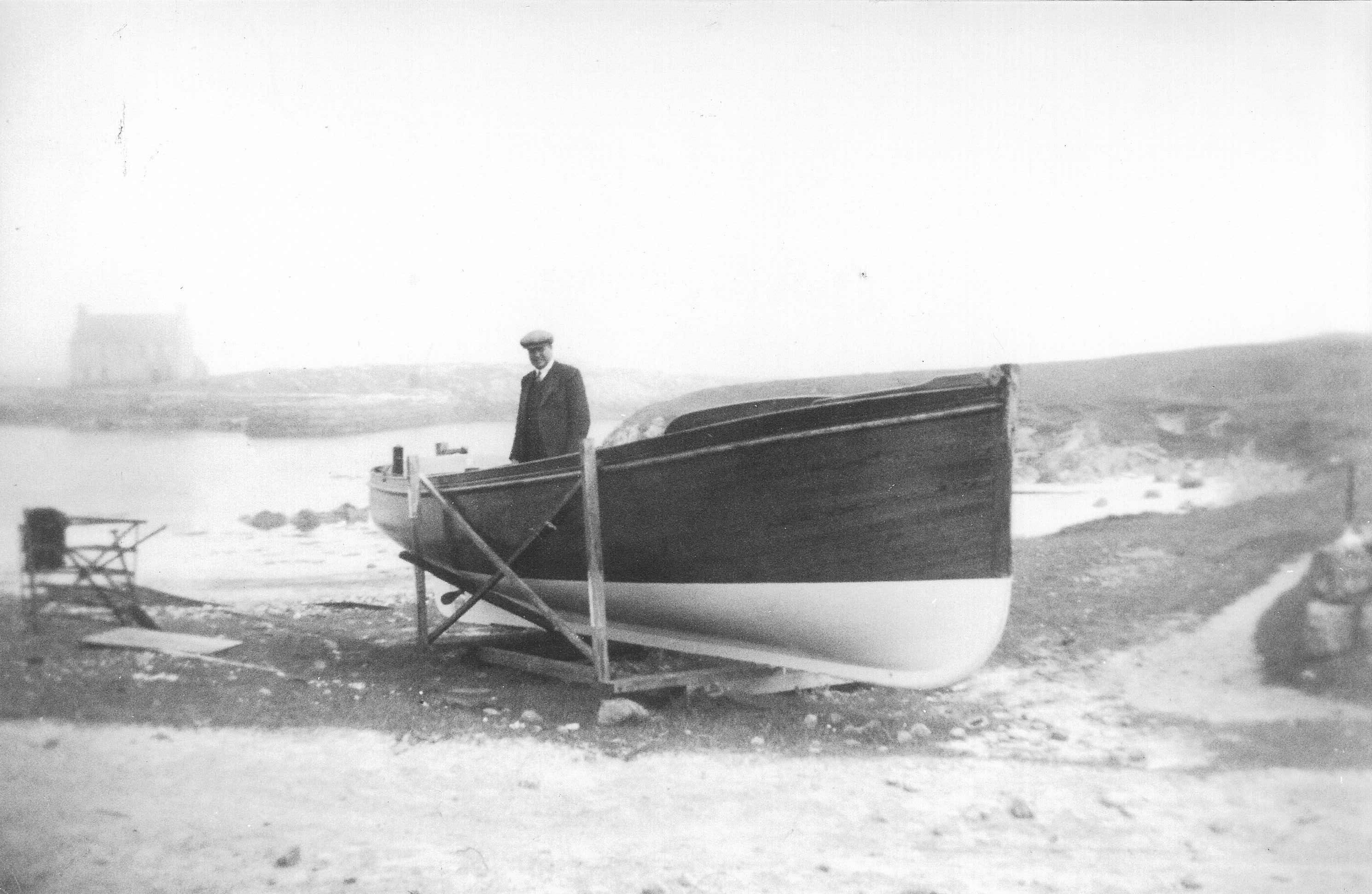
Johnny Brown with the ‘Spindrift’
Photograph of Johnny Brown with his launch ‘Spindrift’ at Scarinish harbour.
Johnny Brown, pictured here at Scarinish harbour, was the tenant of Scarinish Farm and the Temperance Hotel there in the 1930s and 1940s. He was also the owner of the motor launch ‘Spindrift’ which was worked by Neil Munn (Neila) of Heanish.
Neila’s work with the ‘Spindrift’ included fishing for lobsters, taking the hotel guests out on fishing trips, and, when work was needed to be done on the Browns’ family farm in Mannal, ferrying the farmhands from Scarinish to Mannal in the morning and bringing them home at night.
The late Hector MacPhail recorded a practical joke on Neila which backfired. One day the farmhands filled Neila’s sea-boots with water. He said nothing but the next day, once out of Scarinish harbour, he donned oilskins and went full ahead to Mannal, drenching the workers with spray on the way.
Board mounted photograph of Johnny Brown with the `Spindrift` displayed in An Iodhlann`s 1997 exhibition.
Johnny Brown, owner of the Temperance Hotel in Scarinish, with the motor launch ‘Spindrift’ in front of Taigh Mairi Claddaich in the 1930s or1940s.
Former crannog at Loch na Buaile near Scarinish
Photograph of the site of a crannog at Loch na Buaile near Scarinish in 2000
The people of Iron Age Tiree built houses known as crannogs which were protected by water. These may have been a defence against invaders or possibly to keep rats away from corn. The one at Loch na Buaile near Scarinish was connected to the loch side by a four metre long causeway.
The possible remains of three others have been found on Tiree at Eilean Aird nam Brathan and Eilean Mhic Conuill in Loch Bhasapol and at Loch na Gile on the Balephetrish sliabh. The site of Island House, the Tiree residence of the Duke of Argyll, may originally also have been a crannog.
Similar buildings on the mainland were built around 400 BC. Many were used in unsettled times off and on until the 17th century.
Colour photograph of the remains of a crannog in Loch na Buaile in 2000.
Remains of a crannog at Loch na Buaile near Scarinish photographed by Dr John Holliday in 2000.