


Colour photograph of a standing stone at Hough in 2000.
Standing stone at Hough photographed by Dr John Holliday in 2000.


Colour photograph of a standing stone at Hough in 2000.
Standing stone at Hough photographed by Dr John Holliday in 2000.
Colour photograph of An Dunan, Salum in 2000.
An Dùnan at Salum showing the causeway to shore, photographed by Dr John Holliday in 2000.

Former crannog at Loch na Buaile near Scarinish
Photograph of the site of a crannog at Loch na Buaile near Scarinish in 2000

The people of Iron Age Tiree built houses known as crannogs which were protected by water. These may have been a defence against invaders or possibly to keep rats away from corn. The one at Loch na Buaile near Scarinish was connected to the loch side by a four metre long causeway.
The possible remains of three others have been found on Tiree at Eilean Aird nam Brathan and Eilean Mhic Conuill in Loch Bhasapol and at Loch na Gile on the Balephetrish sliabh. The site of Island House, the Tiree residence of the Duke of Argyll, may originally also have been a crannog.
Similar buildings on the mainland were built around 400 BC. Many were used in unsettled times off and on until the 17th century.
Colour photograph of the remains of a crannog in Loch na Buaile in 2000.
Remains of a crannog at Loch na Buaile near Scarinish photographed by Dr John Holliday in 2000.
Colour photograph of Dùn Ìbrig at Baugh in 2000.
Dùn Ìbrig at Baugh photographed by Dr John Holliday in 2000.

A’ Charragh Bhiorach at Balinoe
Photograph of the standing stone at Balinoe in 2000.

Numerous remains from the Bronze Age (2500 – 600 BC) have been found on Tiree and it is probable that the people who left them were the first to occupy the island in any numbers. These early farmers were using metal for the first time and making pottery with turned out rims known as ‘Beakers’.
New religious customs appeared. The dead were buried sitting upright in cists or cremated and the ashes put in funerary urns. Hollowed out cup markings were fashioned on significant rocks and standing stones and stone circles were erected.
The standing stone at Balinoe, 3.6 metres high with a base 1.9 metres by 1.1 metres, is known locally as A’ Charragh Bhiorach (the pointed stone). It must be remembered that this is not the original name as Gaelic came to be spoken here 3,000 years after it was erected.
Colour photograph of A` Charragh Bhiorach at Balinoe in 2000.
Standing stone at Balinoe known as A’ Charragh Bhiorach, the sharp pillar, or Spitheag an Fhoimheir, chip of the giant, photographed by Dr John Holliday in 2000.
Colour photograph of Mairi Lyndsey Campbell and the Princess Royal at Hynish in June 1991.
Mairi Lyndsey Campbell of Cornaigbeg presenting a bouquet to the Princess Royal at the opening of the Alan Stevenson Centre at Hynish in June 1991.

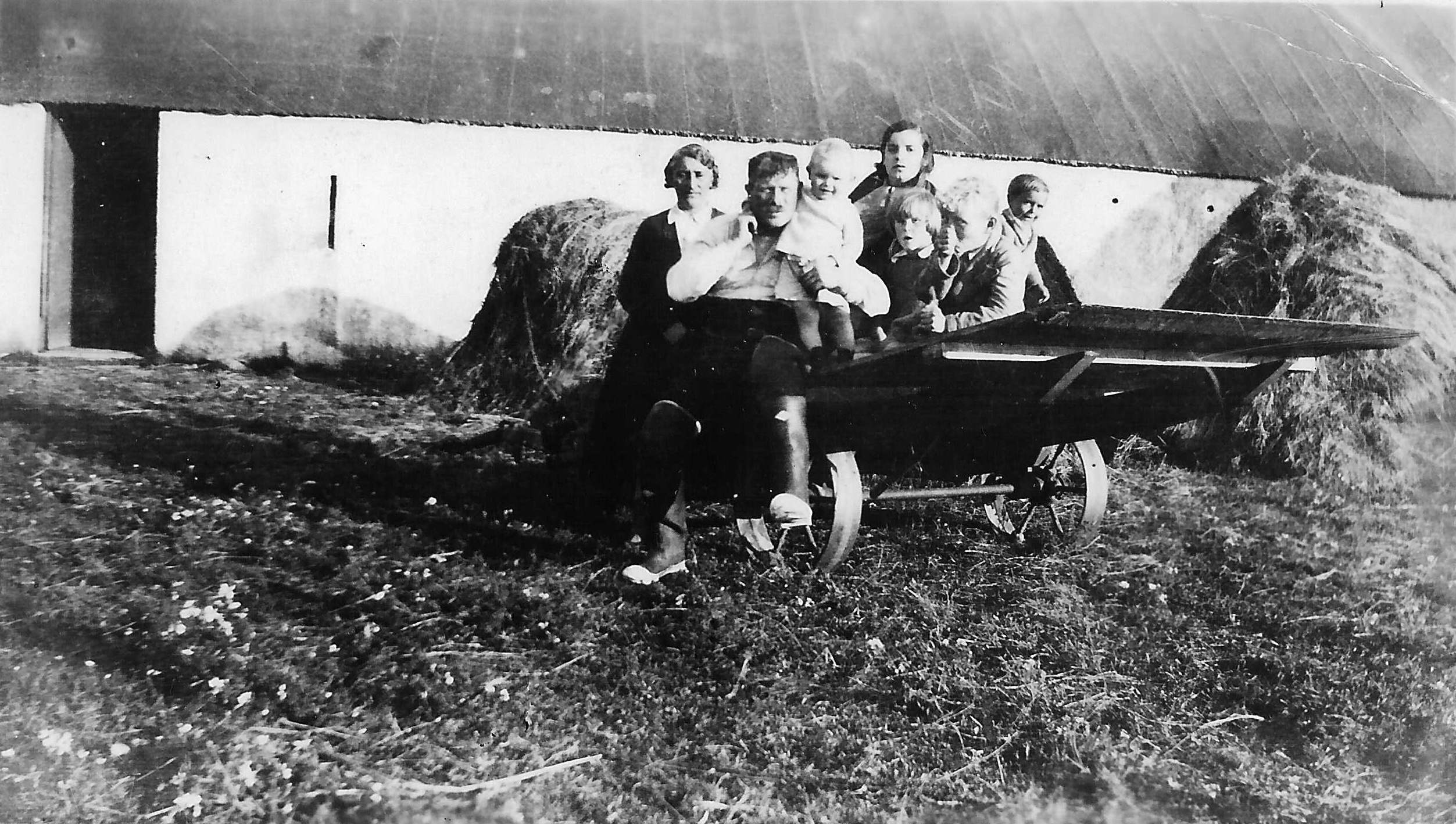
Photograph of George Paterson and his family in the stackyard of his farm at 6 Crossapol in 1937. L-R: (back) Sarah MacPhee née Paterson (George’s sister); George Paterson; his wife Margaret (Meta) with baby Angus; (front) Hamish MacPhee, Sarah’s son; George and Meta’s children, Iain and Mairi.
 Courtesy of Mrs Mairi Campbell
George’s father, Donald Paterson of Balinoe, emmigrated to Pategonia in the 1880s. Patagonia, in the south of Argentina and Chile, was cleared of its indigenous people in the 1880s to make way for large sheep farms. Many men from the Hebrides went out to share in the bonanza.
In 1885 Donald wrote to his brother asking him to send out his birth certificate and baptismal record so he could take possession of twelve square miles of land. He found the native Indians very kind and friendly and recommended shepherding in Patagonia where the pay was good.
Donald married in Patagonia and had a family. He brought his two sons George and John home to Tiree. George was seven years old at the time and could speak Gaelic and Spanish but not a word of English.
The Paterson family of Crossapol in 1937
Photograph of the Paterson family of Crossapol in 1937.
Courtesy of Mrs Mairi Campbell
The Paterson family are pictured in 1937 sitting on a rick-lifter outside their steadings at Crossapol. The cart was used to move stùcanan (small stacks of corn) from the fields to an iodhlann, the stackyard behind the house, where about six to eight of them were carefully built into a mulan (corn stack).
Initially the cut corn was bound into sguaban (sheaves), eight to ten of which were lined up into an adag. Once the seed had hardened, after about ten days if the weather was good, the adagan would be put into a stùc which can stand up to the winds that are common at that time of year.
Stùcanan could be left out if the weather deteriorated. If there was a dry spell, however, the adagan could be taken straight to the stackyard, as every time the corn was handled some grain was lost.
Black and white photograph of the Paterson family of Crossapol in 1937.
The steadings at 6 Crossapol in 1937. The cart was used to move ricks from the fields to the stackyard. L-R: Sarah MacPhee née Paterson (George’s sister); George Paterson with his son Angus; Betty MacLean née MacPhee, Sarah’s daughter (at back); George and Meta’s children, Mairi and Iain; Hamish MacPhee, Sarah’s son.
Calum MacKinnon of Kilmoluaig
Photograph of Calum MacKinnon of Kilmoluaig in 1977.

Courtesy of RCAHMS (Crown copyright)
Calum MacKinnon (1890-1984) is pictured sitting in the kitchen of his thatched house at Cnoc Bhiosta in 1977. It was the last inhabited house on Tiree without electricity. Lighting was by Tilley lamp and all the cooking was done on the coal-fired range or latterly a gas ring.
Originally traditional houses had a peat fire in the centre of the room. When coal began to be imported to Tiree in the mid-19th century, hearths and chimneys were built on to the original walls at one or both ends of the house.
Chimneys, lacking the support of a gable end, were relatively unstable and were built at a sight angle outwards so if they did collapse the inhabitants would be safe.
Black and white photograph of Calum MacKinnon in Kilmoluaig.
Calum MacKinnon (father of Iain, Hector and Hugh) at his thatched house in Kilmoluaig in 1977.
Thatching at ‘Cnoc Bhiosta’
Photograph of Lachie MacLean, Iain and Hugh MacKinnon thatching at ‘Cnoc Bhiosta’ in Kilmoluaig.

Courtesy of Mrs Fiona Munn
Lachie MacLean, Iain and Hugh MacKinnon are pictured here thatching Iain’s house at ‘Cnoc Bhiosta’ in Kilmoluaig. Initially, the thatch is laid over a layer of turfs or sgrothan which are pinned or tied to the roof timbers.
The main roof timbers, ‘ceanna-mhaidean’ or couples, usually of oak, run from the inner wall head to the apex of the roof. Those at the rear are about a foot shorter making the back of the roof slightly steeper than the front. The couples are held together by one or two timbers, making an A-frame.
On top of the couples two or three purlins run lengthwise along the house, over which is laid a layer of finer branches, often hazel. The upper purlins are joined by short lengths of wood which give the roofs their distinctively round shape and allow the thatchers to stand easily on the top.
Colour photograph of thatching at Iain MacKinnon`s croft house in Kilmoluaig.
Thatching Iain MacKinnon`s croft house in Kilmoluaig. L-R: Lachie MacLean, Kilmoluaig; Iain MacKinnon (Iain Chaluim), Kilmoluaig; Iain`s brother Hugh MacKinnon (Eoghann Chaluim), Crossapol.