Calum MacKinnon of Kilmoluaig
Photograph of Calum MacKinnon of Kilmoluaig in 1977.
Courtesy of RCAHMS (Crown copyright)
Calum MacKinnon (1890-1984) is pictured sitting in the kitchen of his thatched house at Cnoc Bhiosta in 1977. It was the last inhabited house on Tiree without electricity. Lighting was by Tilley lamp and all the cooking was done on the coal-fired range or latterly a gas ring.
Originally traditional houses had a peat fire in the centre of the room. When coal began to be imported to Tiree in the mid-19th century, hearths and chimneys were built on to the original walls at one or both ends of the house.
Chimneys, lacking the support of a gable end, were relatively unstable and were built at a sight angle outwards so if they did collapse the inhabitants would be safe.
Black and white photograph of Calum MacKinnon in Kilmoluaig.
Calum MacKinnon (father of Iain, Hector and Hugh) at his thatched house in Kilmoluaig in 1977.
Thatching at ‘Cnoc Bhiosta’
Photograph of Lachie MacLean, Iain and Hugh MacKinnon thatching at ‘Cnoc Bhiosta’ in Kilmoluaig.
Courtesy of Mrs Fiona Munn
Lachie MacLean, Iain and Hugh MacKinnon are pictured here thatching Iain’s house at ‘Cnoc Bhiosta’ in Kilmoluaig. Initially, the thatch is laid over a layer of turfs or sgrothan which are pinned or tied to the roof timbers.
The main roof timbers, ‘ceanna-mhaidean’ or couples, usually of oak, run from the inner wall head to the apex of the roof. Those at the rear are about a foot shorter making the back of the roof slightly steeper than the front. The couples are held together by one or two timbers, making an A-frame.
On top of the couples two or three purlins run lengthwise along the house, over which is laid a layer of finer branches, often hazel. The upper purlins are joined by short lengths of wood which give the roofs their distinctively round shape and allow the thatchers to stand easily on the top.
Colour photograph of thatching at Iain MacKinnon`s croft house in Kilmoluaig.
Thatching Iain MacKinnon`s croft house in Kilmoluaig. L-R: Lachie MacLean, Kilmoluaig; Iain MacKinnon (Iain Chaluim), Kilmoluaig; Iain`s brother Hugh MacKinnon (Eoghann Chaluim), Crossapol.
Copied black and white postcard of Balephetrish from John Barr.
Postcard of Balephetrish in 1931 with the wreck of the `Malve` in the distance.
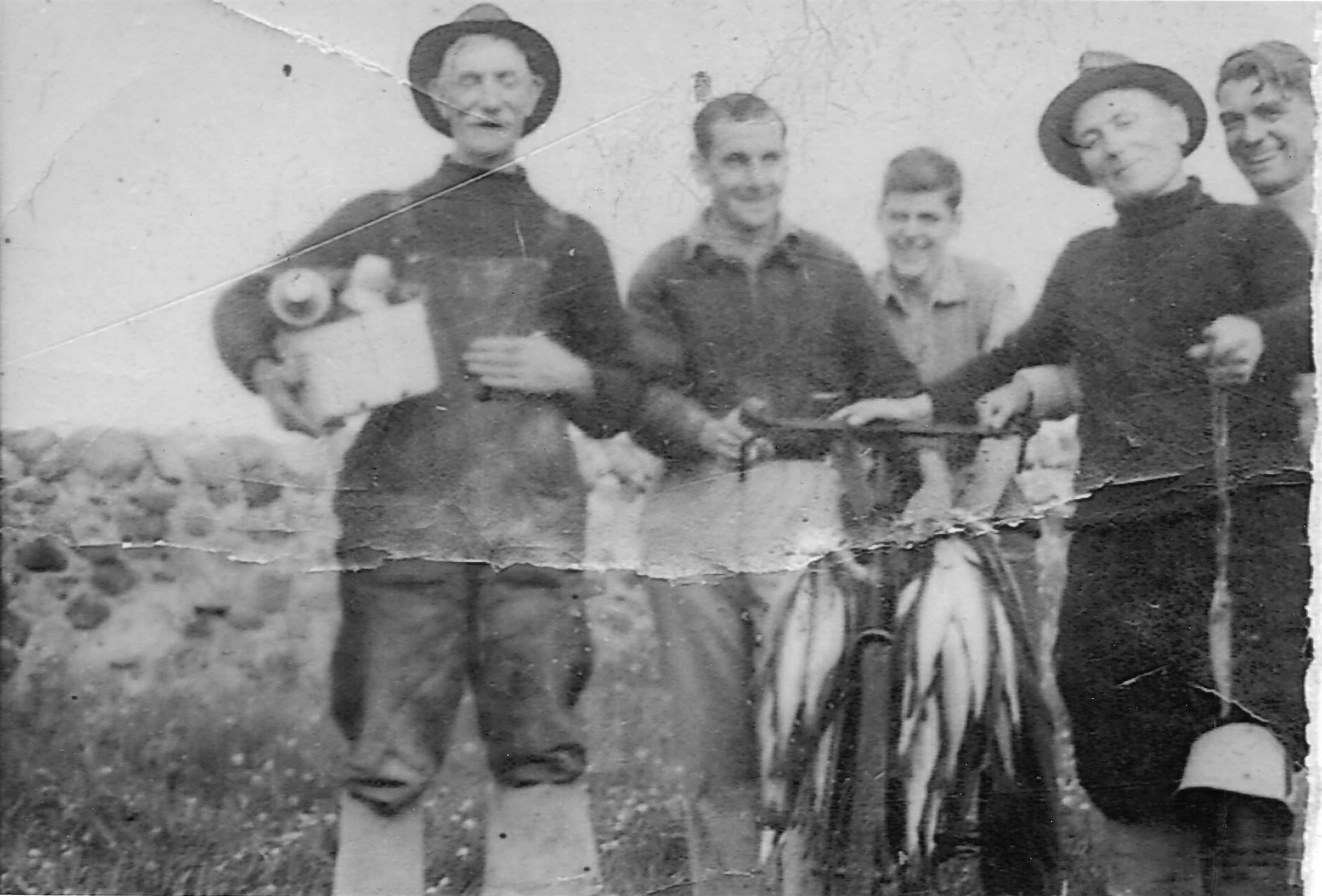
Black and white photograph of a group of men with their fishing catch.
L-R: John MacDonald of Heanish, Lachie MacFadyen, Kennneth Bisset, his father and Will Butler (possibly RAF), taken in the 1940s. Note the catch of fish hanging from the handlebars of the bicycle.
John MacDonald of Heanish with visiting children at Gott Bay pier
Photograph of John MacDonald of Heanish with visiting children at Gott Bay pier around 1930.
Courtesy of Dr John MacDonald
John MacDonald of Heanish is seen here on the left with visiting children on Gott Bay pier around 1930. John, known as ‘Nonian’, was the caretaker for Scarinish lighthouse and also worked as a docker at the pier. On the right is Hector MacKinnon (Eachann Dhonnchaidh) of Scarinish. The horse belonged to Alan MacFadyen of Gott.
In those days, a railway ran down the centre of the pier and a bogey, pulled by the horse, carried cargo between the ferry or puffer and the pier shed and office where all loads were marked in the ledger and pier dues collected. The bogey was attached to the horse’s collar by chains which can be seen in the photograph.
Nonian was good piper and fiddle player and would sing at ceilidhs and dances. His favourite song was ‘The Yellow Rose of Texas’.
Black and white photograph of John MacDonald on Gott Bay pier in the 1920s or 30s.
John MacDonald of Heanish is seen here on the left with visiting children on Gott Bay pier around 1930. John, known as ‘Nonian’, was the caretaker for Scarinish lighthouse and also worked as a docker at the pier. On the right is Hector MacKinnon (Eachann Dhonnchaidh) of Scarinish. The horse belonged to Alan MacFadyen of Gott. In those days, a railway ran down the centre of the pier and a bogey, pulled by the horse, carried cargo between the ferry or puffer and the pier shed and office where all loads were marked in the ledger and pier dues collected. The bogey was attached to the horse’s collar by chains which can be seen in the photograph.
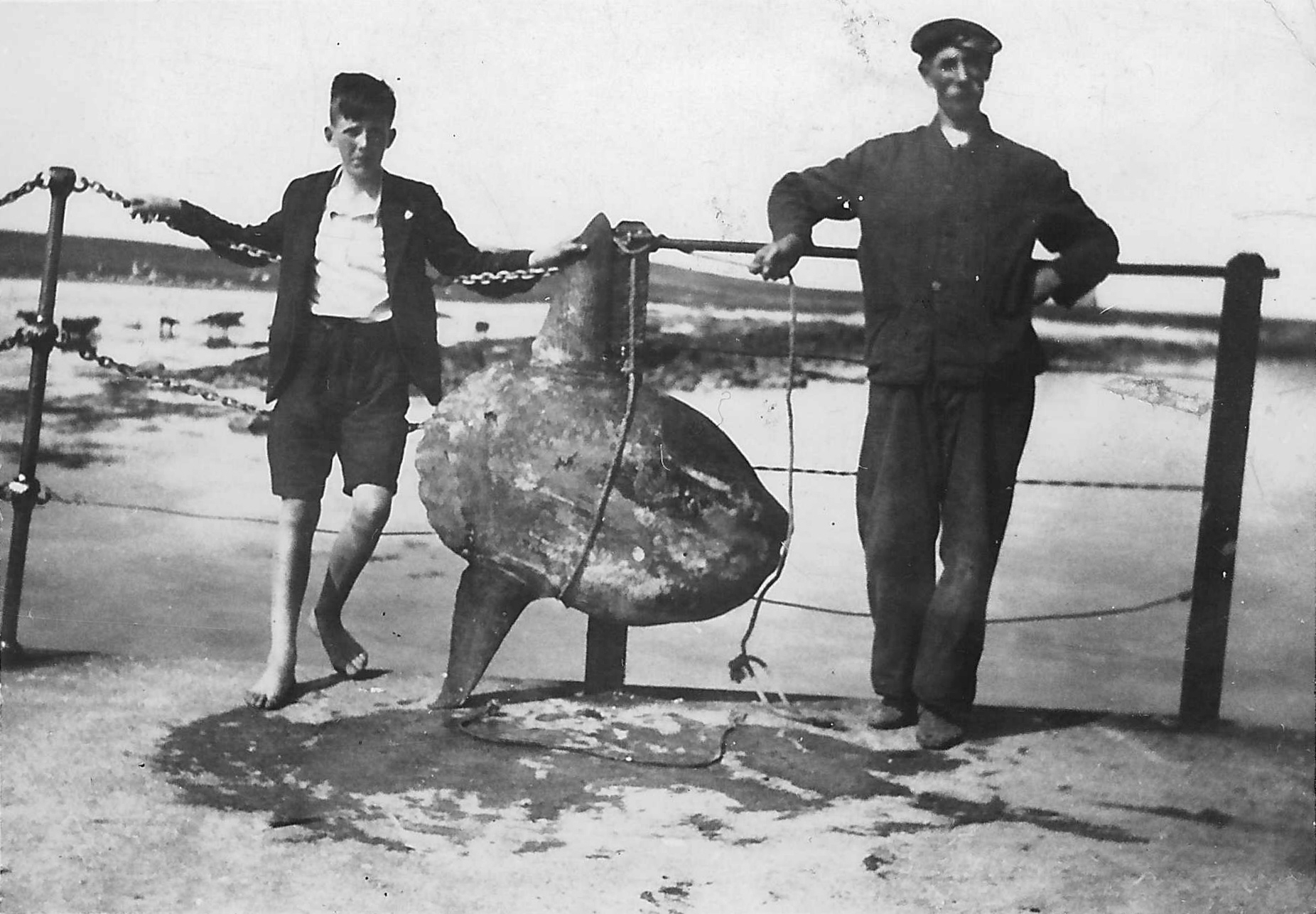
John and Donald MacDonald with a sunfish on Gott Bay pier
Photograph of John and Donald MacDonald with a sunfish on Gott Bay pier.
Courtesy of Dr John MacDonald
John MacDonald of Heanish and his son Donald were photographed with a sunfish on Gott Bay pier in the late 1920s or early 1930s. The ocean sunfish, Mola mola, is the most massive bony fish in the world and can grow over three metres in length.
Sunfish feed on jellyfish, plankton and small fish. They stay primarily in open waters, but can often be seen near kelp beds, large expanses of which surround Tiree. Its name ‘mola’ is Latin for ‘millstone’ which the fish is said to resemble in shape, colour and texture.
They propel themselves by flapping their large fins from side to side. Sometimes they are seen floating sideways in the water and it is commonly thought that they are basking in the sun. They are more often to be found further south in the waters round Cornwall and Wales.
Black and white photograph of John MacDonald on Gott Bay pier in the 1920s.
L-R: John `Nonian` MacDonald of Heanish and his son Donald with a sunfish on Gott Bay pier in the late 1920s or early 1930s. Donald jumped ship in Australia and lived there. (Donald is the brother of Jean MacEwan.)
The ‘Eilean Thiriodh’ in Scarinish harbour in 2000
Photograph of the skiff ‘Eilean Thiriodh’ in Scarinish harbour in 2000.
Courtesy of Mr Ron Hutchison
Owned by David Hepburn, the skiff ‘Eilean Thiriodh’ was built in Oban in 2000 to the dimensions of a traditional Tiree boat belonging to Willie MacIntosh of Urvaig. Raced for the first time in 2000, she won the Tiree regatta.
The classic Tiree skiff was between 20 and 26 feet long, and double-ended (a sharp bow and stern). Some of the larger boats were half-decked with a ‘deaca bheag’, but they were more usually completely open. Later boats built for the lobster fishery around the east end were much wider, or beamier.
They were all rigged as dipping lugs, although a few added a bowsprit and jib in a jackass rig in the 1930s. As outboard engines became popular in the 1930s and 40s flat transom sterns became more common.
Colour photograph of the dinghy `Eilean Thiriodh` in 2000.
The dinghy `Eilean Thiriodh` in Scarinish harbour, photographed by Ron Hutchison in 2000.
Colour photograph of the hanging knoll at Island House.
The hanging knoll (baca chrochaidh) at Island House where, in the MacLean era prior to 1674, the last tenant to pay his rent would be hanged.
Colour photograph of the former bulb fields at Ruaig.
The former bulbs fields at Ruaig.
Lobster boat and dinghy at Scarinish pier
Photograph of a lobster boat and dinghy at Scarinish pier in July 2000.
Tiree may be known as Tìr an Eòrna, the land of barley, but the abundance of shellfish on its shores must have been one of the attractions that brought the first men to the island 7,000 years ago. In the 19th century, dried ling and cod were a major export from the island.
Today the lobster and crab fishery is Tiree’s second biggest earner with an estimated annual catch worth £750,000. By comparison, in 2004 crofting was estimated to be worth £730,000 to the island with a further £680,000 coming in subsidy.
Currently five boats fish out of Tiree for velvet crabs (deiseagan) and brown crabs (crùban or partan) which sell for 50-70 pence a kilo. ‘Deiseagan’ are particularly prized in Spain where they are cut in half and the body contents picked out whole with a spoon.
Colour photograph of Scarinish harbour in July 2000.
Lobster boat and dinghy at Scarinish pier in July 2000.