Tag Archives: crofters and crofting

2004.6.2

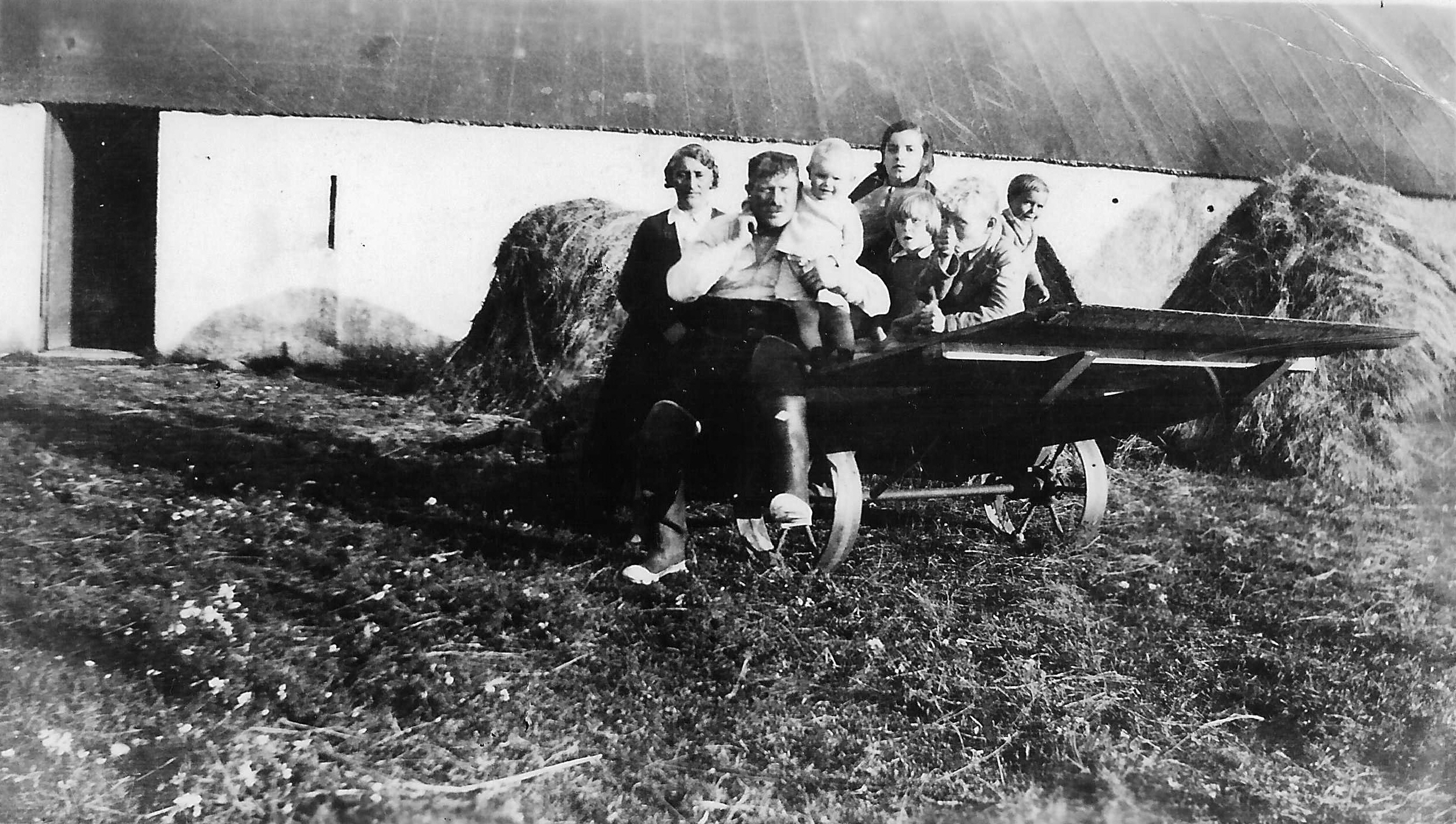
The Paterson family of Crossapol in 1937

Photograph of the Paterson family of Crossapol in 1937.
z10.jpg

Courtesy of Mrs Mairi Campbell

The Paterson family are pictured in 1937 sitting on a rick-lifter outside their steadings at Crossapol. The cart was used to move stùcanan (small stacks of corn) from the fields to an iodhlann, the stackyard behind the house, where about six to eight of them were carefully built into a mulan (corn stack).

Initially the cut corn was bound into sguaban (sheaves), eight to ten of which were lined up into an adag. Once the seed had hardened, after about ten days if the weather was good, the adagan would be put into a stùc which can stand up to the winds that are common at that time of year.

Stùcanan could be left out if the weather deteriorated. If there was a dry spell, however, the adagan could be taken straight to the stackyard, as every time the corn was handled some grain was lost.

Black and white photograph of the Paterson family of Crossapol in 1937.

The steadings at 6 Crossapol in 1937. The cart was used to move ricks from the fields to the stackyard. L-R: Sarah MacPhee née Paterson (George’s sister); George Paterson with his son Angus; Betty MacLean née MacPhee, Sarah’s daughter (at back); George and Meta’s children, Mairi and Iain; Hamish MacPhee, Sarah’s son.

1998.288.1

Audio cassette recording of Hector MacKinnon of Kilkenneth talking to Hector MacPhail in 1998.

Hector MacKinnon of Kilkenneth and Hector MacPhail of Ruaig talk in February 1998 about various prophecies relating to Tiree, his family and the first Browns to come to Tiree, houses and Tiree people in general, the Camerons related to Duncan Cameron of Scarinish and the MacLeans related to Hector MacPhail, Tiree singers and the men from Tiree who joined the police force and became inspectors.
Eachann Mac Fhionghuin o Cill Choinnich agus Eachann Mac Phàil o Ruaig a’ bruidhinn anns am Faoilteach 1998 mu dheidhinn faistean mu dheidhinn Tiriodh, teaghlach Eachann Mac Fhionghuin, a chiad Brùn a thàinig gu Tiriodh, taighean agus daoine bho Tiriodh, an teaghlach Camshron a bha càirdeach ri Donnchadh Camshron o Sgairinis agus an teaghlach MacGillEathain a bha càirdeach ri Eachann Mac Phàil, seinneadairean bho Tiriodh agus na fir bho Tiriodh a chaidh a steach do’n pholis.

1998.288.2

Audio cassette recording of Hector MacKinnon of Kilkenneth talking to Hector MacPhail in 1998.

Hector MacKinnon of Kilkenneth and Hector MacPhail of Ruaig talk in February 1998 about the Tiree bards, ministers, schoolteachers and factors, the cost of tobacco, whiskey and cars in the past and present, the size of houses, families and crofts in past times and tell a few stories about Tiree people. Eachann Mac Fhionghuin agus Eachann Mac Phàil a’ bruidhinn anns am Faoilteach 1998 mu dheidhinn na bàird o Tiriodh, ministearan, tidsearan agus bàillidhan, pròis tombaca, uisge beatha agus chàraichean fo chionn fhada taca ri prìosan an latha an diugh. Tha iad a’ crìochnachadh le sgeulach neo dha mu dheidhinn Tiriodh.

1998.281.1

Audio cassette recording of Alex MacLean of Cornaigbeg interviewed by John Donald MacLean in 1998.

Alex MacLean (Ailig Iain Alasdair) of Cornaigbeg talks to John Donald MacLean in 1998 about his ancestors, some of whom emigrated to New Zealand, a MacLean gathering there of 80 of his relatives, bulb growing on Tiree which was set up in 1958 by the Agricultural College, the MacEachern blacksmiths, one of whom was a lay preacher, the making of a harpoon for catching whales, the coal puffers which unloaded their cargo on different beaches and crofting in general. Tha Ailig MhicIllEathain (Ailig Iain Alasdair) a Còrnaig Bheag a’ bruidhinn ri Teòn Dòmhnall MhicIllEathain ann an 1998 mu a shloinntearachd, cuid dhuibh a chaidh don Seallainn Nuadh, cruinneachadh MhicIllEathain far an robh ceithir fichead da fhear-cinnidh, obair na meacain fluir a chaidh a chur air bonn ann an 1958 le Colaisde an Tuathanachais, na goibhnean Mhic Eacharna, aon dhuibh na shearmonaiche nach buin don chlèir, an dòigh air murghadh a’ dhèanamh airson glacadh na mucan mara, na bàtaichean guail a’ cur a mach an luchd air diofar thràighean agus croitearachd mar as cumanta.