


Black and white photograph of a lobster boat.
Lobster boat from Balephuil laden with with creels.


Black and white photograph of a lobster boat.
Lobster boat from Balephuil laden with with creels.
Crossapol NAAFI during World War II
Photograph of Crossapol NAAFI during World War II.

Courtesy of Mr Willie Dickie
Created in 1921, the Navy, Army and Air Force Institutes (NAAFI) provide retail and leisure services to the British Armed Forces and their families. There were two on Tiree during World War II situated at Crossapol and Hough.
Occasionally in the winter, the clientele would have ‘a bit of session in the NAAFI’, sitting round the stove and plunging red-hot pokers into pints of beer. Pianos apparently didn’t last long. One eyewitness saw a tray loaded with plates of mince and potatoes emptied into the top of the piano. The plates were retrieved but the contents were not.
The RAF Embarkation Unit at Scarinish created their own pub in a Nissen hut which they called the Pier Arms. It had a proper bar, a few tables and chairs and was cosy and warm although the beer was reported to be no better.
Black and white photograph of Crossapol NAAFI during World War II.
Crossapol NAAFI during World War II. L-R: (back) Neil MacDonald, Kenovay (Niall Dubh); (middle) unknown; unknown; Eliza MacLean, Balephetrish; Marion MacDonald, Kenovay; Cathie MacKinnon, Kilmoluaig; Sheena MacKinnon, Cornaigbeg; Chrissie Shaw, Skye; unknown; Effie Dickie nee MacKinnon, Caoles; unknown; unknown; Chrissie Murray, Lewis; unknown; (front) unknown store manager; Isobel Johnston nee MacDonald, Milton; unknown cook, Barra; unknown cook, Lewis; unknown manageress (married to Lochmaddy piermaster); cook Dolly MacLean nee MacCallum, Hough; cook Cathie MacLean, Heylipol; cook Betty Campbell, Skye; van driver Adam; Effie MacDonald, Kinlochleven.
Hough NAAFI in March 1943
Photograph of Hough NAAFI in March 1943.

Courtesy of Mr Willie Dickie
There were two NAAFIs (Navy, Army and Air Force Institutes) on Tiree during World War II: one at Crossapol and the other at Hough, confusingly referred to as Kilkenneth NAAFI by the RAF. Their purpose was to provide retail services and run recreational establishments for the Armed Forces.
Open all day for tea, snacks, beer and cigarettes, the NAAFIs were the hub of many people’s social life. There was a billiard room and a library of sorts. Servicemen and those in the Merchant Navy were admitted but civilians were often allowed in too.
Hut K2, ‘the booze shop’, at Hough was a popular meeting point for locals and servicemen. After monopolising the beer bar on Sunday lunch times, the local Home Guard was finally banned, as were the Italian POWs.
Black and white photograph of Hough NAAFI in March 1943.
Hough NAAFI in March 1943. L-R: (front) Annie Ross, Pat (surname unknown), Miss Sommerville, Edith Martin, (back) unknown, Jessie MacKillop of Bunessan, unknown, Effie Dickie nee MacKinnon of Caoles, cook (name unknown), unknown, Lottie MacDonald, Cathie MacLean of Heylipol, unknown, Kitty MacKinnon of Salen in Mull, Mary Flora MacDonald, manager Gordon Christie, Eliza MacLean, unknown.
The victorious Scotland team
Photograph of the victorious Scotland team in the ‘international’ football match played at RAF Tiree in 1944.

Courtesy of Mr Willie Dickie
In 1944, the RAF Sports Officer on Tiree was Dan Squires who batted for Surrey County cricket team before the war. He would coach players in the gymnasium and they would practise on a wicket set up on the airfield.
Athletic Days were regular events. Bets on the races were taken by the station’s Accounts Officer, the Hon. John Grimston, with the profits going to help the war effort.
Football was a popular sport with the young men on the base and in May 1944 Dan organised a special ‘international’ between ‘Scotland’ and ‘England’ which was won by the Scottish team.
Black and white photograph of the `Scotland` football team in May 1943.
The victorious Scotland football team who played against England in Tiree on 30th May 1944. L-R: (back) referee Cowan, Morton, Jamieson, Gillespie, Anderson, Holmes, Preston, (front) Willie Dickie, Byrne, Duncan, Liddell and Shiels.
518 Squadron in 1944
Photograph of RAF 518 Squadron in 1944.

Courtesy of Mr Willie Dickie
In September 1943, 518 Squadron arrived on Tiree to fly weather reconnaissance missions in long-range Halifaxes. Twice a day flights ‘Bismuth’ and ‘Mercer’ left Tiree for a ten-hour-long trip out into the Atlantic at either 20,000 or 50 feet.
Pressure to fly was relentless and in 1944 518 Squadron flew every day but two. Often icing and enormous waves made this dangerous and the Squadron lost twelve aircraft during their spell on Tiree.
Every half hour, weather readings were sent back in code. The resulting forecasts played an important part in the timing of many operations including the D-Day landings which had been delayed by fog.
Black and white photograph of RAF 224 Squadron in 1942.
The full complement of 110 crewmembers of RAF 224 Squadron with a Liberator aircraft around 1942, during World War II. Liberators were used for long-range maritime patrols and anti-submarine operations. 224 Squadron moved to Tiree from Limavady in April, 1942, with their Hudson aircraft, but in July they converted to Liberators. Following their conversion, they had to move south to Beaulieu, Hampshire, in September 1942, for anti-submarine operations in the Bay of Biscay.
Island House
Postcard of Island House, the Tiree residence of the Duke of Argyll.

Loch an Eilein (loch of the island) lies to the west of Crossapol. An ancient castle was situated on an island in the loch, with a causeway and drawbridge between it and the shore. It was occupied by the MacLeans of Duart, and probably by the MacDonalds of the Isles before them.
Lachlan Mòr MacLean was denounced as a rebel in 1588 and his estates were forfeited six years later. Tiree stayed in the actual, if not legal, possession of the MacLeans until the island passed to the Campbells of Argyll in 1674.
The Earl of Argyll built the present building in 1748, at which time the channel between the island and the shore was filled in using forced labour.
Black and white postcard of Island House, Heylipol.
Island House, Heylipol. (Original postcard in Filing Cabinet 8 drawer 2)
Spectators at the Agricultural Show in 1968
Photograph of spectators at the Agricultural Show at Crossapol in 1968.
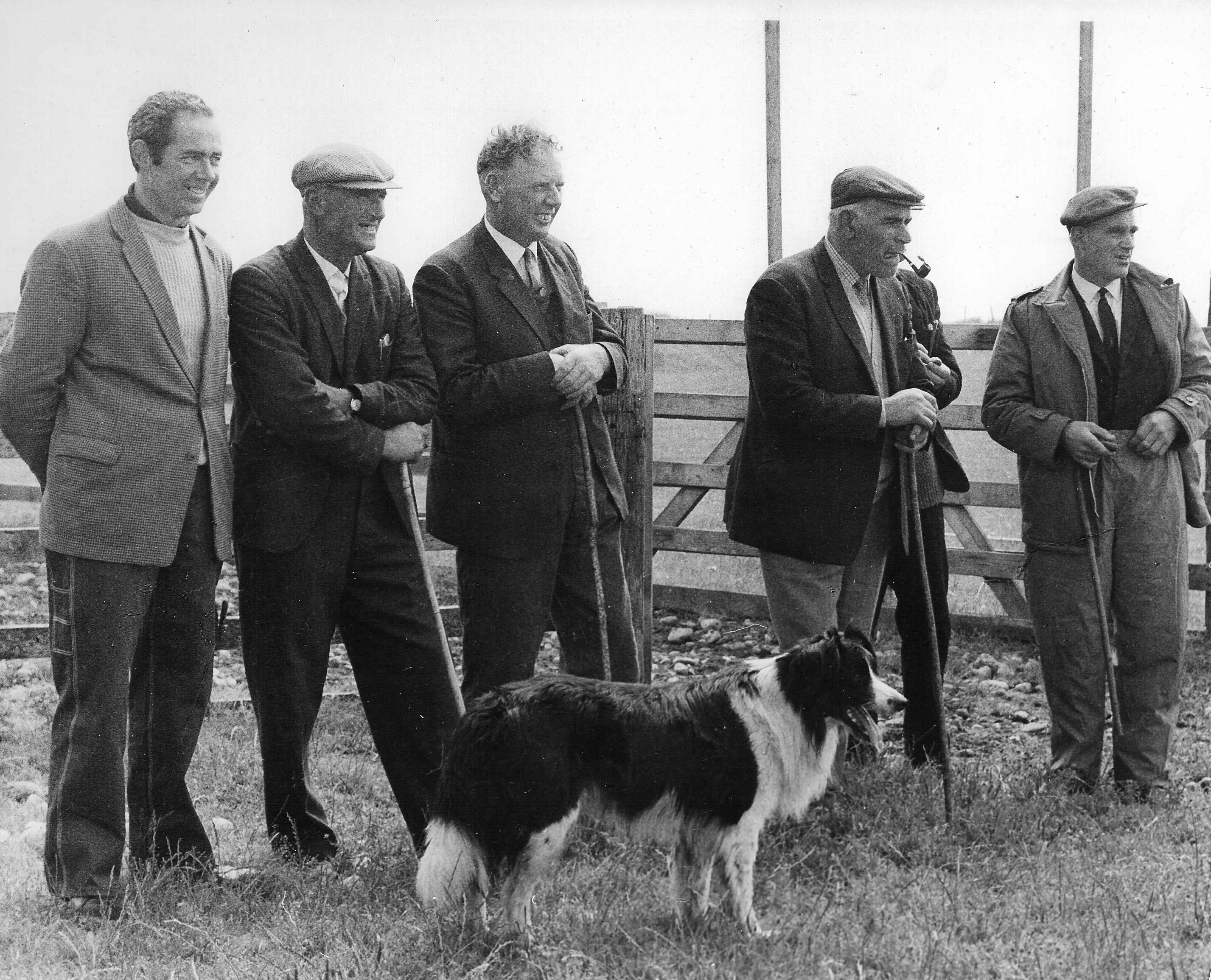
Courtesy of Mrs Nonnie MacFadyen
Pictured from left to right are Donald MacLean, Hugh MacKinnon of Kenovay, Alasdair MacFadyen of Crossapol, Archie MacArthur and John MacArthur, both from Middleton, at the Tiree Agricultural Show at Crossapol in 1968.
Black and white photograph taken at 1968 Agricultural Show in Crossapol.
The Agricultural Show at Crossapol in 1968. L-R: Donald MacLean; Hugh MacKinnon, Kenovay; Alasdair MacFadyen, Crossapol; Archie MacArthur, Middleton; John MacArthur, Middleton (Iain Theonaidh).
The Fever Hospital at Heanish
Photograph of the Fever Hospital at Heanish.

Courtesy of Mr Alasdair MacArthur
From the middle of the nineteenth century, Sanitary Laws were applied on Tiree to keep the island clean and infected patients were isolated. In 1892 the Sanitary Inspector visited the island and cautioned “several parties in regard to dung heaps in my opinion too near to houses”.
In 1893 three people died from typhoid which affected Balephuil. In 1895 an epidemic of scarlet fever swept through Tiree. The County Medical Officer, Dr. McNeill, had recommended the building of an isolation hospital on the island in 1893 and in 1905 the Fever Hospital was built in Heanish.
Made of corrugated iron lined with wood, it comprised two-bedded wards set at each end of the building with a kitchen, nurse’s room and bathroom in the centre. Outside was a washhouse, mortuary, disinfecting room and coalhouse. It was last used in the 1940s and sold in the 1960s as a private house.
Black and white postcard of Heanish machair and old the Fever Hospital.
Heanish machair and old the Fever Hospital. (Original postcard in Filing Cabinet 8 drawer 2)
Mr R. M. Percy at the Hynish bulb farm in the 1950s
Postcard of the Hynish bulb farm in the 1950s.
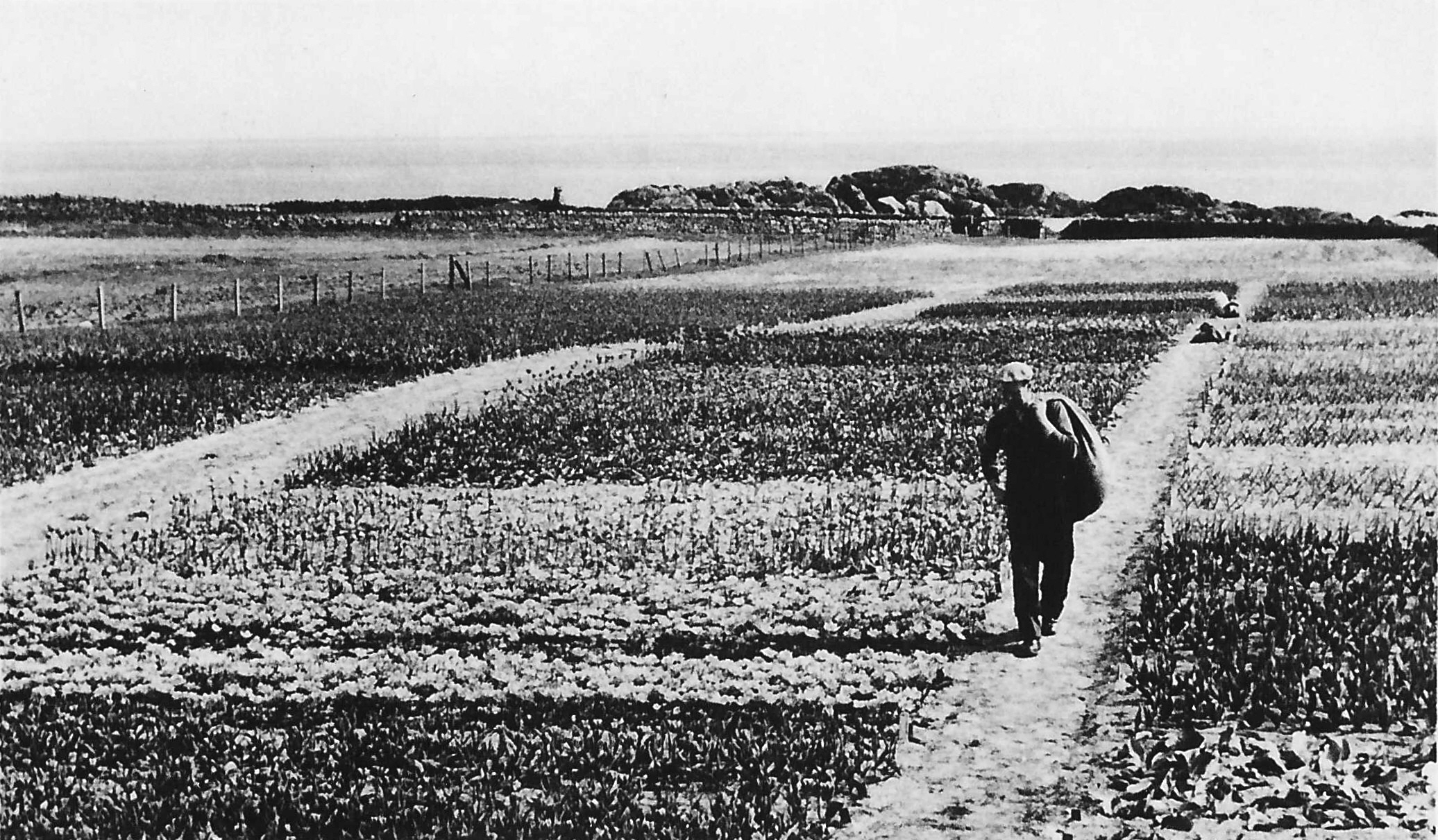
Courtesy of Mrs Mary MacKinnon
In the early 1950s the West of Scotland Agricultural College’s horticultural adviser R. M. Percy suggested an experiment in bulb-growing to Walter Hume of Hynish. The experiment showed that the light sandy soils of Tiree were well suited to growing daffodil, tulip, narcissus and hyacinth bulbs.
Encouraged by this success, a number of crofters formed a Hebridean bulb-growers association and launched into bulb-growing as a commercial enterprise, supplying mainland hot-house growers with bulbs for forcing. Initially the economic prospects looked good as the yield per acre was high.
However, the bulbs were decimated by diseases and ravaged by pheasants, mice and slugs. Reinvigorating spent bulbs took longer than expected and markets became more difficult to find. Nowadays the only reminders of the bulb experiment are patches of daffodils growing wild in the fields.
Black and white postcard of the bulb fields at Hynish.
Postcard of the bulb fields at Hynish.
The Temperance Hotel in Scarinish in 1880
Photograph of the Temperance Hotel in Scarinish in 1880.
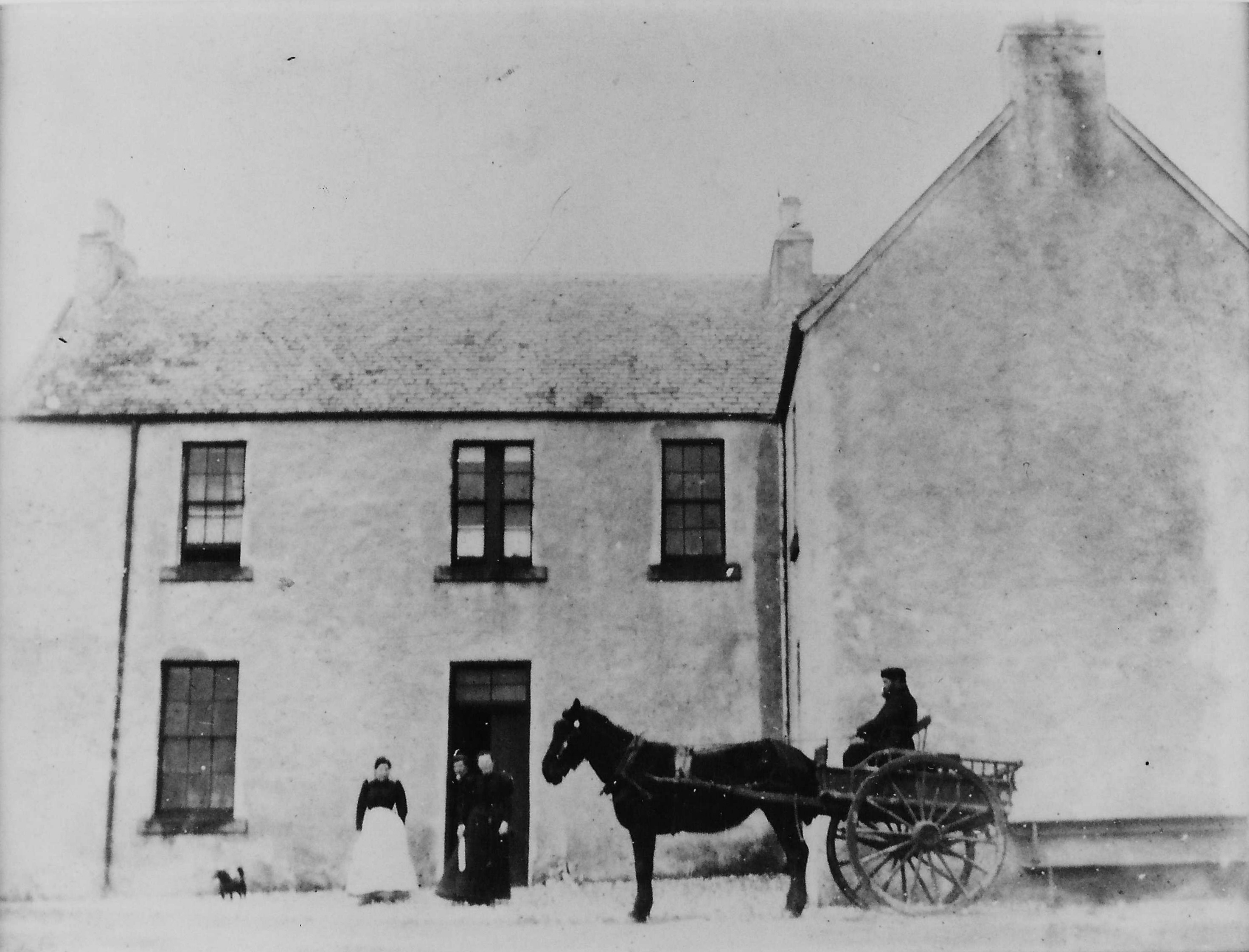
Courtesy of Mrs Mhairi Crookston
The Temperance Hotel in Scarinish was built in the middle of the 19th century. Local tradition has it that the Duke of Argyll had forbidden the sale of alcohol on the island following a fatal accident through drink at the inn in Kilmoluaig.
The Temperance Movement, which flourished in Scotland in the 19th and early 20th centuries, advocated total abstinence from ‘intoxicating liquors’. This stance was actively supported in 1847 by the island’s minister Rev. Neil MacLean who encouraged his parishioners to sign a resolution to refrain from ‘drinking ardent spirits at funerals’.
Spirits could only be obtained on the island by importing them privately by steamer or, between the wars, by drinking on board while the steamer was tied up at the pier. In World War II two NAAFIs were built which sold alcohol. The hotel in Scarinish first obtained a liquor licence in 1950.
Black and white photograph of the Scarinish Hotel in 1880.
The Scarinish Hotel in 1880.