Record Type: review

2003.137.2

Sandaig Terrace

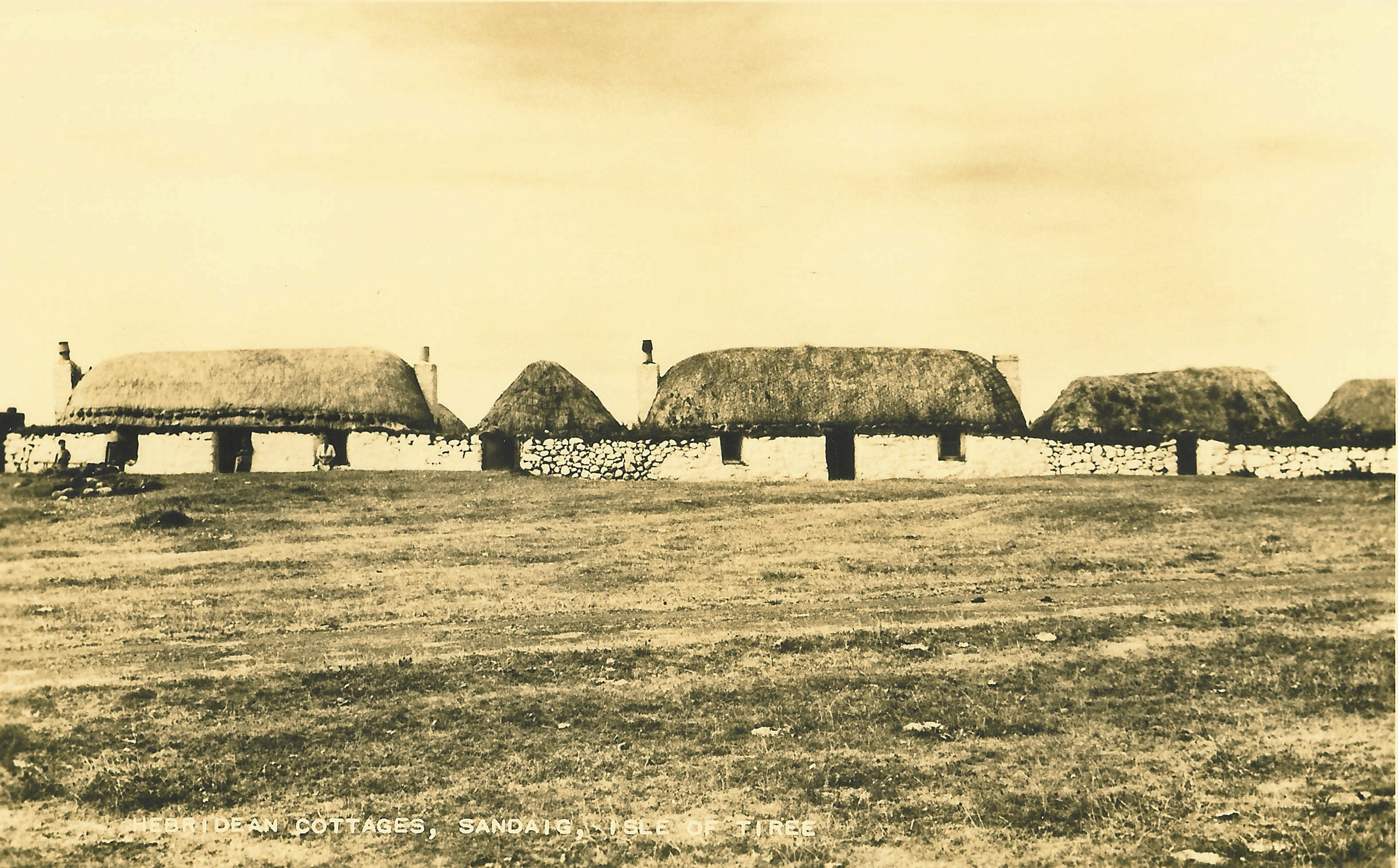
Photograph of Sandaig Terrace in the early 20th century.
a158.jpg

Courtesy of Mr Lachie MacLean

The design of Tiree’s thatched houses (known as ‘taighean-tugha’) is markedly different from those on the mainland and even from traditional houses on the other islands. The rounded curves of the roof and the complex pattern of ropes holding the thatch down make a Tiree ‘taigh-tugha’ unmistakable.

On the outer islands the usual pattern was a combined dwelling and byre with one door. Cattle were housed to the right and people lived to the left. Only one house like this has been found on Tiree where the standard design was the house, byre, workshops and sheds built joined in a line.

Traditionally Tiree houses face east. “Cùl ri gaoith, aghaidh ri grèin” (back to the wind, face to the sun) and “An ear ’s an iar, an dachaigh as fheàrr” (east and west, the best home) are two Gaelic proverbs from Tiree.

Black and white postcard of Sandaig Terrace.

Sandaig Terrace. On the left the MacLeish’s house, on the right the present site of the Sandaig Museum. (Original postcard in Filing Cabinet 8 drawer 2)
2003.133.1

Hector, Duncan and Lachie Dan MacCallum of Pictou Island, Nova Scotia

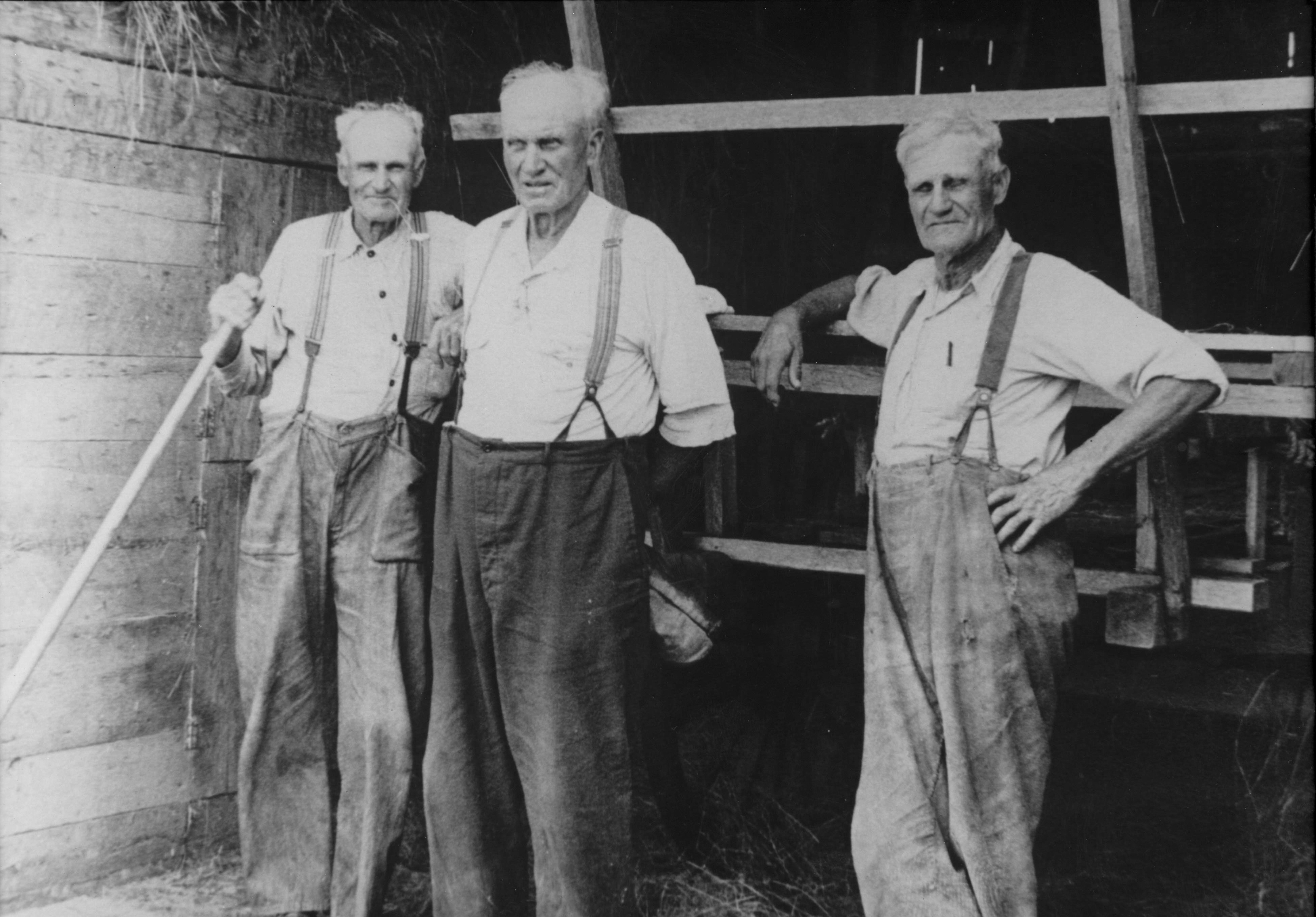
Photograph of brothers Hector, Duncan and Lachie Dan MacCallum on Pictou Island, Nova Scotia in the early 1950s.

a134.jpg

Courtesy of Mr Ken MacCallum

Donald and Flora McCallum emigrated from Tiree around 1823 with their nine children. Donald was probably the son of John McCallum, the first miller at Cornaigmore, who received a tack of the mill from the Duke in 1776. Donald’s brother, Lachlan, emigrated around the same time and settled on Pictou Island in Nova Scotia.

Lachlan’s son Daniel, ‘Big Dan’ McCallum, was born on Pictou Island and followed the charismatic minister Norman McLeod who took a group of followers from Scotland to Cape Breton, sailing on to Australia and finally New Zealand. Big Dan returned from the Victorian gold fields to become a sailor running the Union blockade of the southern ports during the American Civil War before returning to farm on Pictou Island.

Daniel’s three sons in the photograph made their livings as lobster fishermen. His great-grandson, Ken MacCallum, practises law in New York City and resides in Connecticut.

Black and white photograph of Hector, Duncan and Lachie MacCallum in Pictou Island in the 1950s.

The great-grandsons of John MacCallum, the first miller at Cornaig, on Pictou Island, Nova Scotia in the early 1950s. L-R: Hector MacCallum (1878-1953), Duncan MacCallum (1874-1955) and Lachie Dan MacCallum (1881-1967).

2000.128.1

Black and white photograph of the RAF Tiree Corporals` Club in August 1945.


RAF Tiree Corporals` Club in August 1945. Reg Knight, Flixton, Manchester (back row, 2nd left); Alex Harvey, Kilmarnock (middle row, 2nd left); Harry Barr, Birmingham (middle row 5th left); Ken Aldred, Macclesfield (front row, 4th right).

1999.99.30

John and Flora Campbell

Photograph of John and Flora Campbell with a hay rake and pitchfork in the 1930s.

y81.jpg

Courtesy of Mrs Mairi Brady

In this photograph taken in the 1930s, John Campbell from Garaphail in Cornaigmore and his wife Flora MacEachern from Creag Mhòr in Cornaigbeg are helping out with hay-making.

The pitchfork and wooden hay rake would have been made locally, the pitchfork head in one of the island’s smiddies, possibly in Cornaigbeg. Flora was the aunt of Hugh MacEachern, the last blacksmith there.

John and Flora had two sons: Hugh who was a chemist in Port Glasgow and Archie who played with Norwich City Football Club. In their retirement the couple returned to Tiree and lived near the school at Cornaigmore.

Black and white photograph of John and Flora Campbell.

John Campbell from Garaphail and his wife Flora MacEachern from Cornaigbeg with pitchfork and wooden hay rake, probably taken in the 1930s. They had two sons: Hugh who was a chemist in Port Glasgow and Archie who played football with Norwich City F.C.

2003.111.3

Feeding hens at Vaul in the 1930s

Photograph of Catriona MacKinnon and Margaret Doig feeding hens at Vaul in the 1930s.

a199.jpg

Courtesy of Mrs Nan MacClounnan

Catriona MacKinnon of Rhum View and her niece Margaret Doig are pictured feeding hens in Vaul in the 1930s. Most crofters on Tiree kept poultry, mainly hens but also some ducks. Between the wars, these numbered in total over eight thousand birds.

Up to the 1950s Tiree exported large numbers of eggs to the mainland. Eggs were bought by the local shopkeepers from their customers at a rate of 6d a dozen in payment for groceries and shipped by cargo steamer in wooden boxes of thirty dozen direct to Glasgow.

Eggs were also sent privately by post in boxes of two dozen. The eggs were protected by inserts of corrugated cardboard but even so the corner eggs often arrived broken.

Black and white photograph of Margaret Doig and her Aunt Neen in the 1930s.

Margaret Doig and her Aunt Neen (Catriona MacKinnon, Rhum View) feeding hens in Vaul the 1930s.

2003.111.5

‘Taigh Sarah’ in Vaul

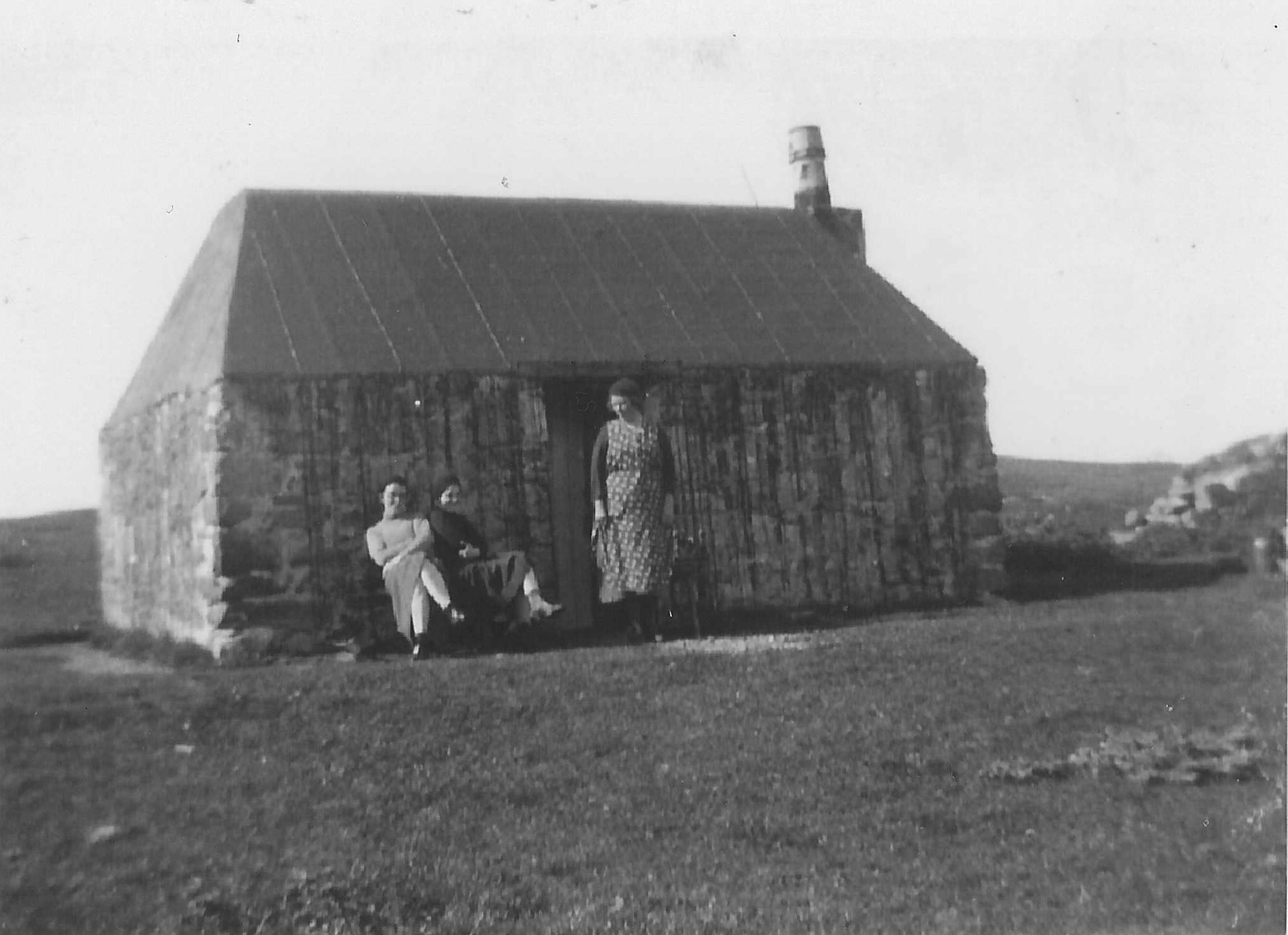
Photograph of Sarah MacFarlane outside her house in Vaul in the 1920s.

b101.jpg

Courtesy of Mrs Nan MacClounnan

Sarah MacFarlane (Sarah Nèill) is pictured on the right outside her house in Vaul in the 1920s. Sarah was a widow; all her family except for one son had died of tuberculosis, a disease that was prevalent in Tiree in the 19th and early 20th centuries.

After it was established in the 1880s that TB was contagious, it was made a notifiable disease, although it was not recognised until much later that the infection could also be transmitted through milk from infected cows.

Sarah’s original house was destroyed as it was thought a source of infection and a new one was built by the men of the township ‘in a day’. A porch was added in the 1930s. The felt roof was water-proofed with heated road tar which ran down the walls if put on in hot weather.

Black and white photograph of Taigh Sarah in Vaul in the 1920s.

Taigh Sarah in Vaul in the 1920s. L-R: unknown, Margaret Johnston nee Pettigrew, Margaret Doig`s mother; Sarah MacFarlane (Sarah Neill).