Black and white photograph of a Ladies` Social at the Lodge around 1900.
Ladies` Social at the Lodge around 1900 with Rev. MacInnes, Jessie MacArthur of Tullymet (below window) and Katy MacKinnon with baby Duncan MacPhee..


Black and white photograph of a Ladies` Social at the Lodge around 1900.
Ladies` Social at the Lodge around 1900 with Rev. MacInnes, Jessie MacArthur of Tullymet (below window) and Katy MacKinnon with baby Duncan MacPhee..
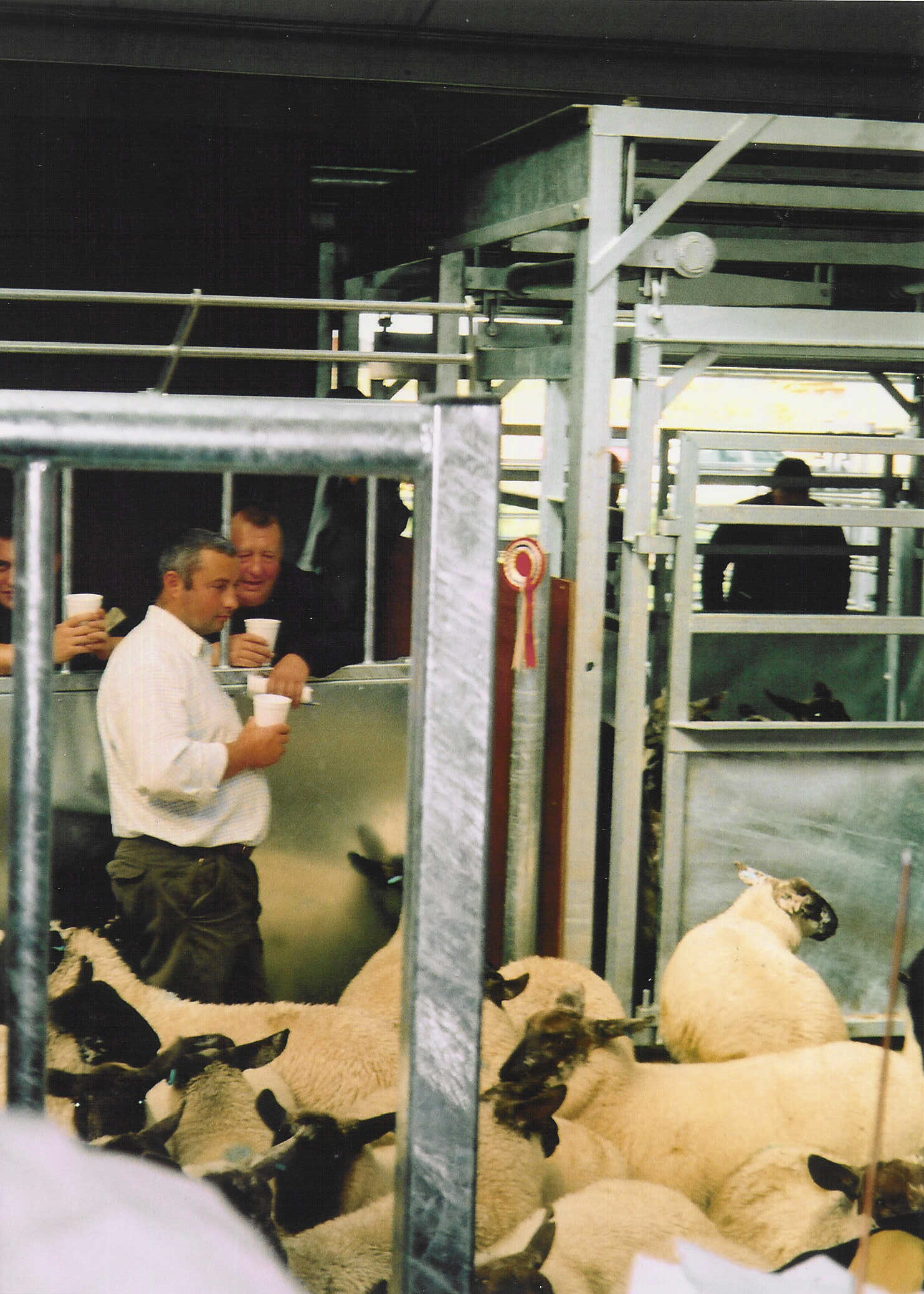
First sale at the new mart
Photograph of the first sale at the new mart at Crossapol in 2003.
For many years crofters on Tiree battled to secure funding to replace the old market stance at Crossapol which had very limited facilities. During sheep and cattle sales, the lorries for transporting livestock caused an obstruction on the main road to the west of the island.
Funding for the project amounting to £532,000 was finally secured in December 2002. The funders were Argyll & the Islands Enterprise, Argyll & Bute Council, the Scottish Land Fund, SEERAD, the Esmee Fairbairn Foundation, United Auctions, Scottish Natural Heritage and Investors in Society.
The Rural Centre was officially opened on the 21st August 2003. The ribbon at the entrance to the Centre was cut by Donald MacIntyre and Iain MacInnes, the island’s oldest and youngest crofters respectively. The following day saw the first sale of a pen of eight lambs donated by the directors of Tiree Rural Development.
Colour photograph of the first sale in the new mart in 2003.
Lambs in the first sale at the new mart on the day of the opening of the Rural Centre at Crossapol in August 2003.
The seven MacDonald sisters of Balemartine
Photograph of the seven MacDonald sisters of Balemartine in the 1920s.

Courtesy of Mrs Maggie Campbell
The seven MacDonald sisters Chrissie, Mary Ann, Sarah, Mary Jane, Neilina, Mairead and Hughina are pictured outside their home in Balemartine in the late 1920s. To supplement the family income, the first six daughters left home aged between 14 and 16 to work on the mainland, mainly in service in Glasgow.
It was believed that a seventh child had healing powers in their hands to cure scrofula (tuberculosis of the neck glands) also known as ‘tinneas an rìgh’, the King’s Evil. The disease was so called because it was formerly supposed to be healed by the touch of a king.
On Tiree, the healer would cross their hands over the swellings three times the first day, four times the second day and seven times the next. They could not be paid in money but were later often given a gift by their grateful patients.
Black and white photograph of the seven MacDonald sisters of Balemartine in the 1926.
The seven MacDonald sisters of Balemartine in the 1920s. L-R: Chrissie, Sarah, Mary Ann, Mary Jane, Neilina, Mairead and Hughina (Veendy).
Black and white photograph of Balevullin Sunday School in 1944.
Balevullin Sunday School in 1944.

The Lodge at Kirkapol
Postcard of the Lodge at Kirkapol.

The Lodge in Kirkapol was enlarged in the early 1890s for Lady Victoria Campbell who made it her permanent home while on Tiree. The Ordnance Survey indicates that the original building was used as a school for boys and girls in 1878.
Initially Lady Victoria visited the islands for around six weeks each year, staying with the factor Hugh MacDiarmid and his family at Island House while on Tiree. In 1891 she determined to spend her winters on Tiree and rented a number of houses until work on the Lodge was complete.
While on the island Lady Victoria organised sewing classes for girls and woodwork classes for boys. She started agitating for Gott Bay pier in 1891 and lobbied successfully for a district nurse for the island.
Black and white postcard of the Tiree Lodge.
The Tiree Lodge at Kirkapol.
Mary Jane and Mary Ann MacDonald of Balemartine
Photograph of Mary Jane and Mary Ann MacDonald of Balemartine feeding a calf.

Courtesy of Mrs Maggie Campbell
Home on holiday from service in Pollockshields, Glasgow in July 1929, sisters Mary Jane and Mary Ann MacDonald of Balemartine are pictured in their Sunday best feeding the family’s three month old calf.
Calves were separated from their mothers immediately after birth to ensure a supply of milk for the house. When old enough, they would be tethered in the summer pasture at Hynish, three miles distant from the croft house, and fed milk from a pail supplemented with meal.
Calves were fed in this manner for up to eight months and sold three or four months later, providing the family’s main source of income.
Black and white photograph of sisters Mary Jane and Mary Ann MacDonald of Balemartine.
Sisters Mary Jane and Mary Ann MacDonald of Balemartine feeding a calf in Hynish in July 1929.
Black and white photograph of the raising of the `Loch Seaforth` in 1973.
The ferry `Loch Seaforth` which sank beside Gott Bay pier in 1973.

‘Magnus III’ at Gott Bay pier in 1973
Photograph of the giant floating crane ‘Magnus III’ raising the ferry ‘Loch Seaforth’ at Gott Bay pier in 1973.

Courtesy of Mr Angus MacLean
In March 1973 the Caledonian MacBrayne ferry ‘Loch Seaforth’ ran aground in the Sound of Gunna. The passengers and crew were taken ashore by three lifeboats, two of which were towed by fishing boats.
After being refloated, the ferry was towed to Gott Bay for inspection, was pumped but continued to ship water and sank the next day, blocking the pier. The ‘Claymore’ came out of retirement and maintained the service assisted by one of the Iona motor ferry boats.
In May the giant floating crane ‘Magnus III’ arrived, lifted the ‘Loch Seaforth’ and moved her to the beach below the Lodge Hotel. She was patched and refloated then towed to Troon where she was scrapped.
Black and white photograph of the raising of the `Loch Seaforth` in 1973.
The giant floating crane `Magnus III` raising the ferry `Loch Seaforth` which sank beside Gott Bay pier in 1973.
Black and white photograph of harvesting in Kilmoluaig in the 1920s.
Harvesting in Kilmoluaig in the 1920s. L-R: Maggie Campbell`s uncle Donald Archie; uncle Alick; Neil MacDonald, Kilmoluaig (Murdoch`s father); Maggie`s father Donald MacKechnie; John Lamont, Balevullin; great-aunt Bella MacLean, Kilmoluaig; aunt Marion and grandfather Alexander MacKechnie.

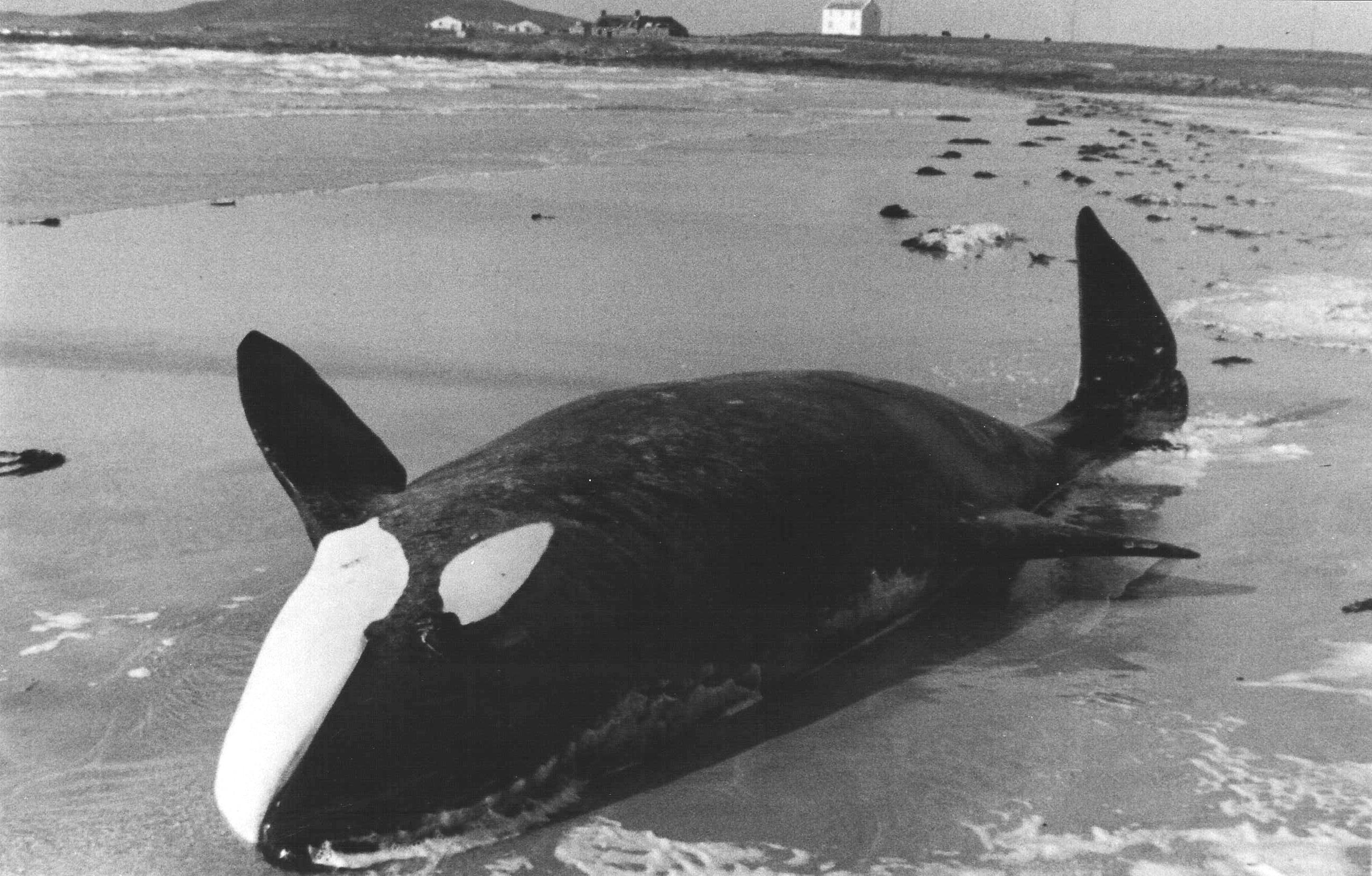
Black and white photograph of a dead killer whale on Crossapol beach.
Dead killer whale on Crossapol beach in 1989.