Record Type: review

2003.166.3

Black & white photograph of Archie MacArthur, Barrapol (1923-1993) in around 1970.  Archie ‘BEA’ was Tiree Airport Superintendent during 1961-1988.

a108.jpg

Courtesy of Mrs Ishbel MacArthur

A former policeman with the Stirling and Clackmananshire Police Force, Archie MacArthur of Barrapol started work at Tiree airport in 1960 on the retirement of Colin MacPhail. Universally known as Archie BEA, he was a larger than life figure.

He welcomed everybody when the plane arrived, a different greeting to each person, and would remember the names of visitors. One day when he was sporting a new BEA tie he was asked what the letters stood for. ‘It’s Big Èairdsidh’s Airways,’ he replied, referring to the Gaelic spelling of his name.

Archie retired in 1988, a well-known figure to all those who passed through Tiree’s airport. When he died in 1993, his funeral was one of the largest in living memory.
2003.163.2

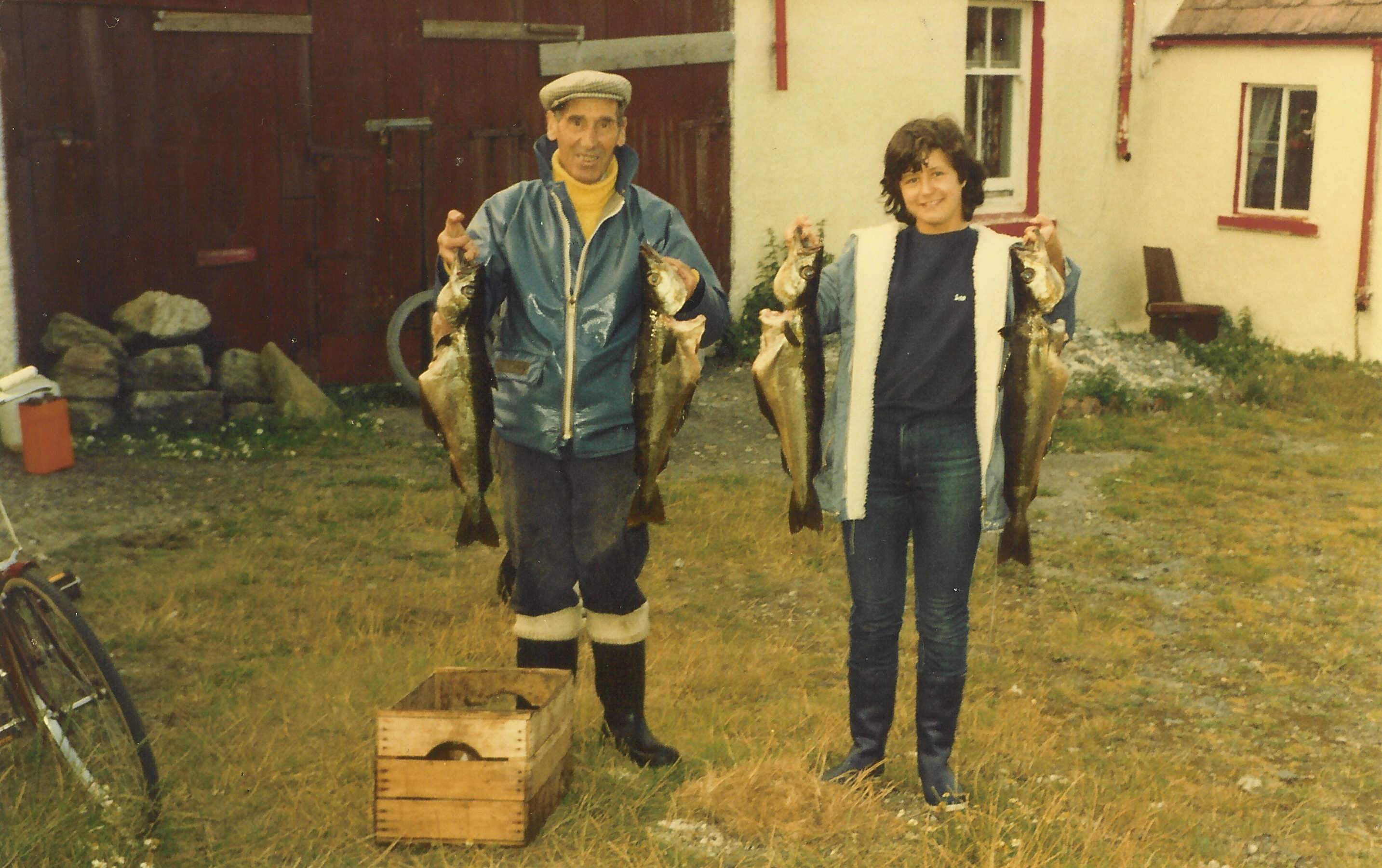
David MacClounnan and Alison MacKay with a catch of lythe

Photograph of David MacClounnan and Alison MacKay in Balephuil with a catch of lythe in 1983.

b161.jpg

Courtesy of Mrs Nan MacClounnan

David MacClounnan and Alison MacKay are pictured here with a catch of lythe (pollack) in Bail’ Ur, Balephuil in August 1983. As lythe feed on sand eels, Tiree fishermen would bait their hooks with rubber eels bought from the local shop or sometimes made from the covering of electrical wires.

Lythe were fished from rocks or from a boat, often very successfully. Fish were preserved for the winter by steeping them in brine then packing them in barrels or pails with coarse salt. Larger fish like cod, lythe and ling were split in two.

Once salted, the fish were hung by the tails on a line outside or in the byre to dry. Others were hung in the chimney and were smoked as well.

Colour photograph of David MacClounnan and Alison MacKay in 1983.

David MacClounnan and Alison MacKay in Bail` Ur with a catch of lythe (pollack) in August 1983.

2003.163.6

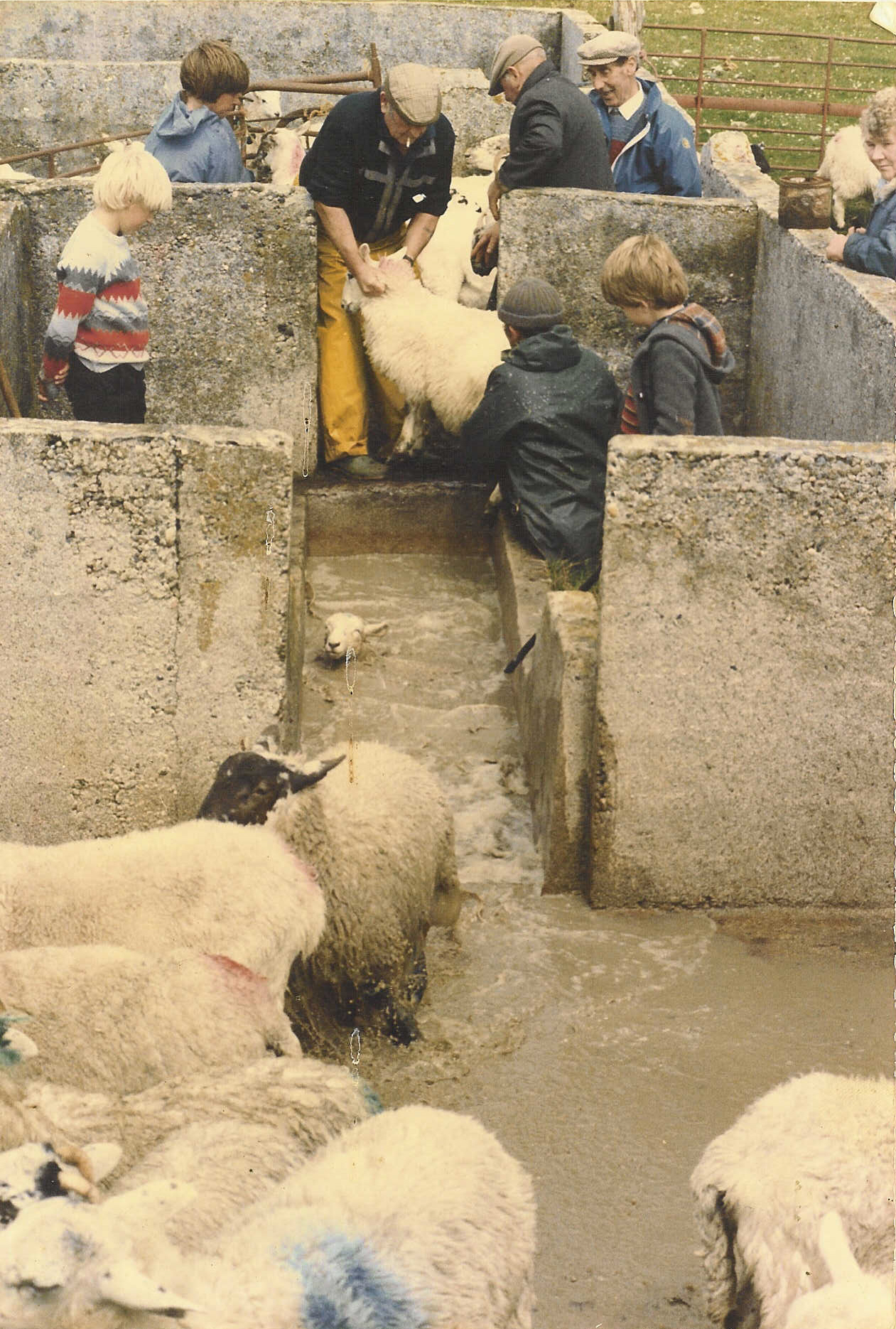
Dipping sheep at Balephuil in 1987

Photograph of sheep-dipping at Balephuil in 1987.

b165.jpg

Courtesy of Mrs Nan MacClounnan

This photograph shows sheep being put through a dip-bath at Balephuil in 1987. Twice-yearly dipping was compulsory up to 1989 in an effort to eradicate scab, a disease caused by a parasitic mite that can result in severe loss of condition and death, especially of lambs. Dipping also treated other parasites such as blowfly maggots and ticks.

The majority of dips contain organophosphates (OP) which were originally developed as chemical warfare agents. The effects of exposure can include headache, exhaustion, blurred vision, muscle twitching and confusion. People subsequently handling sheep can also be at risk.

As well as being hazardous to health, sheep dips are harmful to wildlife and the environment, and their disposal is problematical. Nowadays most crofters on Tiree use non-OP pour-on treatments to control parasites on their sheep.

Colour photograph of sheep-dipping in Balephuil in 1987.

Sheep-dipping in Balephuil in August 1987. L-R: (front) Etty MacDonald, unknown, unknown, (back) unknown, John MacPhail, John Brown, David MacClounnan.

2003.164.5

The staff at Taigh a’ Rudha in the 1980s

Photograph of the staff at Taigh a’ Rudha in the mid-1980s.

b170.jpg

Courtesy of Ms Babs MacIntyre

Taigh a’ Rudha, the Eventide Home in Scarinish, was opened in November 1968. It consists of the former manse for the United Free Church at Kirkapol and purpose-built accommodation for twelve residents.

This photograph shows the staff of Taigh a’ Ruadh in the kitchen in the mid-1980s. They are, from left to right, Cathy MacNeill, Elspeth Gilles, cook Rosie MacIntyre, Rena Goldie, Ishbel MacArthur, Officer in Charge Barbara MacDonald, Vickie MacLean and Flora MacArthur.

Today the kitchen provides Meals on Wheels to elderly people in the community and also lunches three days a week for the Day Centre in Crossapol.

Colour photograph of the staff at Taigh a Ruadh in the mid-1980s.

The staff at Taigh a` Ruadh in the mid-1980s. L-R: Cathy MacNeill, Scarinish; Elspeth Gilles, Scarinish; Rosie MacIntyre, Scarinish; Rena Goldie, Balinoe; Ishbel MacArthur, Barrapol; Barbara MacDonald, in charge of Taigh a` Ruadh; Vicky MacLean, Kenovay; Flora MacArthur, Moss.

2003.161.2

‘Aig a’ Mhuc Mhara’

Photograph of a stranded whale.

b123.jpg

Courtesy of Mr Ronnie MacLean

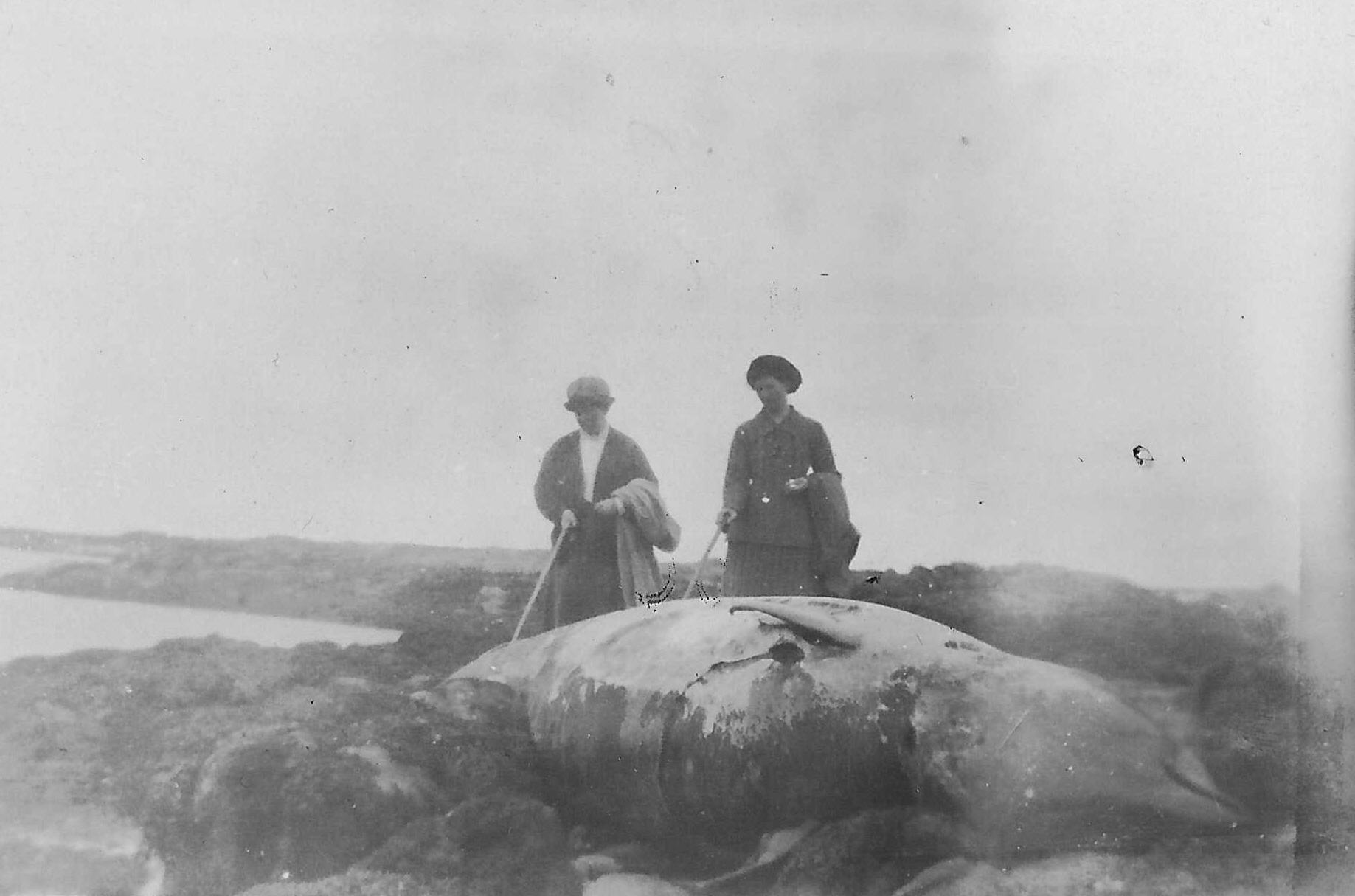
Before the development of paraffin lamps, lighting in Tiree’s houses was provided by small oil lamps known in Gaelic as ‘crùisgean’. Oil from various fish was used but whales stranded on the shore were another important source.

The Statistical Account of 1845 recorded that ‘…shoals of small whales sometimes frequent our bays; and the people have become very expert at driving them ashore with boats… They are commonly from 15 to 20 feet long, and their blubber yields about a barrel of oil, each.’ From this description, they are most likely to have been Long-finned Pilot Whales.

This photograph titled ‘Aig a’ Mhuc Mhara’ (At the whale), of what is probably a Northern Bottle-nosed Whale, came from a small album from Silversands in Vaul and dates from the 1920s or early 1930s.

Black and white photograph of two unknown women and a dead whale from a small album from Silversands.

`Aig a` Mhuc Mhara` (at the whale) from a small album from Silversands, Vaul, titled `Idle Days` probably dating from the 1920s or early 1930s.

2003.161.1

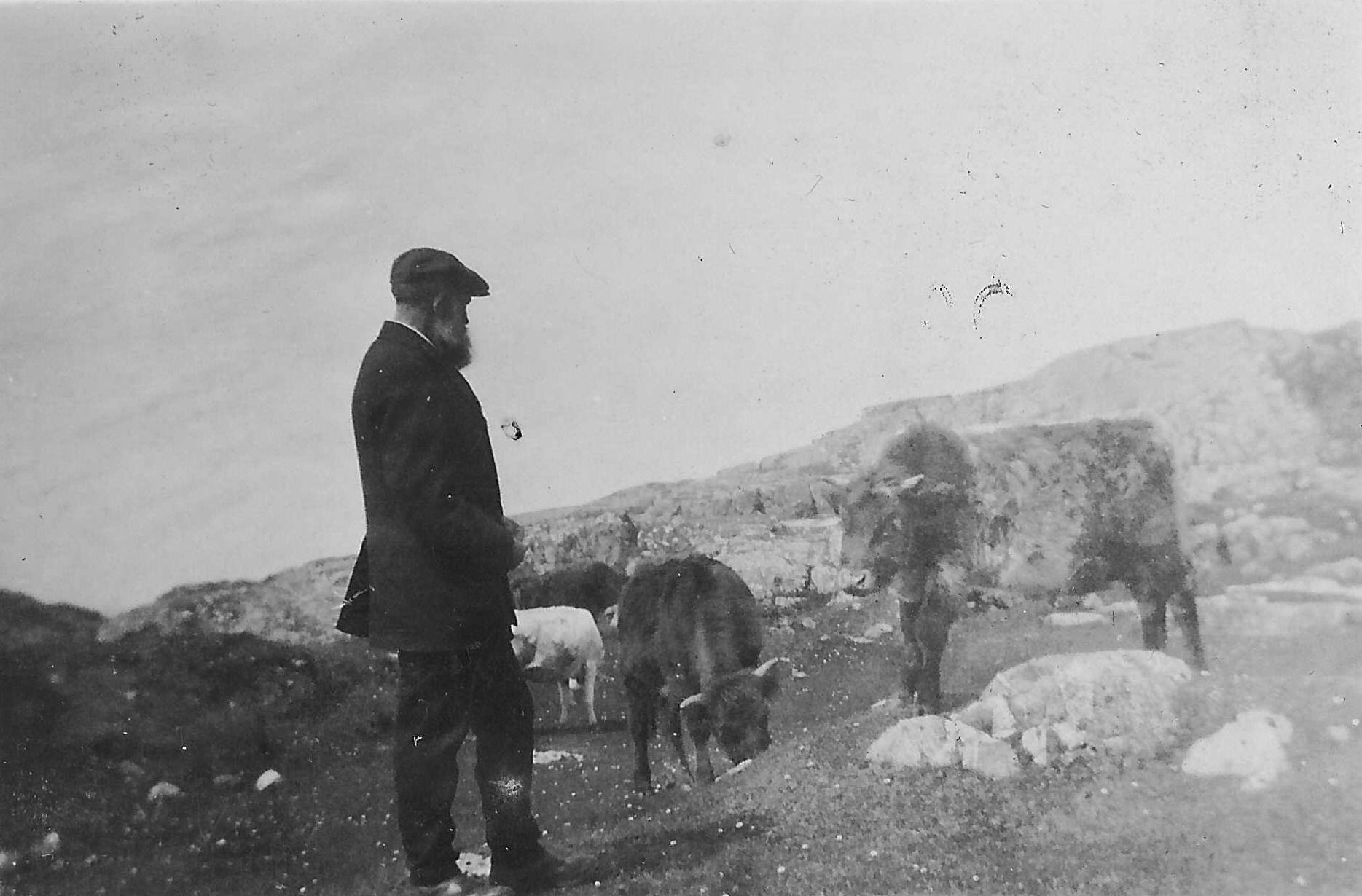
Black and white photograph of an unknown man with cows from a small album from Silversands.

`Am Buachaille` (the cow-herd or shepherd) from a small album from Silversands, Vaul, titled `Idle Days` probably dating from the 1920s or early 1930s.

b122.jpg

2003.161.10

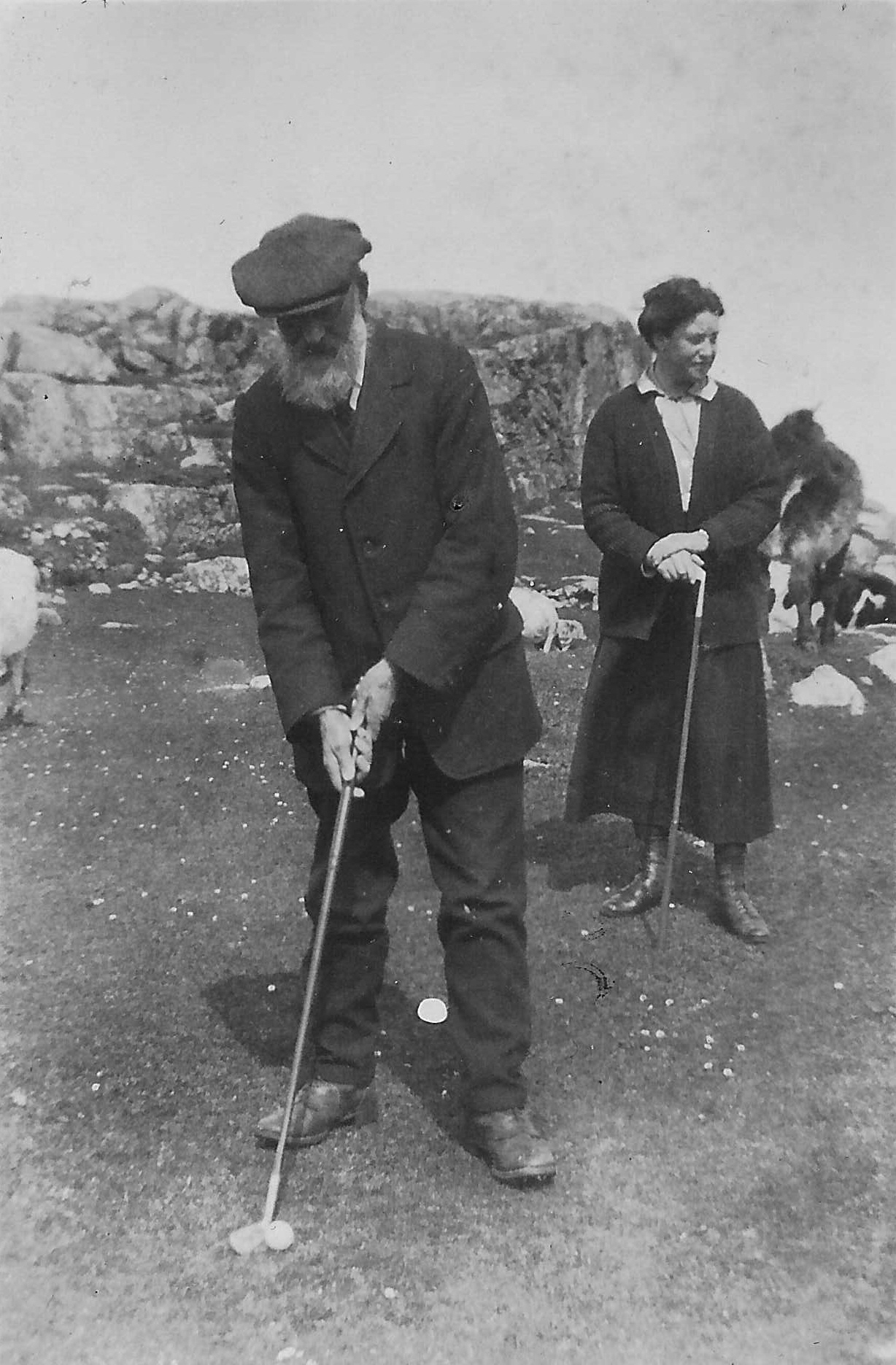
Playing golf at Vaul

Photograph of unknown couple playing golf at Vaul in the 1920s or early 1930s.

b137.jpg

Courtesy of Mr Ronnie MacLean

This photograph of an unknown couple playing golf was found in a small hand-made album titled ‘Idle Days’ from Silversands in Vaul. It probably dates from the 1920s or early 1930s.

A golf course existed in Vaul as long ago as the 1890s. In 1911 an eighteen-hole course, 6,306 yards long, was laid out with the help of a professional golfer, James Hobbins, who married a Tiree woman. In September a club house was gifted by Mr Charles MacNeil of the Colonial Iron Works in Govan.

Before World War II, Tiree was a very popular golfing resort. There were eighteen-hole courses at Vaul, Scarinish and Heanish and a nine-hole course at Cornaig. All were closed during the war and only the Vaul course was brought back into use in 1962 with nine holes.

Black and white photograph of an unknown couple playing golf from a small album from Silversands.

Hugh MacIntyre, Vaul (d. 1932) and possibly his wife Mary of Balinoe (d.1928) playing golf in the 1920s. The photo was titled `Aig iomain` (playing) in a small album from Silversands, Vaul, titled `Idle Days` probably dating from the 1920s to early 1930s.

2003.160.1

Boats at Balemartine in 1946

Photograph of boats at Port an Tobair in Balemartine in 1946.

a193.jpg

Courtesy of Mr Lachie MacArthur

Lug sail boats at Port an Tobair, Balemartine in 1946. Boats pictured left to right: ‘An Gadoch’, ‘Taeping’, ‘Ariel’, ‘Heatherbell’, ‘Girl Pat’, ‘Try Again’.

Black and white photograph of Port an Tobair, Balemartine in 1946.

Port an Tobair, Balemartine in 1946. Boats (L-R): `An Gaodach` (Lachie Dhomhnaill`s), `Taeping`, `Ariel`, `Heatherbell`, `Girl Pat` (Lachie MacArthur`s father`s), `The Try Again`.