Record Type: review

2000.84.1

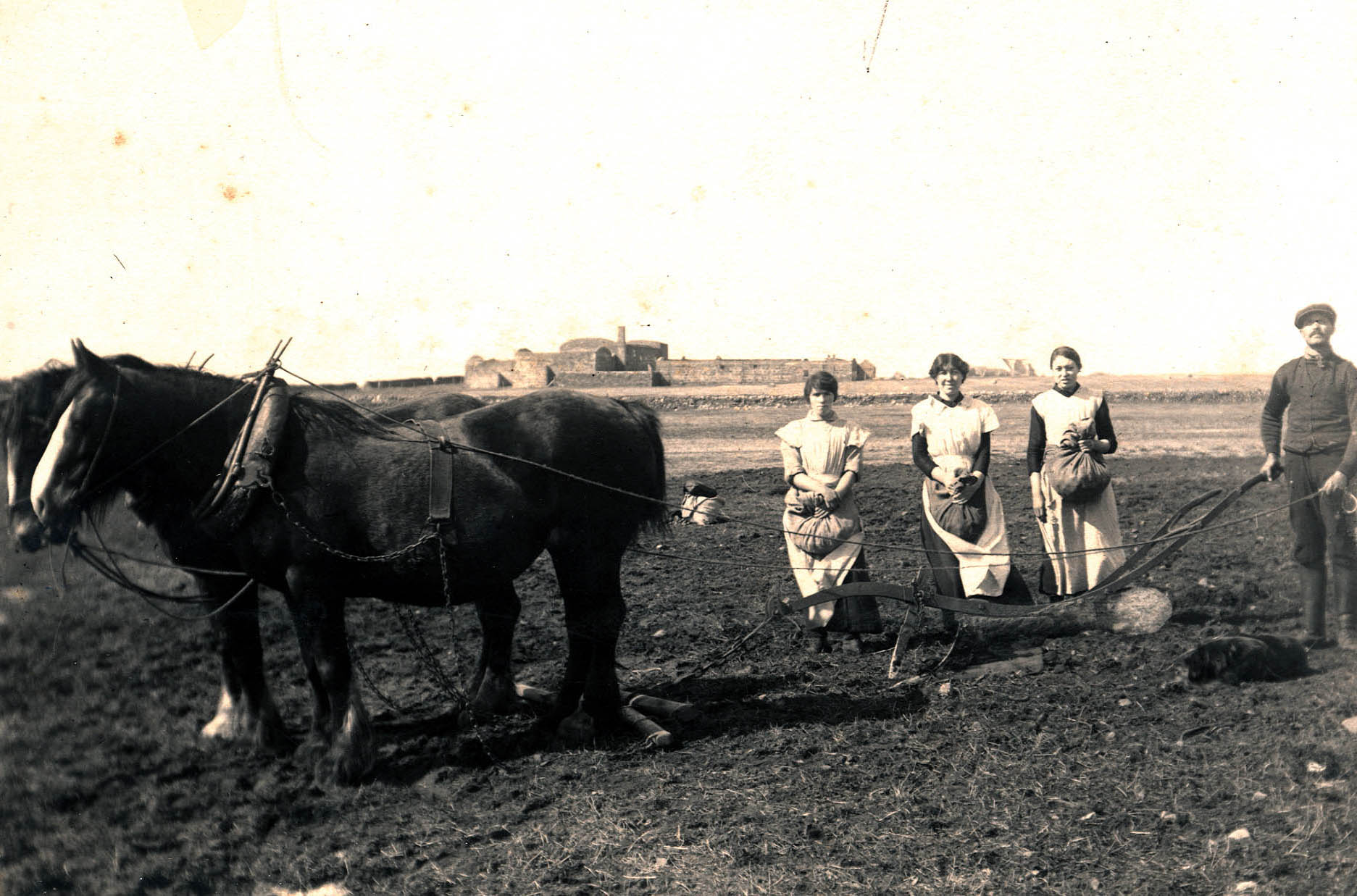
Planting potatoes at Middleton in the 1920s

Photograph of Alasdair MacDonald planting potatoes with Lizzie MacArthur, Effie and Mary Ann MacDonald at Middleton in the 1920s.
k48.jpg

Courtesy of Mr Lachie MacDonald

Taken in the 1920s, the photograph illustrates a standard plough used to prepare the ground for sowing corn. Because of the fine sandy soil in most of Tiree, a ridger was not successful.

The women followed in the furrow planting potatoes from the supplies heaped in their sack aprons and the ploughman made a second furrow to cover them. This process was repeated leaving a 45 cm space between the planted furrows for the grubber.

The Middleton seaweed factory operated by the North British Chemical Company can be seen in the background. Known locally as the Glassary, it ceased operation in 1901 and was demolished during World War II.

Black and white photograph of Alasdair MacDonald planting potatoes at Middleton in the 1920s.

Planting potatoes at Middleton, with the Glessary (as it was known) in the backgound in the 1920s. L-R: Lizzie MacArthur, Middleton and Greenhill – aunt of John MacArthur, Middleton Farm; Effie MacDonald, married to the late Archie Walker, Coll and Kenovaay, Tiree – aunt of Lachie MacDonald , Middleton; Mary Ann MacDonald – aunt of Lachie MacDonald, Middleton; Alasdair MacDonald – father of Lachie MacDonald, Middleton. The photograph illustrates a standard plough used to prepare the ground for sowing corn. Because of the fine sandy soils in most of Tiree, a ridger was not successful. Instead, the standard plough was used and the women followed in the furrow with supplies of potatoes heaped in their sack aprons. The ploughman made a second furrow to cover the potatoes. The same process was repeated thus leaving an 18 inch (45cm) space between planted furrows to allow the grubber to be used.

2000.130.2

The souterrain in Kilkenneth in 1918

Photograph of John MacIntyre and his son Colin at the opened souterrain in Kilkenneth in 1918.

k89.jpg

Courtesy of Mr Colin MacKinnon

John MacIntyre (Iain Chailein Mhurchaidh) and his son, Colin, are pictured here at the souterrain in Kilkenneth opened by chance when ploughing in 1918. It was later covered over.

Less than a mile away, a Y-shaped passage was exposed in the 1890s in the sand dunes at Tràigh Ghrianail. Measuring 9.2 metres long, 1 metre wide and 1.5 metres high, it was known locally as An Taigh Falaichte (the hidden house) and used for shelter by those working on the shore. It has since disappeared.

Similar underground structures were built on the mainland around 200 AD. They may have been used as byres or stores, or as places to hide from raiders.

Black and white photograph of John MacIntyre at the souterrain in Kilkenneth around 1920.

John MacIntyre at the rear of the horse and his son Colin at the opened souterrain in Kilkenneth around 1920.

2003.180.1

S.S. ‘Cygnet’

Postcard of the S.S. ‘Cygnet’ approaching Gott Bay pier.

w20.jpg

Courtesy of Mrs Ishobel MacDonald

Built as a cargo steamer, the S.S. ‘Cygnet’ was launched from Inglis’ Yard on the Clyde in 1904. She received a boiler and the starboard engine salvaged from the MacBrayne steamship ‘Flowerdale’ which was lost off Lismore earlier that year.

Initially on the Glasgow-Inverary route, the ‘Cygnet’ was modified after World War I to accommodate passengers and transferred to the Oban-Coll-Tiree-Castlebay-Lochboisdale route. She was sold in 1930 and broken up the following year.

Alasdair Sinclair of Brock remembers the ‘Cygnet’ as a dreadful wee boat: ‘There was nowhere at all to sit…You just stood on deck ankle-deep in water and watched your luggage floating about.’

Black and white postcard of the ferry approaching Tiree pier.

The ferry `Cygnet` approaching Tiree in the 1920s. The SS `Cygnet` was launched in 1904, relieved the Outer Isles ferries until the end of WWI, then was based in Oban and conducted the Islands mail services until 1930 when she was sold. (Original postcard in Filing Cabinet 8 drawer 2)

2003.181.4

Construction of the roll-on roll-off ferry terminus at Gott Bay pier

Photograph of the construction of the roll-on roll-off ferry terminus at Gott Bay pier in 1992.

w24.jpg

Courtesy of Ms Rona Campbell

The roll-on roll-off ferry terminus at Gott Bay pier was constructed in 1992 at a cost of £2.5 million. A new pier, incorporating the linkspan, was built to the east of the old pier-head, extending into deeper water where, some argued, the original pier-head should have been situated.

The linkspan, a mechanically operated steel ramp, can be raised or lowered to suit the tides, enabling vehicles to be driven straight on to the car deck of the ferry from the pier. Prior to this, vehicles were side-loaded in batches and lowered to the car deck by lift.

In the same year, a linkspan was constructed at Coll pier. The ferry turnaround times at both piers were cut to around a third, substantially reducing the sailing time from Oban to Tiree.

Colour photograph of the construction of the roll-on roll-off ferry terminus at Gott Bay pier in 1992.

The construction of the roll-on roll-off ferry terminus at Gott Bay pier in 1992.

1998.184.4

The seaweed factory at Middleton

Photograph of the remains of the seaweed factory at Middleton.

p29.jpg

Courtesy of Mr Donald MacKinnon

The kelp forests around Tiree are the fourth largest in Scottish waters. This abundance fuelled the seaweed industry on the island which, for a hundred years, produced alkali for soap and glass manufacture, and for bleaching linen.

Undercut by cheap foreign imports, the industry slumped from the 1830s until the 1860s when the North British Chemical Company appointed as manager a brilliant young chemist, Edward Curtis-Stanford. He arrived in Tiree in 1864 to supervise the building of the factory at Middleton, known locally as the Glassary.

Until 1901 the factory extracted iodine and alginates from the tangles, selling the residual charcoal as fertilizer and deodorants for earth closets, and using the gas produced by the process to light the buildings. Most of the factory was demolished in 1941 to provide the foundations of the runways built at the Reef for the RAF station.

Black and white photograph of the old seaweed factory at Middleton.

The old seaweed factory at Middleton in the early 20th century.

1998.184.3

Dr Dan MacKinnon of Ruaig

Photograph of Dr Dan MacKinnon of Ruaig in Balemartine during World War I.

p28.jpg

Courtesy of Mr Donald MacKinnon

Dr Dan MacKinnon (Dòmhnaill Eòghainn na Sraide) is pictured on his motorbike in Balemartine during World War I. Born at Tor a’ Bhaile in Ruaig in 1890, he was educated locally and in 1913 qualified as a doctor in Glasgow.

After working briefly at the Grampian Sanatorium in Kingussie, he returned to Tiree in 1914 as the island’s doctor. He once had a spill from his motorbike in Heanish. Although unhurt and able to continue on his rounds, the racing engine and spinning wheels caused some consternation to those who came to his aid.

He enlisted in the Royal Army Medical Corps in 1917 and went off to the war, returning to Tiree in June 1919 but resigning the following year to take up the post of Parochial Medical Officer in Aberfoyle. He died unmarried in 1938 and is buried in Kirkapol cemetery.

Black and white photograph of Dr Dan MacKinnon of Ruaig in the 1910s.

Dr Dan MacKinnon of Ruaig on his motorbike in Balemartine in the 1910s. Houses (L-R): Lachlan MacNeill (former Post Office); Flora Lamont, John Paterson (thatched houses); MacArthurs’ houses. Dr Dan was born at Tor a’ Bhaile in Ruaig in 1890, came back to Tiree in 1914 as its doctor and enlisted in the Royal Army Medical Corps in 1917.

2003.175.1

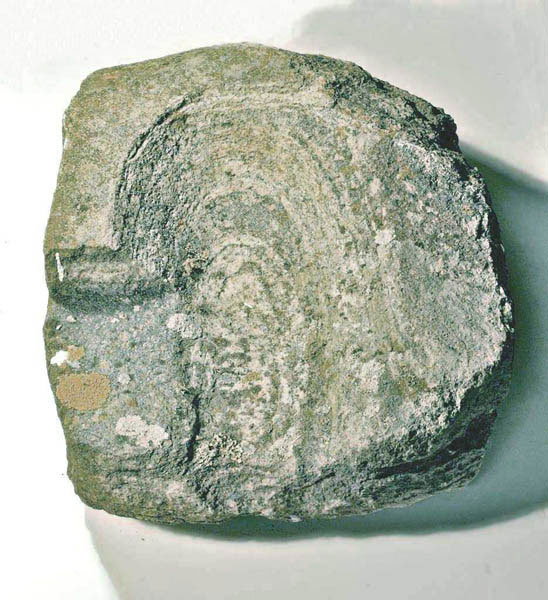
Saddle quern found in Moss.

Saddle quern

Courtesy of Catriona McLeod

Saddle querns are the most ancient and widely used type of quern-stone. This one was found in Moss in the mid-1980s and may date back to Neolithic times. It was used with a rubbing stone held in the hand, a process that crushed the grain rather than ground it.

Considered women’s work, preparing grain using a saddle quern would have taken many hours and placed great strain on the body, particularly the toes, knees, hips and lower back. They continued in use into the medieval period and were superseded by rotary querns.

Turnbull, in a report on Tiree written in 1768, wrote that meal was made ‘with querns or hand mills which appears to be an expensive and troublesome method. Two women at once, or sometimes three, are commonly employed. By this means there is so much of their time taken up that it greatly retards them from other industry.’

Tiree in 100 Objects – 2 – Saddle Quern

The History of Tiree in 100 Objects

1998.176.11

Archie MacEachern and his sister Fileag in Harris

Photograph of blacksmith Archie MacEachern and his sister Fileag at Leverburgh Sunday School in Harris in the 1920s.

r17.jpg

Courtesy of Mrs Mairi Brady

In this photograph taken at Leverburgh Sunday School in Harris in the 1920s, Archie MacEachern is in the centre and his sister Fileag is second on the left. Their father was Archibald MacEachern, the blacksmith at Creag Mhòr in Cornaigbeg.

Archie worked for around eleven years on Harris as a blacksmith and missionary. Part of his work involved making spearheads for the harpoons used in the whaling industry. He returned to Tiree in the 1930s to work in the smiddy at Creag Mhòr.

He married Catherine MacLean from The Brae, Cornaigbeg and the couple had three children, Archibald, Hugh and Mary. Archie continued his missionary work, preaching in the United Free Church in Kirkapol in the 1930s.

Black and white photograph of Archie and Fileag MacEachern in Harris in the 1920s.

Leverburgh Sunday School, Harris, in the 1920s. Archie MacEachern is in the centre and his sister Fileag is second left. Archie was the blacksmith at Creag Mhor in Cornaigbeg and also a lay preacher and missionary. He preached in the United Free Church in Kirkapol in the 1930s.