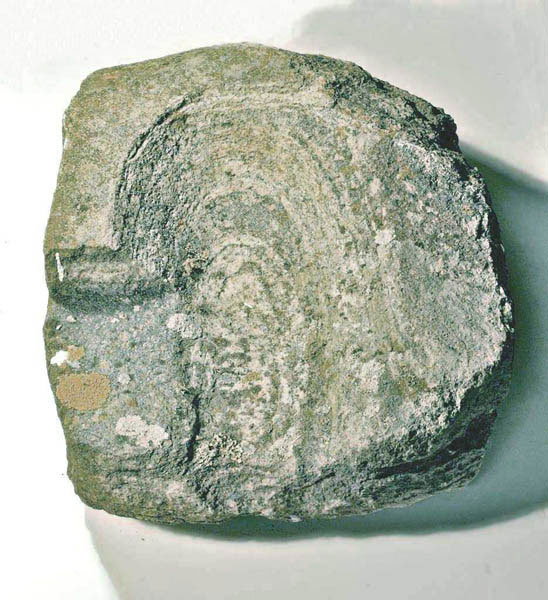
Saddle querns are the most ancient and widely used type of quern-stone. This one was found in Moss in the mid-1980s and may date back to Neolithic times. It was used with a rubbing stone held in the hand, a process that crushed the grain rather than ground it.
Considered women’s work, preparing grain using a saddle quern would have taken many hours and placed great strain on the body, particularly the toes, knees, hips and lower back. They continued in use into the medieval period and were superseded by rotary querns.
Turnbull, in a report on Tiree written in 1768, wrote that meal was made ‘with querns or hand mills which appears to be an expensive and troublesome method. Two women at once, or sometimes three, are commonly employed. By this means there is so much of their time taken up that it greatly retards them from other industry.’
The Campbell-Stokes Heliograph sunshine recorder from Tiree Met Station.
Courtesy of Mr Ray Sharp
The Campbell-Stokes sunshine recorder was invented in 1853 by John Francis Campbell, the editor of ‘Popular Tales of the West Highlands’, and modified by Sir George Gabriel Stokes in 1879. It consists of a glass sphere, about ten centimetres in diameter, mounted on a metal stand.
Manufactured to Met Office specification, the glass sphere focuses the rays of the sun to an intense spot which chars a mark on a curved graduated card mounted concentrically with the sphere. As the earth rotates, the position of the spot moves across the card. The card is held in place by grooves, of which there are three overlapping sets, to allow for the height of the sun during different seasons of the year.
Its main advantage is its simplicity and ease of use. However, the results require interpretation by an observer and may differ from one person to another.
Photocopied extracts from the County of Argyll Fifteenth Annual Report by the Medical Officer of Health Dr Roger MacNeill, pp 38-41.
The building of the Isolation Hospital at Heanish and four cases of diptheria; tables of the numbers of cases of infectious diseases between 1892 and 1905.
Glass, black paint and coloured silver paper picture of a Dutch boy made an Italian POW on Tiree during WWII. The silver paper is probably from cigarette packets.
Bell gun with firing mallet used as a humane killer for slaughtering cattle and sheep. Originally used by Tiree butcher, Donald Archie MacLean, to slaughter cattle and sheep, this humane killer was given to the vetinary on the island, Robert Beck, in the 1960s. Made of cast iron, the maker’s name, W. W. Greener of Birmingham, is embossed around the rim of bell. Once loaded with a single bullet, the bell was positioned on the front of the animal’s head and the gun fired by hitting the trigger (the protruding knob) with the wooden mallet. Although very efficient and humane, it required two hands to operate and another person to steady the animal’s head. Not considered safe enough for use indoors, humane killers with captive bolts are now used instead.