


Board mounted photograph of a hay cart displayed in An Iodhlann`s 1997 exhibition.
Horse-drawn haycart – people unknown.

Board mounted photograph of a hay cart displayed in An Iodhlann`s 1997 exhibition.
Horse-drawn haycart – people unknown.
Audio cassette recording of Archie John MacLean, Heylipol talking to Maggie Campbell in 2000.
Archie John MacLean of Heylipol talks to Maggie Campbell in 2000 about the changes in crofting especially the decline in cultivation, the work done at different times of the year, fertilisers and machinery, problems with geese, cattle breeding, BSE, the need for conservation, sheep breeding, the six farms on Tiree, dipping sheep and the associated problems, transporting animals, subsidies and quotas.
Colour photograph of a stuc of oats in September 2001.
Stùc of oats grown by Hugh Archie MacCallum at Whitehouse, Cornaigbeg in September 2001.

Audio cassette recording of Janet Brown of Balephuil talking to Maggie Campbell in November 1999.
Janet Brown of Balephuil talks to Maggie Campbell in November 1999 about making butter and cheese, how there was always plenty of food even if the ferry couldn’t make Tiree, different kinds of scones, how all the work had to be finished by Saturday night in order to observe the Sabbath, washing using galvanised baths and Sunlight soap, washing blankets in the burn, harvesting, how herring were plentiful, how everyone helped preparing for a wedding, ceilidhs and dancing and different kinds of stockings.
Audio cassette recording of a ceilidh with Maggie Campbell, Neil MacLeod and Murdoch MacDonald in 1998.
Maggie Campbell and Neil MacLeod of Kilmoluaig sing several songs composed by Tiree bards and a love song; Murdoch MacDonald of Kilmoluaig talks about shepherding, harvesting, the spring work on a croft, bulk buying of groceries, sharing barrels of herrings, travelling people, first-footing, home-coming events during the Glasgow fair, barn weddings and blanket washing days.Tha Magaidh Chaimbeul agus Niall MhicLeòid a Cill Moluag a’ seinn iomadach òran air an cur ri chèile aig bàird Thirisdeach agus òran gaoil; Murchadh MhicDhòmhnaill a Cill Moluaig a’ bruidhinn mun obair cìobair, obair foghair, obair an Earraich air a’ chroit, ceannach biadh ann am meudachd, a’ roinn barraille sgadain, na ceàrdan, a’ dol a mach air oidhche na Callaine, cùisean aig àm tighinn dhachaigh re Faidhir Glaschu, bainnsean sàbhail agus làithean nigheadh na plaideachan.
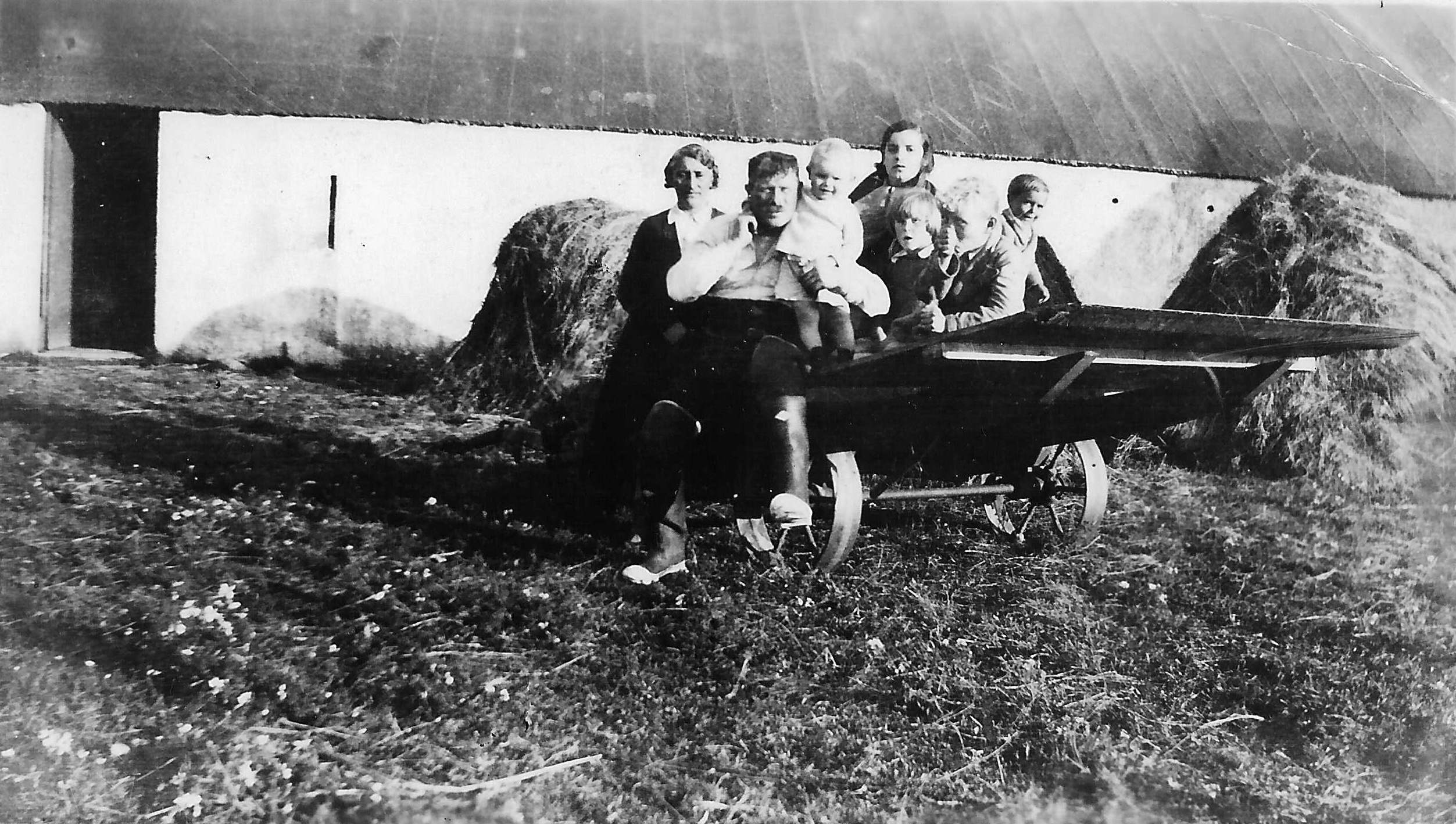
Photograph of George Paterson and his family in the stackyard of his farm at 6 Crossapol in 1937. L-R: (back) Sarah MacPhee née Paterson (George’s sister); George Paterson; his wife Margaret (Meta) with baby Angus; (front) Hamish MacPhee, Sarah’s son; George and Meta’s children, Iain and Mairi.
 Courtesy of Mrs Mairi Campbell
George’s father, Donald Paterson of Balinoe, emmigrated to Pategonia in the 1880s. Patagonia, in the south of Argentina and Chile, was cleared of its indigenous people in the 1880s to make way for large sheep farms. Many men from the Hebrides went out to share in the bonanza.
In 1885 Donald wrote to his brother asking him to send out his birth certificate and baptismal record so he could take possession of twelve square miles of land. He found the native Indians very kind and friendly and recommended shepherding in Patagonia where the pay was good.
Donald married in Patagonia and had a family. He brought his two sons George and John home to Tiree. George was seven years old at the time and could speak Gaelic and Spanish but not a word of English.
The Paterson family of Crossapol in 1937
Photograph of the Paterson family of Crossapol in 1937.
Courtesy of Mrs Mairi Campbell
The Paterson family are pictured in 1937 sitting on a rick-lifter outside their steadings at Crossapol. The cart was used to move stùcanan (small stacks of corn) from the fields to an iodhlann, the stackyard behind the house, where about six to eight of them were carefully built into a mulan (corn stack).
Initially the cut corn was bound into sguaban (sheaves), eight to ten of which were lined up into an adag. Once the seed had hardened, after about ten days if the weather was good, the adagan would be put into a stùc which can stand up to the winds that are common at that time of year.
Stùcanan could be left out if the weather deteriorated. If there was a dry spell, however, the adagan could be taken straight to the stackyard, as every time the corn was handled some grain was lost.
Black and white photograph of the Paterson family of Crossapol in 1937.
The steadings at 6 Crossapol in 1937. The cart was used to move ricks from the fields to the stackyard. L-R: Sarah MacPhee née Paterson (George’s sister); George Paterson with his son Angus; Betty MacLean née MacPhee, Sarah’s daughter (at back); George and Meta’s children, Mairi and Iain; Hamish MacPhee, Sarah’s son.
Colour photograph of Grace Baxter and John Neil Brown in the mid-60s.
Grace Baxter and her nephew John Neil Brown haymaking at Cornaigbeg in the mid-60s.

Partially made harvest knots with instructions.
Partially made harvest knots with instructions from Lachie MacLean, Druimfhraoich on how to make them, recorded by John and Sarah Holliday. (Instructions in Filing Cabinet 8 drawer 3)

Black and white photograph of hay-making in the 1930s.
Haymaking in the 1930s. L-R: Mairi Paterson (m.s. Campbell); visitor Iain MacDonald from Glasgow; Iain’s father, Mr MacDonald; Iain Paterson, Mairi’s brother; Harry Skelton; George Paterson of Crossapol, father of Mairi and Iain.
