


Collection of seven postcards of Tiree by Sue Anderson.
Seven postcards of Tiree by Sue Anderson: Balevullin thatched house; Brock; Port Ban; Balinoe beach; Kennavara; four traditional Tiree houses; Gott Bay pier.

Collection of seven postcards of Tiree by Sue Anderson.
Seven postcards of Tiree by Sue Anderson: Balevullin thatched house; Brock; Port Ban; Balinoe beach; Kennavara; four traditional Tiree houses; Gott Bay pier.
Audio cassette recording of Janet MacIntosh talking to Maggie Campbell in March 2000.
Janet MacIntosh of Caoles and Balinoe talks to Maggie Campbell in March 2000 about her schooldays in Balemartine, her pastimes, the delivery of a telegram from Balinoe Post Office, wartime and the pictures, the funeral of 16 RAF crew members who died in a plane crash, monthly ceilidhs, dances and Gaelic plays, travelling shops, funerals, transport, gathering and cooking seafood and seaweed, and the health benefits of sea water.
Audio cassette recording of Willie MacLean of Balinoe talking to Maggie Campbell in January 2000.
Willie MacLean (Uilleam Dhòmhnaill Eòghainn Mhòir) of Balinoe recorded by Maggie Campbell in January 2000 singing his own Gaelic songs and playing his own tunes on the small pipes.
Hardback book `Megalithic Lunar Observatories` by A. Thom.
Descriptions of 35 lunar and solar Megalithic sites in Britain from which accurate declinations can be obtained (see p67 for Tiree).
A’ Charragh Bhiorach at Balinoe
Photograph of the standing stone at Balinoe in 2000.

Numerous remains from the Bronze Age (2500 – 600 BC) have been found on Tiree and it is probable that the people who left them were the first to occupy the island in any numbers. These early farmers were using metal for the first time and making pottery with turned out rims known as ‘Beakers’.
New religious customs appeared. The dead were buried sitting upright in cists or cremated and the ashes put in funerary urns. Hollowed out cup markings were fashioned on significant rocks and standing stones and stone circles were erected.
The standing stone at Balinoe, 3.6 metres high with a base 1.9 metres by 1.1 metres, is known locally as A’ Charragh Bhiorach (the pointed stone). It must be remembered that this is not the original name as Gaelic came to be spoken here 3,000 years after it was erected.
Colour photograph of A` Charragh Bhiorach at Balinoe in 2000.
Standing stone at Balinoe known as A’ Charragh Bhiorach, the sharp pillar, or Spitheag an Fhoimheir, chip of the giant, photographed by Dr John Holliday in 2000.
Audio cassette recording of Annie MacPhee from New Zealand talking to Maggie Campbell in June 2000.
Annie MacPhee of New Zealand talks Maggie Campbell in June 2000 about her childhood in Balephuil and Hynish, her schooling and teachers at Balemartine, her father’s smiddies in Hynish and Balinoe, her family’s emigration to New Zealand in 1927, the help they received from Tirisdeach Donald MacLean in acquiring a sheep station, and the party arranged for her family’s visit to Tiree by Lachie and Sandra Brown.
Colour photograph of George Paterson at Balinoe in the 1910s.
George Paterson of Crossapol in front of a thatched house at Balinoe in the 1910s.

Black and white photogrpah of Willie Maclean in Home Guard uniform around 1942.
Willie Maclean of Balinoe in Home Guard uniform around 1942.

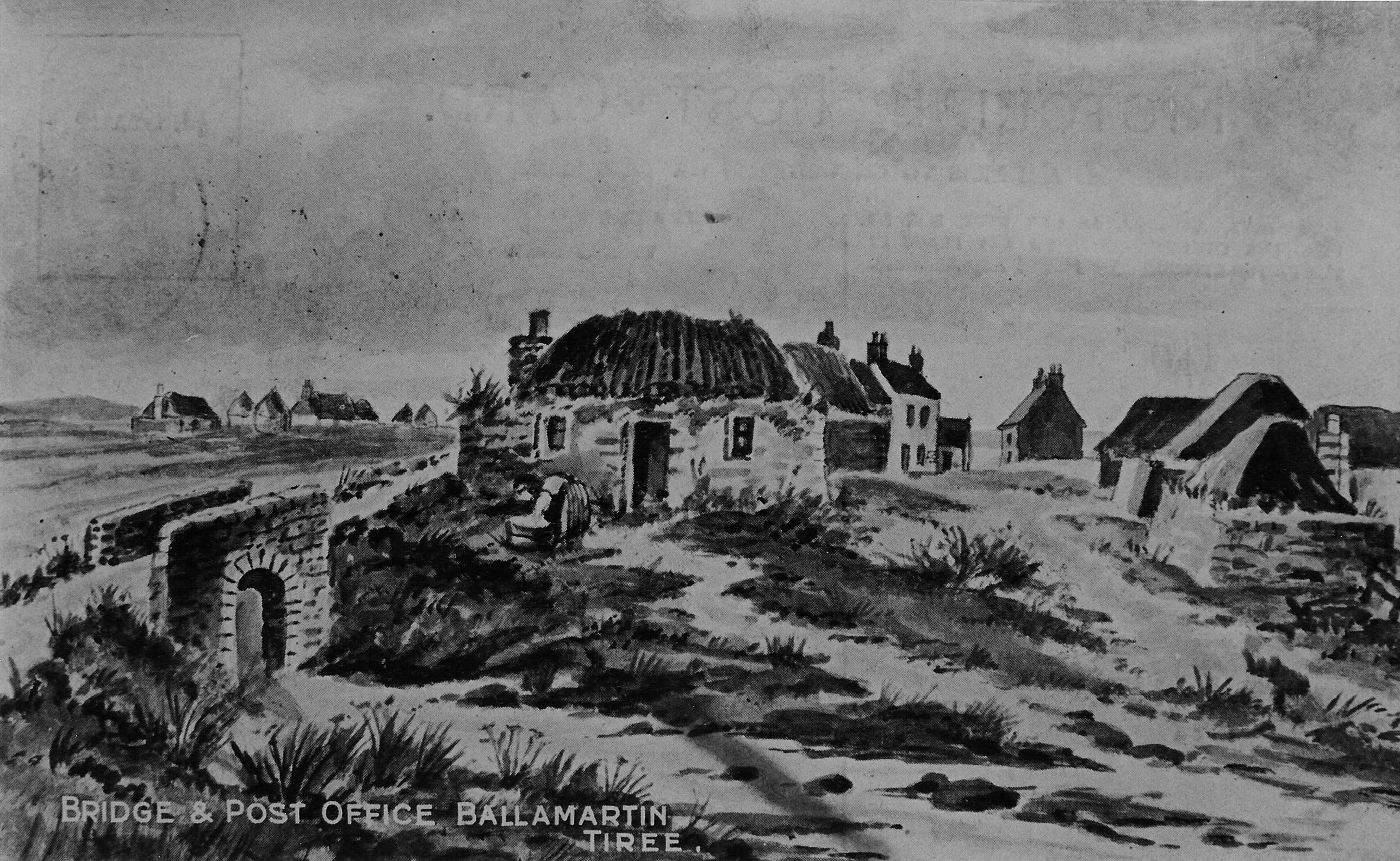
Black and white postcard of a painting of Balinoe.
Postcard painting of Balinoe showing the bridge and Post Office.
Black and white postcard of Soroby and Balinoe from Balemartine.
Cu` Dheis and Soroby from Balemartine. (Original postcard in Filing Cabinet 8 drawer 2)
