


Photocopied extract from `Outer Isles` by Ada Goodrich Freer, pp 1-61.
Account of a visit to Tiree in 1894.

Photocopied extract from `Outer Isles` by Ada Goodrich Freer, pp 1-61.
Account of a visit to Tiree in 1894.
Paperback booklet `Mull: Monuments and History` by Jean Whittaker.
An excursion guide to the monuments and history of Mull.
De-accessioned 26.2.2026.
Hardback book `Early Medieval Sculpture in the West Highlands and Islands` by Ian Fisher.
The results of two extensive surveys covering over 150 sites, most of the carved stones catalogued belonging to the period between the sixth and twelfth centuries. Illustrated.
Audio cassette recording of Angus MacLean, Scarinish, interviewed by Maggie Campbell in 2000.
Angus MacLean talks to Maggie Campbell about the crofts in Caoles going back to the 18th century, blacksmiths, boat-builders, stone masons and tailors, the mill in Caoles, standing stones and the stories and legends associated with them, the school and the many bards who came from there including Bard Thighearna Cholla.
Book `Scotland: An Archaeological Guide` by Euan W. MacKie.
Scotland`s history and archaeology from earliest times to the 12th century A.D. Geographical arrangement of major sites with Tiree`s Dun Mor Vaul broch pp. 159 – 160.
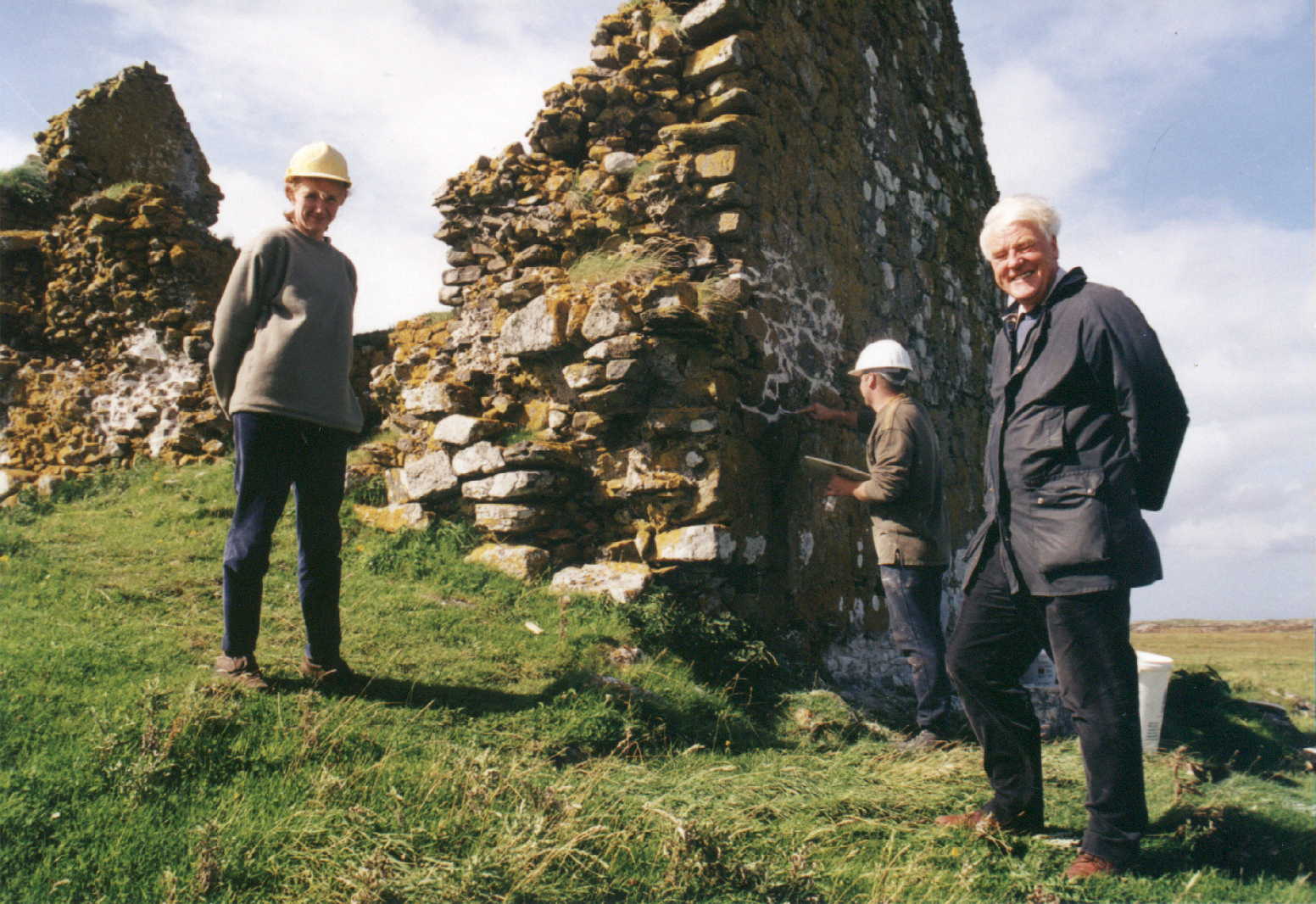
Colour photograph of Rev. Bob Higham at the Kirkapol chapel.
The smaller of the two Kirkapol chapels, possibly called St Brendan`s, in 2001, with contractor Sara Carruthers on the left and Rev. Bob Higham on the right.
Black and white photograph of the interior of one of the Kirkapol chapels.
Interior of the larger of the Kirkapol chapels, St Columba`s, showing excavated human bones to the right, taken in 2001.

Black and white photograph of excavated human remains in one of the Kirkapol chapels.
Excavated human bones in the larger of the Kirkapol chapels, St Columba`s, taken in 2001.

Black and white photograph from the interior of one of the Kirkapol chapels.
View of the old graveyard from the interior of the larger of the Kirkapol chapels, St Columba`s, taken in 2001.

The chapel at Kilkenneth
Photograph of the ruins of the chapel at Kilkenneth in 2001

Courtesy of Rev. Robert Higham
The ruins of a small chapel dedicated to St Cainnech lie in the sand-dunes at Kilkenneth. Like the other remaining medieval chapels on Tiree, it was built from lime-mortared local rubble. Oblong in plan, it measures 8.7 by 3.1 metres within walls three-quarters of a metre thick.
The entrance is situated in the west gable-wall, of which a large part has collapsed. The chapel was lit by two slit-windows opposite each other in the side walls near the east end of the building.
The Statistical Account of 1794 records that at the chapel was ‘a burying ground so sandy, that, by blowing, heaps of human bones are seen, and coffins often exposed, before half consumed. It is now surrounded by sand banks higher than the side walls; they no longer bury there.’
Colour photograph of the Kilkenneth chapel in 2001.
The chapel at Kilkenneth, photographed in 2001.