


Black and white photograph of Gott Bay pier under construction.
Gott Bay pier under construction in the 1910s.


Black and white photograph of Gott Bay pier under construction.
Gott Bay pier under construction in the 1910s.
Black and white photograph of Lady Victoria Campbell.
Lady Victoria Campbell in the door of the annexe to the Lodge, known in the family as `The Crystal Palace`, probably photographed in the 1890s or early 1900s.

Photocopied letter from estate factor Hugh MacDiarmid dated 13/7/1905 about a soup kitchen in Moss.
Letter from estate factor Hugh MacDiarmid dated 13/7/1905 to Donald MacDonald, teacher at Heylipol School, about a soup kitchen in Moss started by Lady Victoria Campbell for the benefit of scholars

Leaflet about St Columba and Tiree by the Rev. Robert Higham.
Acoount of Columban settlements on Tiree.

Typewritten township history of Barrapol by Neil Brownlie.
Township history of Barrapol and The Land giving position and descriptions of houses and ruins wnd who lived in them.

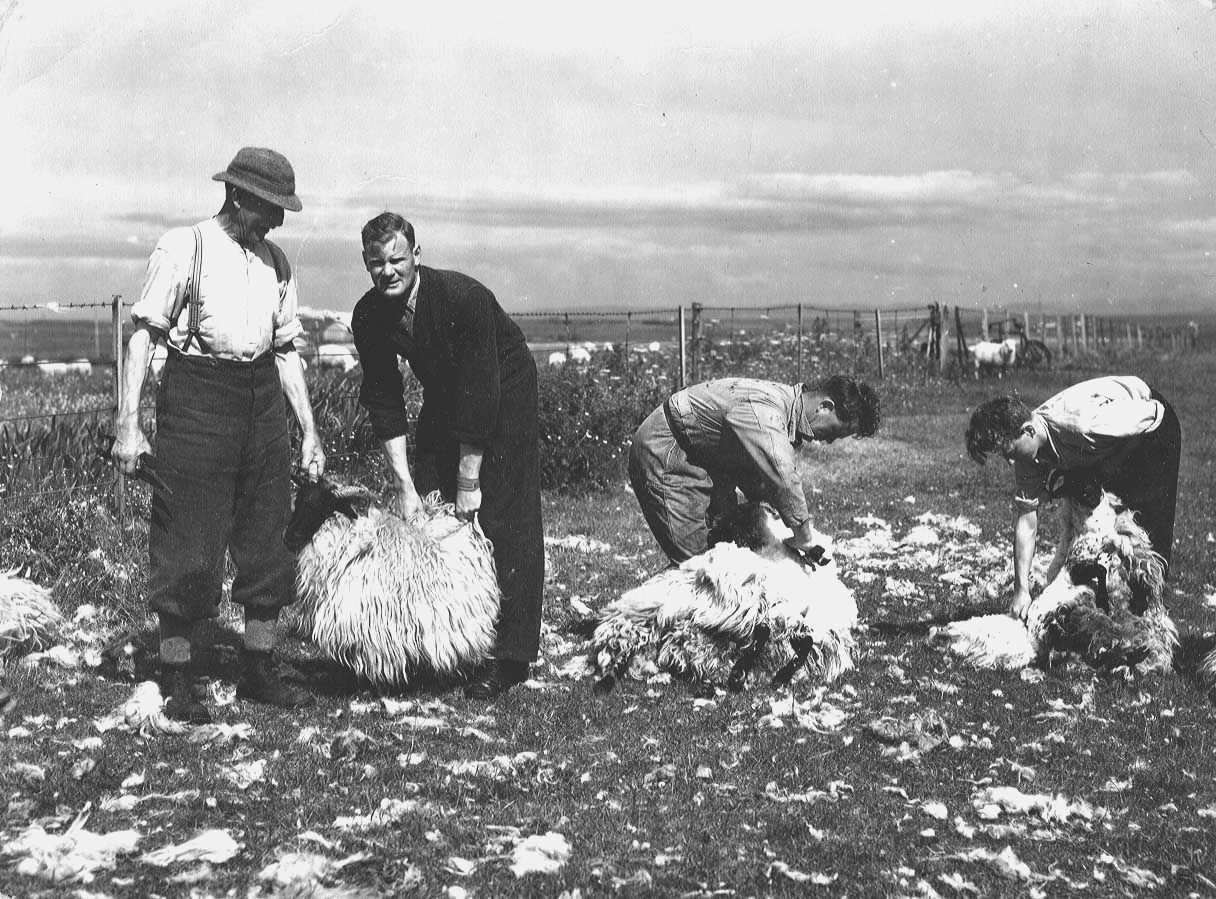
Shearing sheep at Heylipol Farm in the 1940s
Photograph of sheep-shearing at Heylipol Farm in the 1940s.
Courtesy of Mrs Cathie Omand
From left to right, farm manager John Hume, factor Iain MacLaren, Lachie MacFarlane of Hynish and Neil MacLean of Heylipol are clipping black-faced sheep at Heylipol Farm using hand shears in the 1940s. Hogs are sheared at the end of May or the beginning of June. Sheep with lambs are sheared in July when the weather is warmer.
Crofters would send their best Cheviot fleeces to the Scottish Wool Growers mill in Brora on the Moray Firth to be made into blankets or spun into hanks known as ‘snath Gaidhealach’ (Highland wool). Wool prices plummeted in the 1980s coinciding with increasing use of feather duvets.
In Tiree nowadays, Suffolk tups (rams) are commonly put to ‘mule’ ewes, a black-face/Blue Leicester cross. The Blue Leicester input maintains the quality of the fleece and produces a larger lamb.
Black and white photograph of sheep-shearing at Heylipol Farm in the 1940s.
Sheep-shearing at Heylipol Farm in the 1940s. L-R: shepherd John Hume; factor Iain MacLaren; Lachie MacFarlane, Hynish; Neil MacLean, Heylipol Farm.
Black and white photograph of a coal puffer on the beach at Balephetrish in 1945.
Coal puffer on the beach at Balephetrish in September 1945.

Colour photograph of Alasdair MacDonald, Kilmoluaig.
Alasdair MacDonald, Kilmoluaig milking a cow into a `tanger`, used to milk cows that kicked and to measure feed for calves.

Fridge magnet with photograph of Iceland ponies at Caoles.
Fridge magnet with photograph of Iceland ponies at Caoles.

Black and white photograph of Balephetrish pier.
Balephetrish pier constructed during WWII so that barges could unload materials for the aerodrome.
