


Copied photograph of the house and outbuildings at Port Bàn in Caoles. Found in a tin of cards, brochures and photographs at the refuse dump.
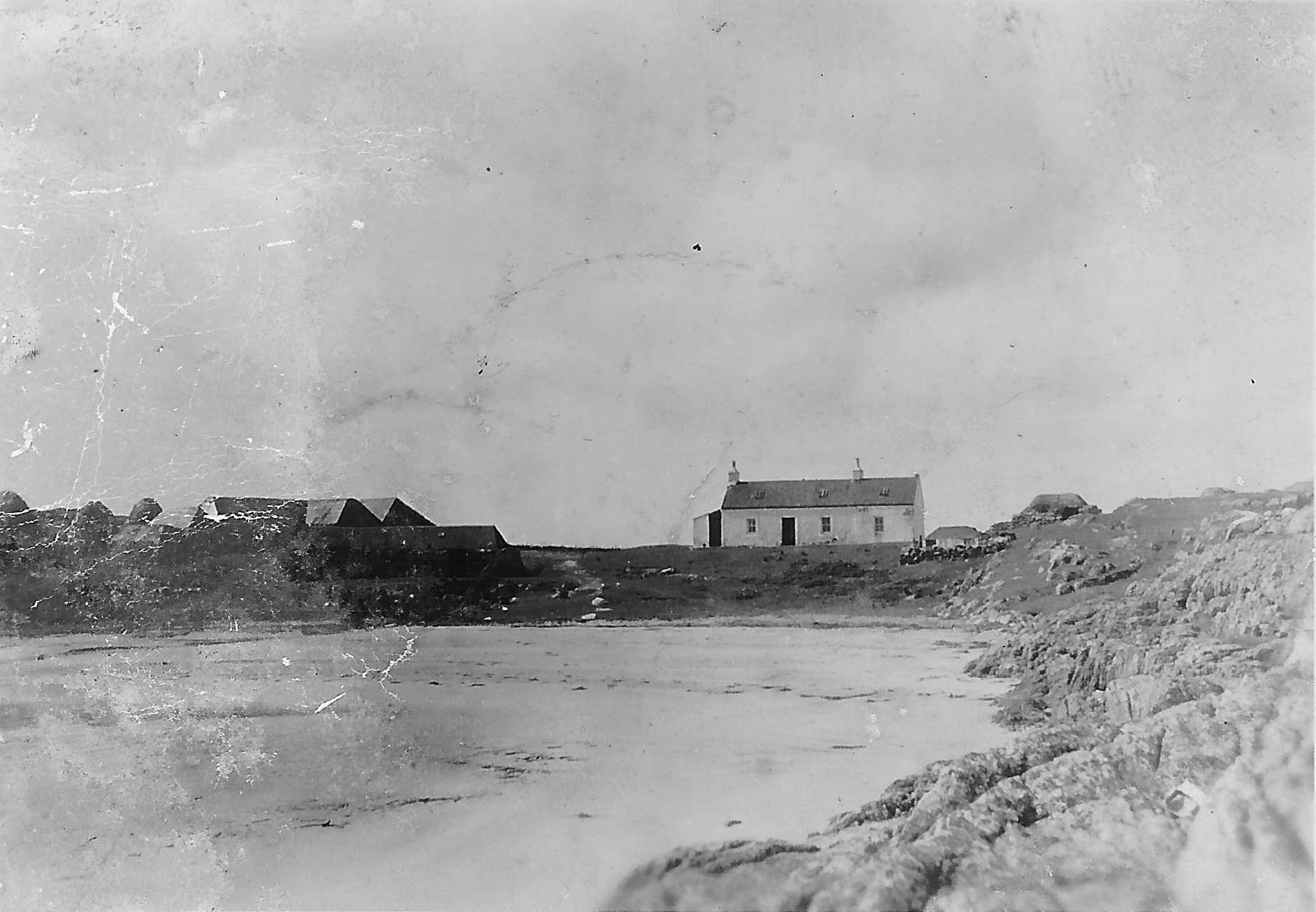

Copied photograph of the house and outbuildings at Port Bàn in Caoles. Found in a tin of cards, brochures and photographs at the refuse dump.
The shed at Balemartine with the roof made from an old boat, photographed by Dr John Holliday in 2004.

The unpredictability of the sea quite naturally bred a strong sense of the magical and superstitious amongst Tiree’s fishermen. Everything had to be done sun- or clock-wise. Boats were always pushed into the sea stern first and then turned ‘deiseal’, clock-wise.
Women were thought to be unlucky in or near a boat. It was widely thought that it brought misfortune to have a minister on a boat. Even meeting a minister on the way to fishing was a bad sign. If anyone called after a fisherman going to sea it was unlucky and they turned back.
It was bad luck to burn a boat and the old fishermen would pull boats that were no longer seaworthy up on the shore and leave them to rot. Sometimes old boats were made into roofs for outhouses as in this photograph taken in Balemartine.
Black and white photograph of a postcard of Hillcrest, Balephetrish.
Postcard of Hillcrest, Balephetrish.

Hardback book `The Thatched Houses of the Old Highlands` by Colin Sinclair.
Descriptions of different types of thatched houses in the Highlands and Islands, with floor plans, descriptions of construction and furnishings and Black and white photographs (Tiree: plate Va).
Report by Headland Archaeology on Upper Square, Hynish.
Detailed record of the historic fabric of Upper Square, Hynish with maps, descriptions of buildings and photographs of details.
Black and white photograph of the stackyard at Corrairigh, Cornaigbeg.
The stackyard and new steadings at Corrairigh, Cornaigbeg in the 1930s.

Black and white photograph of Iain MacKinnon`s croft in Kilmoluaig.
The thatched house, outbuildings and stackyard at Iain MacKinnon`s (Iain Chaluim) croft in Kilmoluaig.

George Paterson’s byre
Photograph of George Paterson’s byre at Crossapol in the 1930s.

Courtesy of Mrs Mairi Campbell
George Paterson and Archie Kennedy were photographed milking cows in George’s cattle byre at Crossapol in the 1930s. The byre was white-washed every year and housed up to ten cows which were mainly Ayrshire and Shorthorns.
The cows were put out to graze in the summer and brought in twice a day to be milked. In winter they were kept inside. The family made butter which they sold as well as milk, and also made cheese for their private use.
Until thirty or so years ago crofters commonly kept a milking cow for their own use. Very few do so now, and with the changes in the law regarding ‘raw’ milk, all milk for sale is imported into the island.
Black and white photograph of George Paterson`s cattle byre at Crossapol in the 1930s.
George Paterson and Archie Kennedy milking cows in George`s cattle byre at Crossapol in the 1930s.
Binder `The Island of Tiree 1941 – 1943` containing an account of George Holleyman’s time on Tiree, plus 123 related photographs.
Account by RAF policeman and amateur archaeologist George Holleyman FSA of his time on Tiree between September 1941 and June 1943. Includes seventy-five photographs taken on Tiree by George Holleyman between September 1941 and June 1943, and forty-eight black and white photographs/postcards taken by unknown photographer(s). George Holleyman carried out significant amounts of pioneering archaeological work in Sussex during the first half of the 20th century along with Drs. Eliot and Cecil Curwen. He was made a Fellow of the Society of Antiquaries in 1949.
Photocopied report by Argyll & Bute District about the thatched houses on Tiree, Coll and Mull.
Survey of thatched houses on Tiree, Coll and Mull giving the owner, its listing, rateable value, description, uses, remarks and analysis.