Tag Archives: crofters and crofting

2002.100.1

Audio cassette recording of Ailig MacArthur, Heylipol, interviewed by Maggie Campbell in Heylipol on 24/5/2002.

Maggie Campbell talks to Ailig MacArthur (Ailig a’ Chìobair) of Heylipol in 2002 about his work as fireman at Tiree airport and the different types of service planes used, crofting and how its affected by the Environmentally Sensitive Area scheme and the grant system, how crofts are being amalgamated into farms, cattle sales and the local wildlife especially geese, the shops in Balemartine and Balephuil and the shop vans, story-telling. Tha Ailig Mac Artair (Ailig a’ Chìobair) a’ bruidhinn ri Magaidh Chaimbeul ann an 2002, mu ’n obair a bh’ aige aig Port Adhair Thiriodh, nuair a bha e na fhear-smalaidh, na h-itealan a bha air an cleachdadh, croitearachd agus mar a tha an sgeama an ‘Environmentally Sensitive Area’, a’ beantal do ’n eilean, mar tha croitean air an cur còmhla mar bhaile-fhearainn, fèill cruidh, eunlainn an eilean, gu sònraichte na geòidh, bùthan ann am Baile Mhàrtainn agus Bail’ a’ Phuill, carabadan agus naidheachdan.

2000.9.2

Audio cassette recording of Angus MacLean, Scarinish, interviewed by Maggie Campbell in 2000.

Angus MacLean talks to Maggie Campbell about the crofts in Caoles going back to the 18th century, blacksmiths, boat-builders, stone masons and tailors, the mill in Caoles, standing stones and the stories and legends associated with them, the school and the many bards who came from there including Bard Thighearna Cholla.

2000.9.3

Audio cassette recording of Lachie MacKinnon, Parkhouse, interviewed by Maggie Campbell on 18/1/2000.

Lachie MacKinnon talks to Maggie Campbell about the division of Balephetrish farm into crofts for the men returning from World War I and various other houses in the township, growing bulbs for sale, crofting today compared with when he was young and the changes in social behaviour.

2000.10.26

Extract from John Knox’s Tour through the Highlands and the Hebrides in 1786

Transcription of an extract from ‘A Tour through the Highlands of Scotland and the Hebride Isles, in 1786’ by John Knox.

In 1786 the British Society for Extending the Fisheries sent John Knox to the north and west coasts of Scotland to prospect for new harbours and fishing grounds. During his visit to Tiree, he surveyed the coastline and concluded that Gott Bay was the most practicable place for a pier.

This was in line with the thinking of the Society’s Governor, the 5th Duke of Argyll, who over the previous fifteen years had encouraged settlement in a new fishing village at Scarinish by offering ‘a few years’ free possession of a house-room, two acres of arable and a cow’s grass.’

In 1793 the Duke again instructed the island’s Chamberlain to encourage his tenants to attend to the fishing. However, in a list of exports from Tiree in the following year there is still no mention of any fish being sent from the island.

The full publication is available to borrow from An Iodhlann: 2017.50.3

2000.10.16

Book `Eigg – the Story of an Island` by Camille Dressler.

The story of Eigg and its inhabitants from earliest times to the present day, using written accounts, oral history, legends, song, and photographs. Covers crofting, clearances, clan battles, famine and changing landscapes until the community buy-out in June 1997.

1997.156.4

John and Christina MacPhail of Balinoe

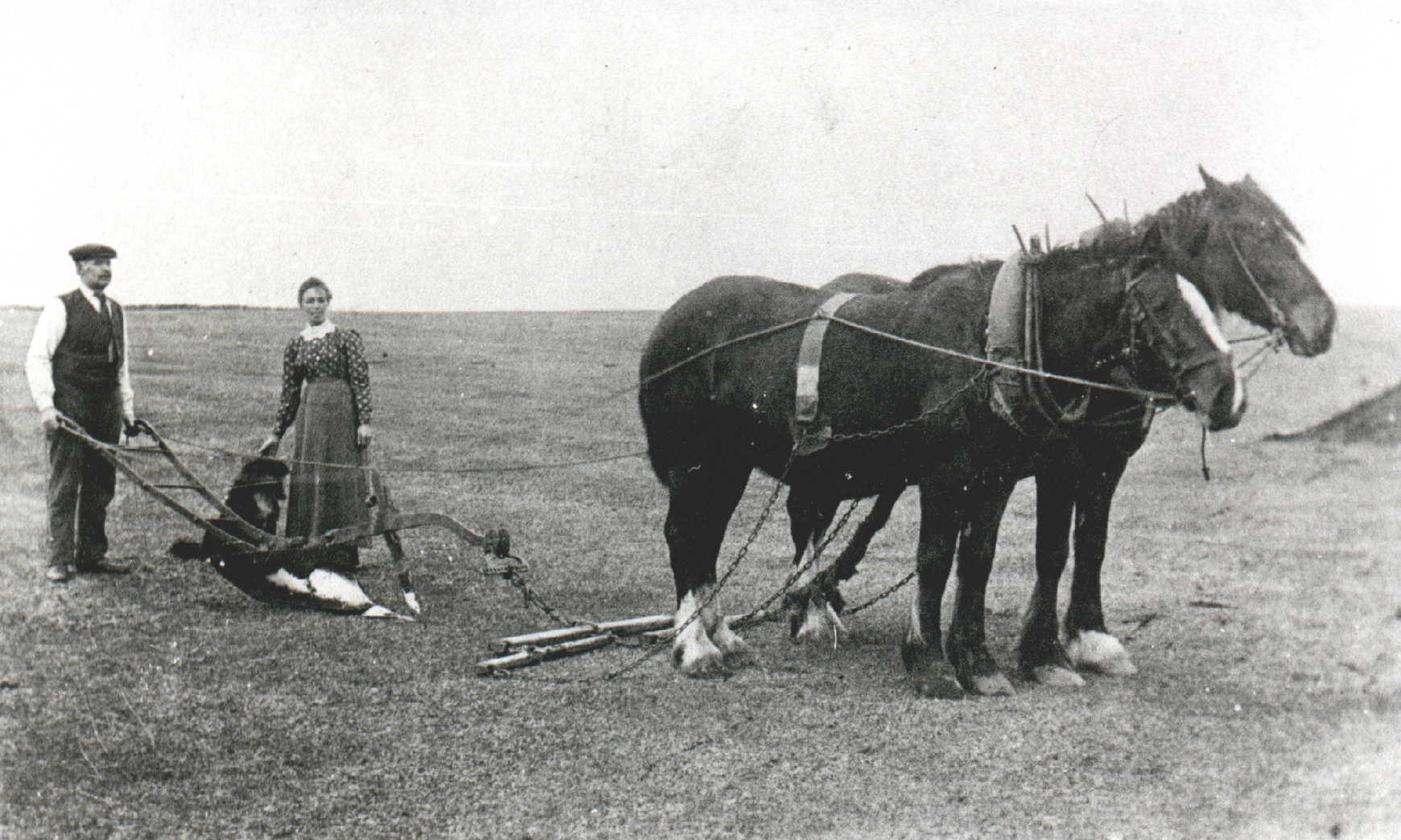
Photograph of John and Christina MacPhail of Balinoe.

b5.jpg

Courtesy of Mrs Mairi Campbell

John MacPhail (Iain Eacha’ Ruaidh) and his wife, Christina (Hutty Nèill an Tuathanaich), of Balinoe are pictured with a standard plough used for preparing the ground for sowing corn and potatoes.

Out of his working clothes, the crofter is celebrating the end of his spring ploughing. The polished ploughshare is oiled and ready to be returned to the implement shed until the autumn when it will be used for opening potato drills.

The plough is hitched to two exceptionally well-bred Clydesdales of the Tiree type. Introduced in the 1870s, Clydesdales were crossed with local ponies to produce lighter and faster draught animals for which Tiree was famous in the early 20th century.

Black and white photograph of John and Christina MacPhail of Balinoe.

L-R: John MacPhail (Iain Eacha` Ruaidh) of Balinoe and his wife Christina (Hutty Neill an Tuathanaich) with a plough drawn by two exceptionally well-bred Clydesdales of the Tiree type. Out of his working clothes, the crofter celebrates the end of his spring work. Note the polished ploughshare is oiled and ready to be returned to the implement shed till next spring. (Crofting details supplied by Donald MacIntyre, Gott)