


Black and white photograph of Duncan MacPhee of Scarinish and Chrissie MacDonald of Balemartine in the 1930s.
Duncan MacPhee of Scarinish and Chrissie MacDonald of Balemartine by Scarinish harbour in the 1930s.


Black and white photograph of Duncan MacPhee of Scarinish and Chrissie MacDonald of Balemartine in the 1930s.
Duncan MacPhee of Scarinish and Chrissie MacDonald of Balemartine by Scarinish harbour in the 1930s.
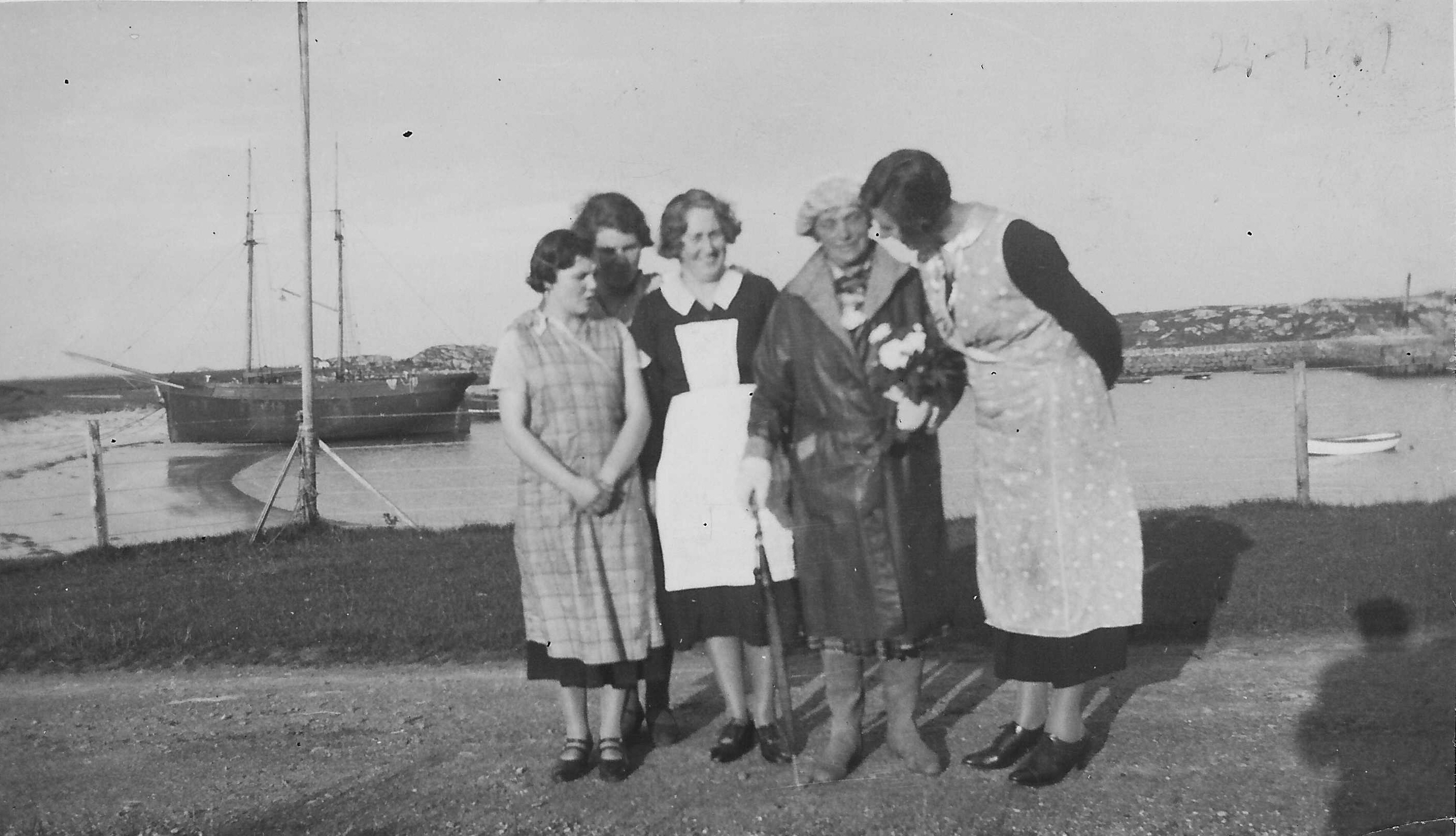
Black and white photograph of Chrissie MacDonald of Balemartine and others in the 1930s.
Scarinish harbour with the Mary Stewart in the 1930s. On the extreme right is Chrissie MacDonald of Balemartine who worked in the Scarinish Hotel.
Paperback book `The Yachtsman`s Pilot to the Isle of Mull` by Martin Lawrence.
Pilotage for the Isle of Mull and adjacent islands.
Paperback book `In fair waether and in foul` by Colin J. Smith.
The history of 30 years of Scottish passenger ships and ferries.
Hardback book `Six Inner Hebrides` by Noel Banks.
Comprehensive account of six inner Hebrides: Eigg, Rum, Canna, Muck, Coll and Tiree.
Folder titled `Argyll County Council` containing correspondence with Tiree and Coll District Council 1928 – 1969.
Folder titled `Argyll County Council` containing correspondence with Tiree and Coll District Council 1928 – 1969 about piers, graveyards, schools, housing water supply and sewerage, war memorials, the airstrip on Coll, roads, ferry and air services.
Folder titled `Tiree Ward Minutes` containing District Council papers dated from 1952 to 1964.
Folder titled `Tiree Ward Minutes` containing minutes of Tiree Ward meetings and Coll Ward meetings from 1952 to 1964 and some correspondence with Argyll County Council.
The ‘Mary Stewart’ in Scarinish harbour.
Photograph of the schooner ‘Mary Stewart’ in Scarinish harbour in the early 20th century.

Courtesy of Mr Angus Munn
This photograph taken in the 1920s or 1930s shows the ‘Mary Stewart’ in Scarinish harbour with the Temperance Hotel on the right and MacArthurs’ general store on the left. Built by Barclay in Ardrossan in 1868, the sixty-four foot long ‘Mary Stewart’ was rigged as double-topsail schooner and had a tonnage of sixty-five.
Originally trading on the Irish coast, she was bought in 1908 for Donald MacLean of Scarinish by his relation, Dugald MacKinnon. Dugald was known as Dùghall an Òir (Dugald of the gold) because he had had been successful in the Australian Gold Rush.
Donald MacLean, with his sons as crew, traded up and down the West Coast of Scotland carrying coal and other cargo until the late 1930s when steam superseded sail. The remains of the ‘Mary Stewart’ can still be seen in Scarinish harbour.
Black and white photograph of the Mary Stewart in Scarinish harbour.
The Mary Stewart in Scarinish harbour with MacArthur`s Store in the background at the left and the Scarinish Hotel on the right, photographed in the early 20th century.
Clydesdale horses at Scarinish harbour
Photograph of Clydesdale horses at Scarinish harbour in the late 19th or early 20th century.

Courtesy of Mr Angus Munn
This photograph, taken before Gott Bay pier was finished in 1913 shows Clydesdale horses from Tom Barr’s farm at Balephetrish being loaded on to a lighter at Scarinish for transportation to the steamer standing off in deeper water outside the harbour.
The horses would be loaded by ramp on to the main deck of the steamer, an operation that could only be attempted in calm weather. Passengers were likewise ferried to and from the steamer by lighter, sometimes sharing the boat with livestock.
Tom Barr, the son of an Ayrshire farmer and the tenant of Balephetrish farm from 1864 to 1913, introduced the first Clydesdale stallions to Tiree in the 1870s. Cross-bred with native ponies, the Tiree Clydesdale was in great demand in the early 20th century.
Black and white photograph of horses being loaded into a lighter at Scarinish harbour.
Horses from Tom Barr`s farm at Balephetrish being loaded into a lighter at Scarinish pier for transportation to the ferry in the early 20th century.
Account of the sinking of the SS Volendam in 1940 by Desmond Fik.
An accountby Desmond Fik of the sinking of the SS Volendam carrying evacuated children in 1940. One of the crew is buried at Kirkapol graveyard.