


Photocopied journal extract `On a submarine forest on the coast of Tiree` by the Rev. Colin Smith.
Discovery of the remains of trees in `moss-land` by the Rev. Colin Smith of Inverary during a visit to Tiree in 1826.

Photocopied journal extract `On a submarine forest on the coast of Tiree` by the Rev. Colin Smith.
Discovery of the remains of trees in `moss-land` by the Rev. Colin Smith of Inverary during a visit to Tiree in 1826.
Donald and Morag MacLean listening to a crystal set
Photograph of Donald and Morag MacLean listening to a crystal set in 1920.

Courtesy of Mrs Flora MacKinnon
Donald and Morag MacLean from Balevullin are listening with headphones to a crystal set at their uncle’s house on Paisley Road West in Glasgow in 1920. The set, which can be seen on the chest of drawers behind them, is the simplest type of radio receiver in existence. Requiring no external power, such apparatus was in widespread use in the early days of radio.
The set consisted of an aerial attached to a coil of wire, a crystal fixed in a brass cup and the ‘cat’s whisker’, a thin wire which the operator touched to various points on the surface of the crystal to find the loudest signal.
Because there was no electrical amplification, earphones were required and there was no way to control the audio volume. Different stations could be found by moving a slider along the coil, but in the 1920s the choice was very limited.
Black and white photograph of Donald and Morag MacLean in 1920.
Donald and Morag MacLean listening to a crystal radio set in 1920.
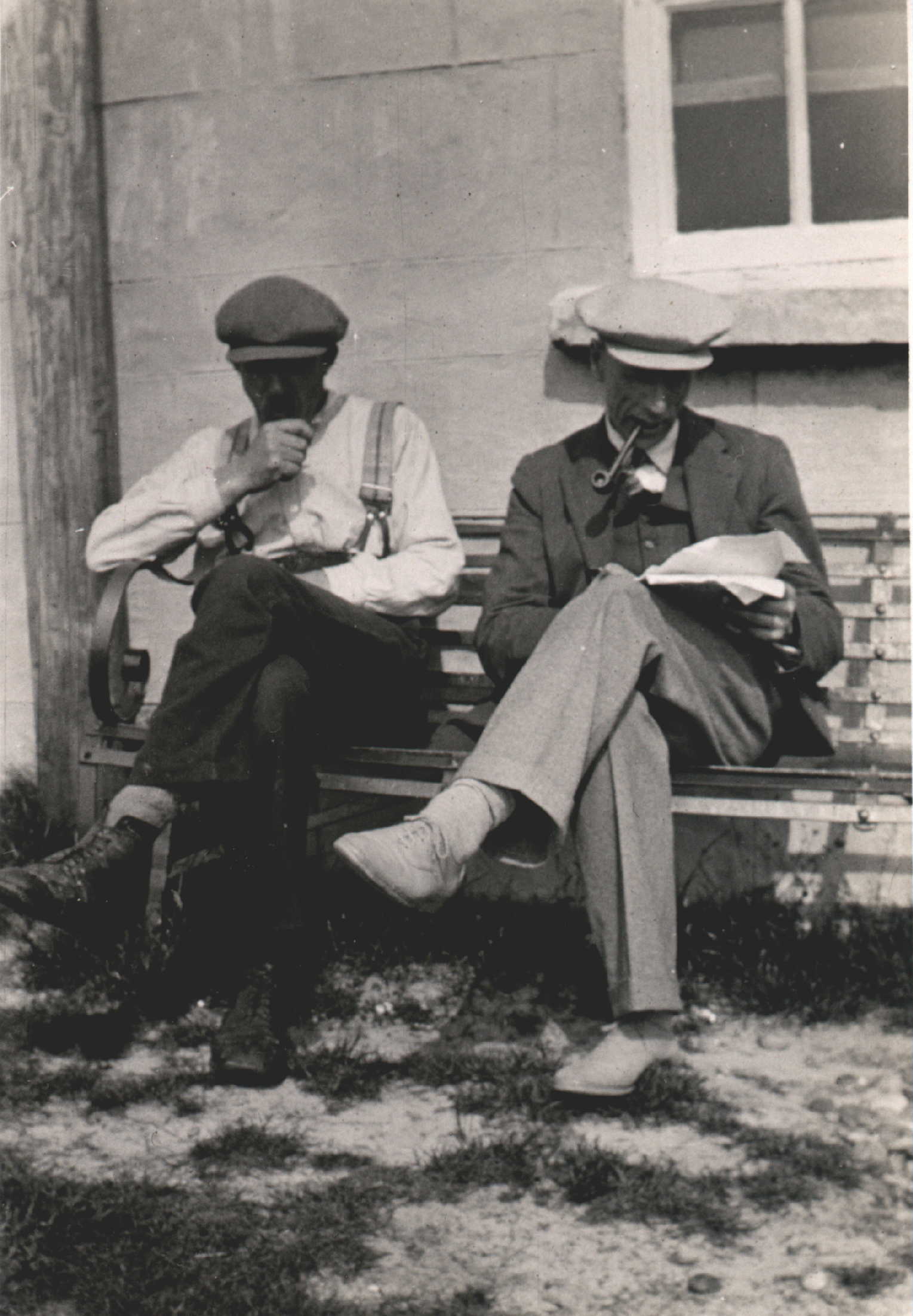
Black and white photograph of Hugh Lamont of Ruaig Post Office.
L-R: Hugh Lamont of Ruaig Post Office with an unknown man, probably taken between WWI and WWII.
Audio cassette recording of John Fletcher, Balemartine, interviewed by Maggie Campbell on 8/2/2003.
John Fletcher of Balemartine talks to Maggie Campbell in March 2003 about different methods of domestic lighting, such as oil lamps, Chinese lanterns and Tilley lamps, their use and maintenance, before electricity came to Tiree in the mid-1950s; also the use of dog-fish liver oil in the cure of ringworm and scurvy. Tha Iain Fletcher a Baile Mhartainn a’ bruidhinn ri Magaidh Chaimbeul ann am Mart 2003 mu dòighean soillse de gach seòrsa ann an dachaigh mar làmpa ola, làmpa Shìna agus làmpa Tilley, am feum agus an dòigh air an cumail an òrdugh mun dh’ thàinig an dealan do Thiriodh anns na leth-ceudan, cuideachd feum ola grùthan a’ bhearaich airson leighis buaileag-thimchill agus an t-achas tioram.
Letter from Helen MacDonald dated 16/2/2003 about Dr Thomas Stewart.
Letter from Helen MacDonald dated 16/2/2003 about the first baby Dr Thomas Stewart delivered, a Robert MacDonald. Dr Stewart arrived on Tiree in June 1920 newly qualified from Edinburgh.
Photocopied newspaper cutting about Gordon Donald 1929-1988.
Obituary for Gordon Donald (1929-1988) in Gaelic with English summary.
Christmas card for 1925.
Christmas card for 1925, with an embossed `A` and glitter sent by blacksmith Archibald MacEachern during his stay in Leverburgh, Harris.
Thomas Barr, tenant of Balephetrish Farm 1864-1912
Photograph of Thomas Barr, tenant of Balephetrish Farm 1864-1912.

Courtesy of Mr Angus Munn
In the mid-19th century, the 8th Duke of Argyll was keen to modernise Tiree’s agriculture and introduce dairy farming which he thought admirably suited to island’s pasturage. In 1864 he signed a 19-year lease for £400 a year with Robert Barr, a farmer from Dalry in Ayrshire.
So keen was the Duke for his new tenant to be successful he amalgamated the farms of Vaul, Balephetrish, the Reef, Kenovay and Crossapol to make a sizeable holding of over 3,000 acres. He also repaired the farmhouse and erected byres, stables, cart sheds and other outhouses.
Robert Barr sent his son Thomas to the island to establish the farm. Some cheese was made, but Tom Barr soon found that breeding beef cattle and horses was more lucrative. He introduced the first Clydesdale stallions to Tiree and also introduced the first mechanised hay rake.
Black and white photograph of Thomas Barr of Balephetrish Farm.
Thomas Barr who farmed in Balephetrish from 1864 to 1912.
Black and white postcard of Scarinish harbour.
Postcard of Scarinish harbour. The building in the background was originally built as a church, was then used intermittently as a prison and latterly as a store by the owners of the Mary Stewart. It was pulled down to make roads during World War II.

Black and white postcard of Scarinish harbour ca. 1880
Postcard of Scarinish with the Mary and Effie in the harbour and the hotel in the background taken around 1880. One of the boats is Alan MacFadyen`s smack.
