Black and white photograph of the MacArthurs` shop in Scarinish.
The MacArthurs` shop in Scarinish in the early 20th century. L-R: Donald MacArthur, Jessie MacDonald, Margaret Robertson, Morag MacPhail.


Black and white photograph of the MacArthurs` shop in Scarinish.
The MacArthurs` shop in Scarinish in the early 20th century. L-R: Donald MacArthur, Jessie MacDonald, Margaret Robertson, Morag MacPhail.
Cross-incised stone at St Patrick’s Chapel
Photograph of a cross-incised stone at St Patrick’s Chapel on Kennavara.

Courtesy of Mrs Grace Campbell
Up on Kennavara for a picnic, the young man in this photograph of 1920 is hiding behind the smaller of two incised stones at St Patrick’s Chapel which bear Latin crosses on both faces. Another cross is carved into a boulder to the south-east of the chapel.
On the shoreline below the chapel is a naturally formed swallow-hole sixty centimetres in diameter and over one metre deep which is known locally as St Patrick’s Vat or Well. It is traditionally regarded as a baptismal font.
There is no evidence that St Patrick ever came to Tiree but there is a Tiree tale that St Comgall, the founder of Bangor Abbey in Northern Ireland and a contemporary of St Columba, founded a monastery on Kennavara.
Black and white photograph of St Patrick`s Chapel on Kennavara in 1920.
The cross-marked stone at St Patrick`s Chapel on Kennavara in 1920.
Audio cassette recording of Hugh MacLeod, Cornaigbeg, interviewed by Maggie Campbell on 1/3/2003.
Hugh MacLeod (Eòghann Charrachan) of Cornaigbeg talks to Maggie Campbell about predicting the weather from the direction of the wind, the moon, stars, tides and rainbows, the behaviour of birds, the view of the islands, how these predictions regulated the crofting year in his younger days and how the weather has changed since then. Tha Eòghann Mhic Leòid a Cornaig Bheag a’ bruidhinn ri Magaidh Chaimbeul mu chomharradh na side a rèir na gaoithe, a’ gealach, na rionnagan, an tràghadh ’s an lìonadh, na boghachan-frois, cleachdadh nan eòin, sealladh nan eileanan agus mar a bha comharradh a riaghail bliadhna croitearachd ann an laithean òige.
Handwritten information about the Mary Stewart by Donald MacKinnon, Sandaig.
Information about the Mary Stewart written by Donald MacKinnon, Sandaig, with typed transcript.
Photocopied extract from `Glorious Canaries Past & Present 1902-1994` by Mike Davage.
Information and photograph of Archibald MacEachern Campbell 1897-1987 (an uncle of Mairi Brady) who played as full back for Norwich City F.C. from 1924-28.
Booklet titled `The Tiree Crofter`s Struggle 1886-1986` produced by Alex MacArthur in 1986.
Booklet produced to mark the centenary of the Tiree crofters` struggle for security of tenure.
Black and white photograph of the Green.
The Green in the early 1900s, titled `Sahara`.

Photocopied journal extract `On a submarine forest on the coast of Tiree` by the Rev. Colin Smith.
Discovery of the remains of trees in `moss-land` by the Rev. Colin Smith of Inverary during a visit to Tiree in 1826.
Donald and Morag MacLean listening to a crystal set
Photograph of Donald and Morag MacLean listening to a crystal set in 1920.

Courtesy of Mrs Flora MacKinnon
Donald and Morag MacLean from Balevullin are listening with headphones to a crystal set at their uncle’s house on Paisley Road West in Glasgow in 1920. The set, which can be seen on the chest of drawers behind them, is the simplest type of radio receiver in existence. Requiring no external power, such apparatus was in widespread use in the early days of radio.
The set consisted of an aerial attached to a coil of wire, a crystal fixed in a brass cup and the ‘cat’s whisker’, a thin wire which the operator touched to various points on the surface of the crystal to find the loudest signal.
Because there was no electrical amplification, earphones were required and there was no way to control the audio volume. Different stations could be found by moving a slider along the coil, but in the 1920s the choice was very limited.
Black and white photograph of Donald and Morag MacLean in 1920.
Donald and Morag MacLean listening to a crystal radio set in 1920.
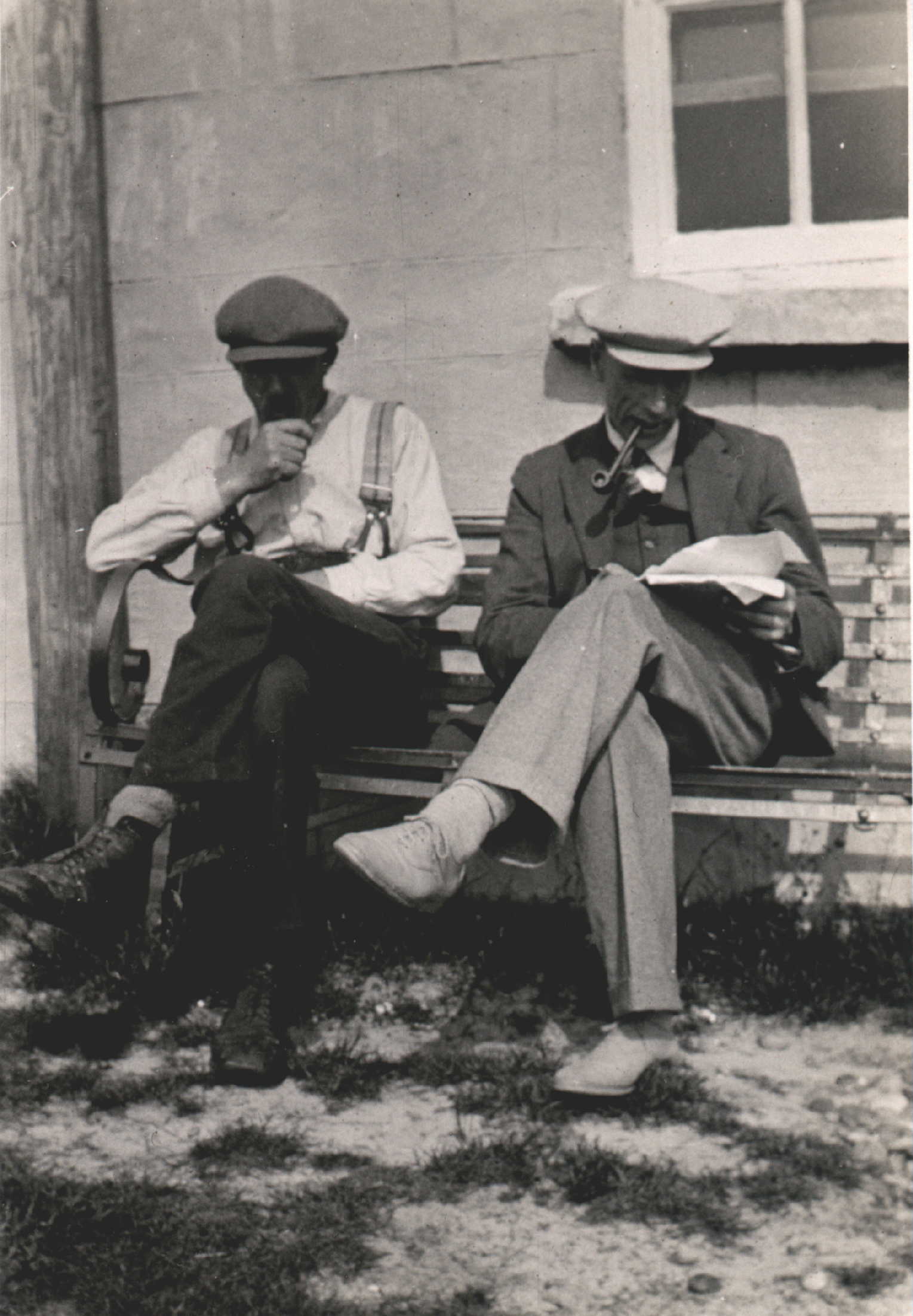
Black and white photograph of Hugh Lamont of Ruaig Post Office.
L-R: Hugh Lamont of Ruaig Post Office with an unknown man, probably taken between WWI and WWII.