Woman`s skirt, blouse and bonnet from Salum House and worn in the late 19th or early 20th century. All items are black. The skirt has a black netted overskirt, the blouse has black beadwork and a netted overlay and the bonnet is black crocheted wool.
Audio cassette recording of Hugh MacLean of Barrapol talking to Maggie Campbell in October 1999.
Hugh MacLean of Barrapol talks to Maggie Campbell in October 1999 about his boyhood and schooling at Sgoil na Mòintich, his work on the farm, a spell in the Merchant Navy and 40 years as clerk to Tain Committee, old burial places, old farming methods using horses, harvesting, changes in the weather, planting potatoes, Tiree-made shoes, storms and tornadoes, New Year festivities, whisky, the Glassary and Curtis-Stanford. Tha Iain Aonghais a’ bruidhinn ri Magaidh Chaimbeul anns an Dàmhair 1999 mu na daoine agus àiteachan ann agus mun cuairt Cill Moluaig, feum crotail airson aodach a dhath gu dearg, diofrach thobhtaichean mun cuairt Loch Bhasapol far am b’ àbhaist bradan agus bric a bhi, mac fear-uasal Dhòmhnall ’IcIllEathain a bha na fhear-brathaidh airson an Ruis, mar a fhuair ‘An Green’ ainm, na cathaidhean gainmhaiche a b’ àbhaist a bhi ann, uisge air a tharraing a tobraichean, ag obair air na croitean le eich, a’ cur coirce, neipean agus buntàta, a’ toirt sìol don mhuilinn ann an Còrnaig agus cion nan daoine far an robh iad uaireigin gu math lìonmhor.
Mullard PM22A 5-pin master valve in its original box (130 x 50 x 50 mm) used to power a radio from a 120V battery, probably in use from the mid-1920s until the 1950s.
Bell gun with firing mallet used as a humane killer for slaughtering cattle and sheep. Originally used by Tiree butcher, Donald Archie MacLean, to slaughter cattle and sheep, this humane killer was given to the vetinary on the island, Robert Beck, in the 1960s. Made of cast iron, the maker’s name, W. W. Greener of Birmingham, is embossed around the rim of bell. Once loaded with a single bullet, the bell was positioned on the front of the animal’s head and the gun fired by hitting the trigger (the protruding knob) with the wooden mallet. Although very efficient and humane, it required two hands to operate and another person to steady the animal’s head. Not considered safe enough for use indoors, humane killers with captive bolts are now used instead.
Black and white photograph of an unknown group at Silversands from a small album from Silversands.
Unknown group at the porch door of Silversands, from a small album from Silversands, Vaul, titled `Idle Days` probably dating from the 1920s or early 1930s.
Black and white group photograph outside Rhum View, Vaul in the early 1920s.
Rhum View, Vaul in the early 1920s. L-R: (back) Jessie Pettigrew, Iain MacKinnon (Johnny London), Mary Flora Pettigrew née MacKinnon, Catriona MacKinnon, Mary Flora’s sister, (front) Marion Spears née MacKinnon. Mary Flora married Jimmy Pettigrew who was the brother of Margaret Johnston, Margaret Doig’s mother.
Before the development of paraffin lamps, lighting in Tiree’s houses was provided by small oil lamps known in Gaelic as ‘crùisgean’. Oil from various fish was used but whales stranded on the shore were another important source.
The Statistical Account of 1845 recorded that ‘…shoals of small whales sometimes frequent our bays; and the people have become very expert at driving them ashore with boats… They are commonly from 15 to 20 feet long, and their blubber yields about a barrel of oil, each.’ From this description, they are most likely to have been Long-finned Pilot Whales.
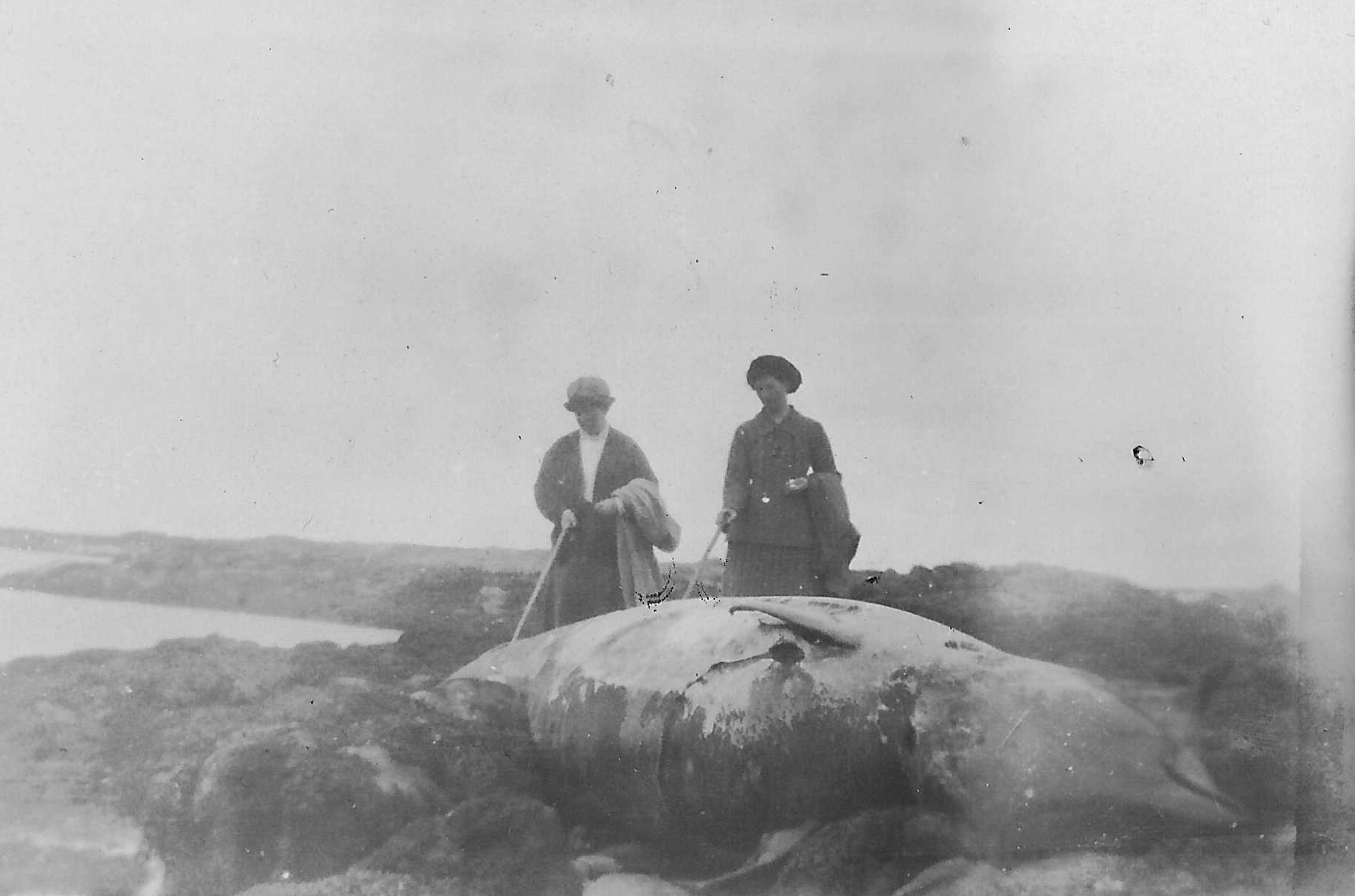
This photograph titled ‘Aig a’ Mhuc Mhara’ (At the whale), of what is probably a Northern Bottle-nosed Whale, came from a small album from Silversands in Vaul and dates from the 1920s or early 1930s.
Black and white photograph of two unknown women and a dead whale from a small album from Silversands.
`Aig a` Mhuc Mhara` (at the whale) from a small album from Silversands, Vaul, titled `Idle Days` probably dating from the 1920s or early 1930s.