Three cotton reels.
Three wooden cotton reels with thread from `Melness`, Cornaigbeg. One is made by J & P Coats of Paisley, James Coats donated hundreds of books to Tiree’s schools and to the Reading Room (now An Iodhlann).
John and Christina MacPhail of Balinoe
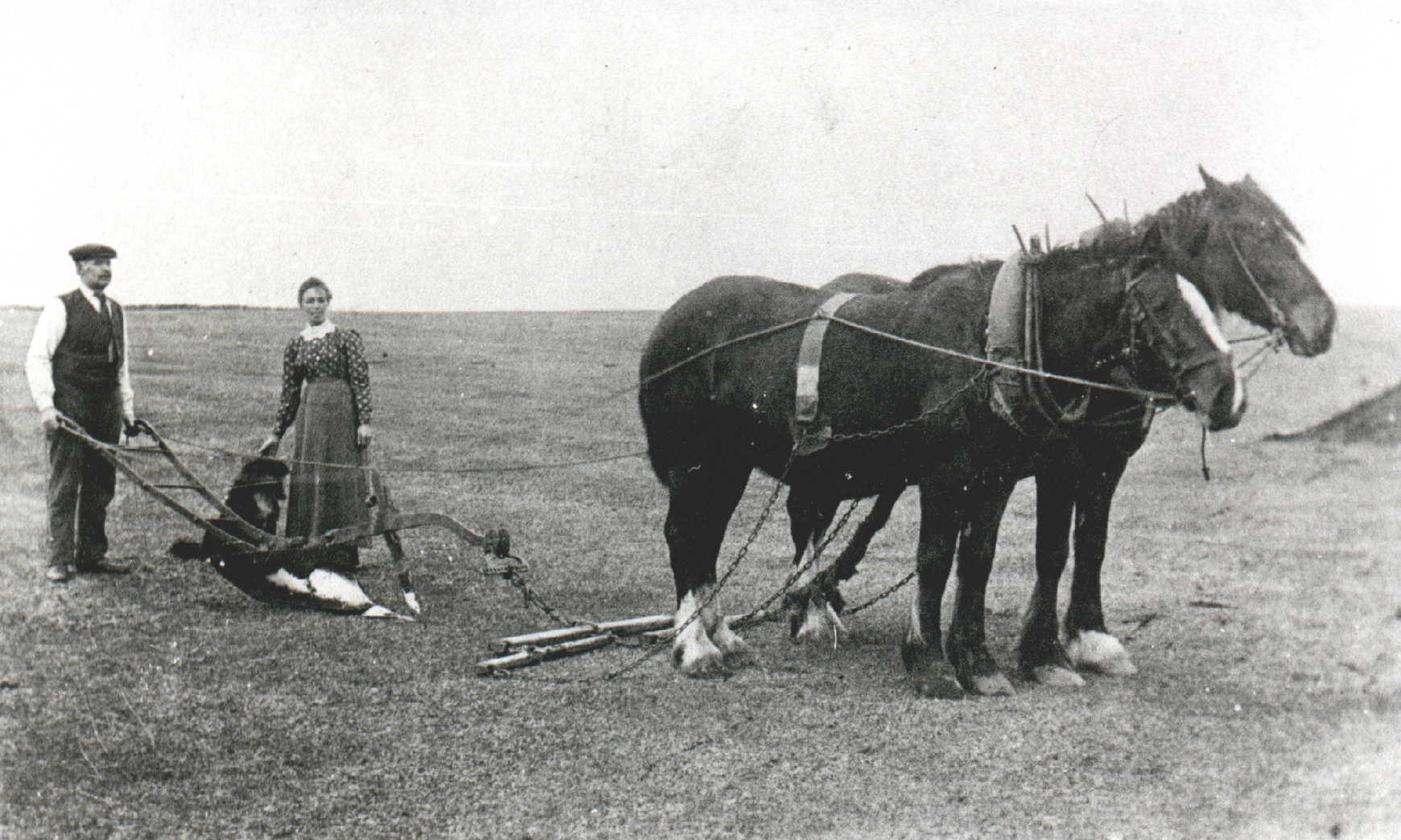
Photograph of John and Christina MacPhail of Balinoe.
Courtesy of Mrs Mairi Campbell
John MacPhail (Iain Eacha’ Ruaidh) and his wife, Christina (Hutty Nèill an Tuathanaich), of Balinoe are pictured with a standard plough used for preparing the ground for sowing corn and potatoes.
Out of his working clothes, the crofter is celebrating the end of his spring ploughing. The polished ploughshare is oiled and ready to be returned to the implement shed until the autumn when it will be used for opening potato drills.
The plough is hitched to two exceptionally well-bred Clydesdales of the Tiree type. Introduced in the 1870s, Clydesdales were crossed with local ponies to produce lighter and faster draught animals for which Tiree was famous in the early 20th century.
Black and white photograph of John and Christina MacPhail of Balinoe.
L-R: John MacPhail (Iain Eacha` Ruaidh) of Balinoe and his wife Christina (Hutty Neill an Tuathanaich) with a plough drawn by two exceptionally well-bred Clydesdales of the Tiree type. Out of his working clothes, the crofter celebrates the end of his spring work. Note the polished ploughshare is oiled and ready to be returned to the implement shed till next spring. (Crofting details supplied by Donald MacIntyre, Gott)
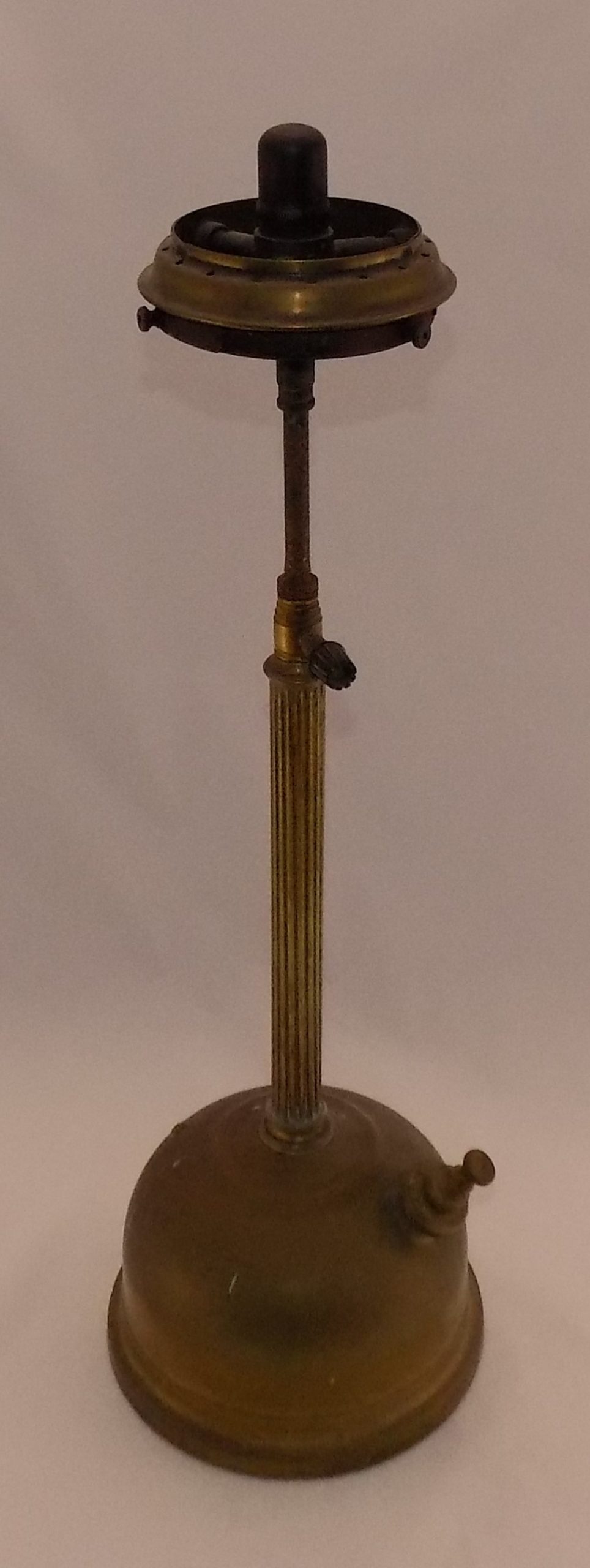
Tilley lamp (minus glass globe), 1925-1950. Tilley lamps were named after John Tilley, inventor of the hydro-pneumatic blowpipe in the early 1800s. Domestic Tilley lamps were fuelled with paraffin, which was pressurised by use of a pump on the base.
Colour scan of brass plate.
Colour scan of brass plate from the Glassary seaweed factory cart engraved `NORTH BRITISH CHEMICAL CO. LD. TYREE NO. 1`.
Black & white photograph of Neil MacLaine and his wife Catherine MacFadyen in their Highland finery. The ‘Bard’, as Neil MacLaine was familiarly known, was at the forefront of the Celtic movement in Glasgow from the late 1890s until his death in 1925.
Courtesy of Mrs Mairi Campbell
The Bard had a gift for telling humerous Gaelic stories and reciting his own compositions. He regularly attended meetings of the Clan MacLean, Tiree Association and Ceilidh nan Gaidheal and was a vice-president in each of these societies.
Born in Caoles in 1851, he went to Glasgow at an early age to become apprenticed to the joinery trade. Apart from four years spent in the Kimberley Diamond Fields in South Africa, he remained in the city until his death in 1919.