Black and white photograph of harvesting in Kilmoluaig in the 1920s.
Harvesting in Kilmoluaig in the 1920s. L-R: Maggie Campbell`s uncle Donald Archie; uncle Alick; Neil MacDonald, Kilmoluaig (Murdoch`s father); Maggie`s father Donald MacKechnie; John Lamont, Balevullin; great-aunt Bella MacLean, Kilmoluaig; aunt Marion and grandfather Alexander MacKechnie.
From the middle of the nineteenth century, Sanitary Laws were applied on Tiree to keep the island clean and infected patients were isolated. In 1892 the Sanitary Inspector visited the island and cautioned “several parties in regard to dung heaps in my opinion too near to houses”.
In 1893 three people died from typhoid which affected Balephuil. In 1895 an epidemic of scarlet fever swept through Tiree. The County Medical Officer, Dr. McNeill, had recommended the building of an isolation hospital on the island in 1893 and in 1905 the Fever Hospital was built in Heanish.
Made of corrugated iron lined with wood, it comprised two-bedded wards set at each end of the building with a kitchen, nurse’s room and bathroom in the centre. Outside was a washhouse, mortuary, disinfecting room and coalhouse. It was last used in the 1940s and sold in the 1960s as a private house.
Black and white postcard of Heanish machair and old the Fever Hospital.
Heanish machair and old the Fever Hospital. (Original postcard in Filing Cabinet 8 drawer 2)
Cardboard seed box stamped `The British War Relief Society`.
Cardboard box measuring 180 mm x 120 mm x 70mm and stamped with `The British War Relief Society – A gift of seeds from the United States of America` and found in the Nutts` house in Balemartine.
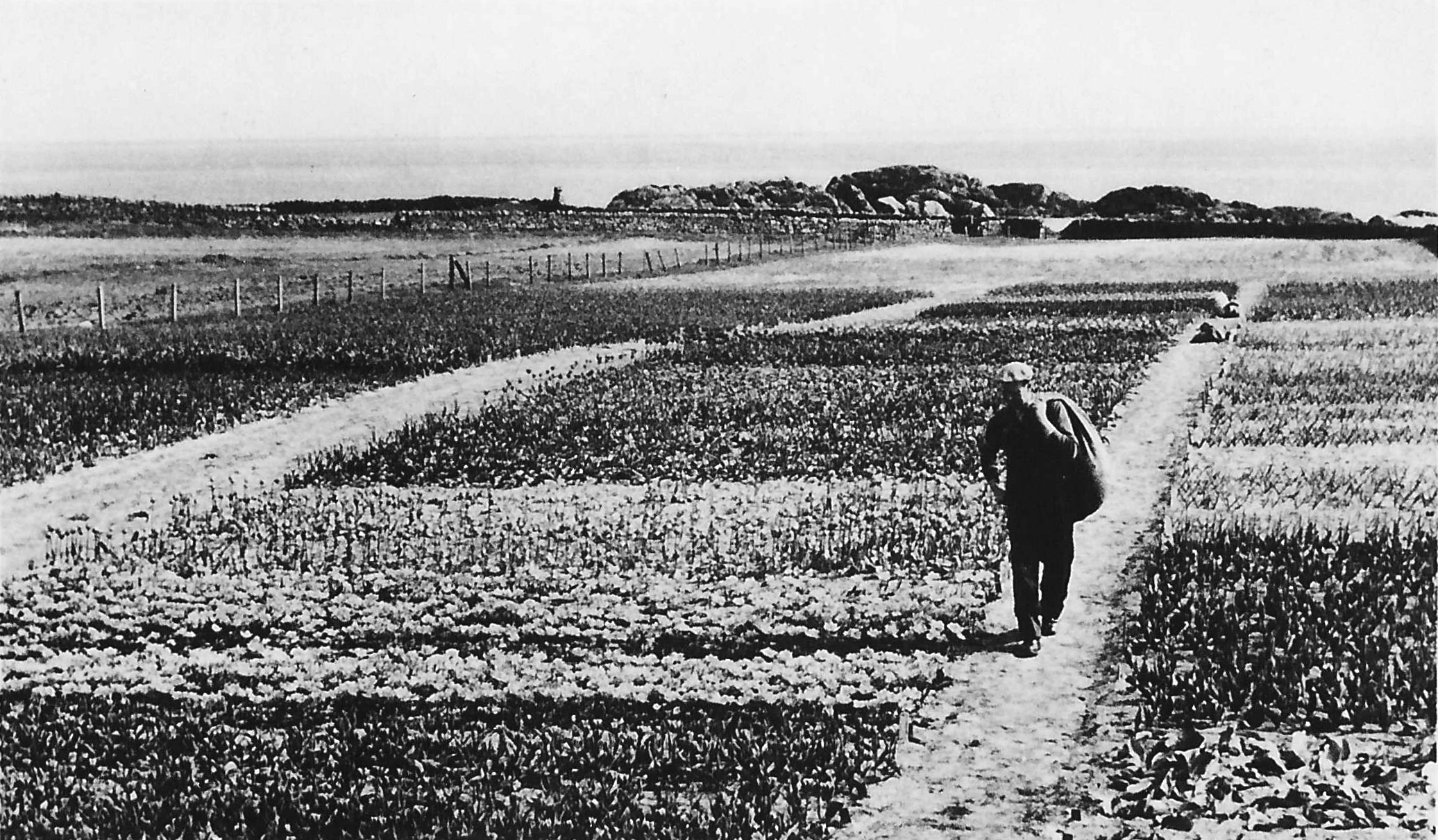
Mr R. M. Percy at the Hynish bulb farm in the 1950s
Postcard of the Hynish bulb farm in the 1950s.
Courtesy of Mrs Mary MacKinnon
In the early 1950s the West of Scotland Agricultural College’s horticultural adviser R. M. Percy suggested an experiment in bulb-growing to Walter Hume of Hynish. The experiment showed that the light sandy soils of Tiree were well suited to growing daffodil, tulip, narcissus and hyacinth bulbs.
Encouraged by this success, a number of crofters formed a Hebridean bulb-growers association and launched into bulb-growing as a commercial enterprise, supplying mainland hot-house growers with bulbs for forcing. Initially the economic prospects looked good as the yield per acre was high.
However, the bulbs were decimated by diseases and ravaged by pheasants, mice and slugs. Reinvigorating spent bulbs took longer than expected and markets became more difficult to find. Nowadays the only reminders of the bulb experiment are patches of daffodils growing wild in the fields.
Black and white postcard of the bulb fields at Hynish.