Seven O/S maps with hand-drawn croft numbers and boundaries, 1977
Seven O/S maps with croft numbers and boundaries drawn in by donor`s sister, Mary Robertson: (1) sheet NL 93 NE Hynish and West Hynish, (2) sheet NL 94 NE Hough, Balevullin, Kilmoluaig, Cornaigmore, Cornaigbeg and Kenovay and boundaries of Croish, Cornaigmore Farm and Kilmoluaig common grazing, (3) sheet NL 94 SE Moss, Barrapol, Balephuil, Balemartine, Balinoe, Heylipol and Crossapol and boundaries of Kilmoluaig common grazing, Barrapol Farm and Heylipol Farm, (4) sheet NL 94 NW Hough and Balevullin, (5) sheet NL 94 SW Middleton, Sandaig and Kilkenneth, (6) sheet NM 04 NW Balephetrish, Scarinish, Gott, Kirkapol and Vaul and boundaries of Scarinish Farm and Balephetrish special common, (7) sheet NM 04 SW Baugh and Scarinish.
British Geological Survey Technical Report `Trial infiltration gallery on Tiree – an island water supply from a shallow sand aquifer` by N. S. Robins and D. F. Ball.
Report on a trial infiltration gallery built in a raised beach near to the outflow from Loch a` Phuill to assess the possibility of providing an alternative water supply to loch water currently used.
Black and white photograph of Donald and Sarah Black in 1895.
Donald Black(1854-1937) and his wife Sarah Brown both from Balephuil, photographed in 1895 when Donald was appointed Justice of the Peace for Assinboia Territory in the Canadian North West Territories.
Black and white photograph of Donald and Sarah Black in 1934.
Donald Black(1854-1937) and his wife Sarah Brown both from Balephuil, photographed in 1934 in Saskatoon, Canada on the occasion of their 50th wedding anniversary.
Photocopied letter to Donald MacKinnon of Balephuil dated 10/2/1914.
Letter to Donald MacKinnon of Balephuil dated 10/2/1914 from the Board of Agriculture for Scotland regarding his application to the Land Court to register as a New Holder.
Black and white photograph of Donald and Christine MacKinnon of Balephuil.
Photograph of L-R: Donald MacKinnon (shoemaker and member of the Land Leagues movement), Alasdair MacKinnon (Donald`s brother and grandfather to the twins at Bail` Ur), Caroline Black`s father, Christine MacKinnon (Donald`s wife), and two children “who brought him up” (referring to Bernie Smith, Balephuil?)
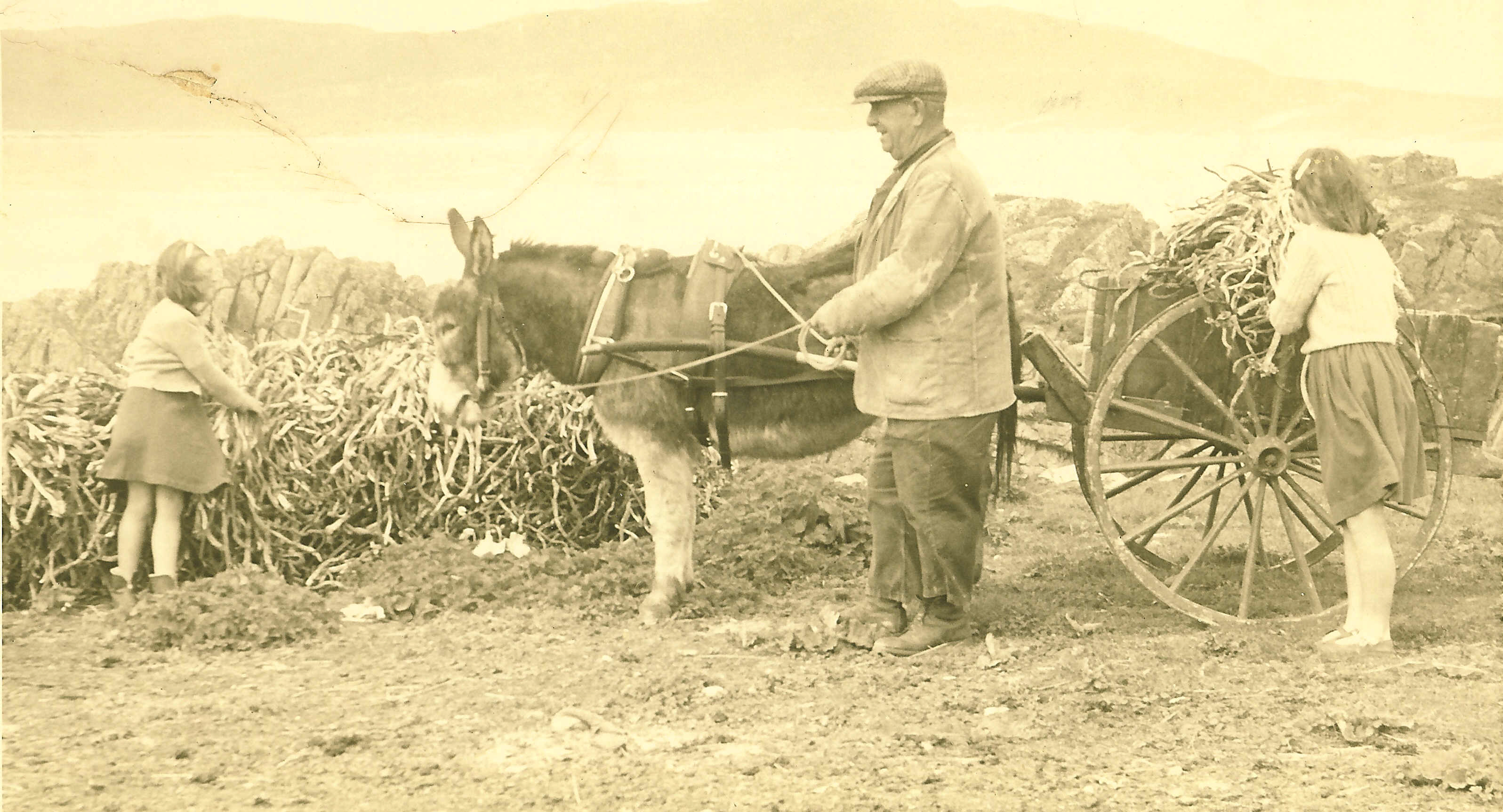
Photograph of Johnny MacKay of Balephuil transporting tangles with a donkey and cart in 1957.
Courtesy of Mr Alan Boyd
Morton Boyd photographed Johnny MacKay of Am Bail’ Ur in Balephuil in 1957 transporting dried kelp, known as tangles, with a donkey and cart. The tangles would be sent each year to the mainland for processing into alginates which are widely used to thicken food and size cloth.
Seaweed has also been used from the earliest times as animal fodder, for medicinal use, for human consumption – a milk pudding made from carrageen is still widely eaten on Tiree – and as a fertiliser for hay meadows and particularly for potatoes.
Crofters collecting seaweed divided the shoreline between them but occasionally disputes arose. As late as 1914 the Land Court had to adjudicate between crofters in Caoles, one of whom was ‘only allowed to take seaweed from the boundary of Ruaig to Ardeas until Old St. Patrick’s Day’ while his neighbour had free access to the beaches.
Black and white photograph of Johnny MacKay in 1957.
Johnny MacKay of Bail` Ur, Balephuill, collecting dry tangles in 1957.