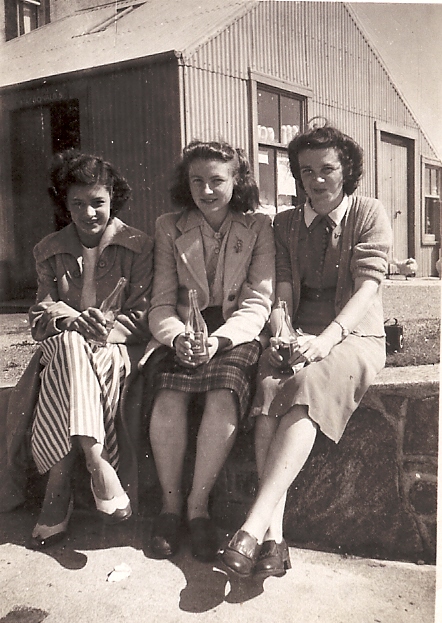
Photograph of three women drinking sodas outside a shop in July 1950
Black & white photograph of L-R: Margaret Brownlie (nee Stoack), Mary F MacKinnon, Sandaig, and Flora MacLean, Druimfraoich, Kenovay, sitting with bottled drinks outside a shop constructed on corrugated sheeting, possibly Scarinish, in July 1950. Identity uncertain as the back of the photo was labelled `Flora, Chrissie and Cecilia`.
Notes on Gaelic words and phrases made by George Holleyman in 1942-43
Photocopy of George Holleyman`s notebooks in which he recorded Gaelic words, phrases, idioms, sayings, children`s games & toys, song titles, Tiree dishes, and girls & boys names that he heard while serving in the RAF on Tiree in 1942-43, and a list of books about Tiree.
Notice from the Edinburgh Gazette 1943 regarding Barbara Curran changing her name to Bridget Curran.
Printed transcript of a notice from the Edinburgh Gazette 1943 regarding Barbara Curran`s intention of changing her name to Bridget Curran. Bridget worked at the Scottish Cooperative Wholesale Society (SCWS) Canteen on Tiree.
Large cast-iron `pot-bellied` cooking pot with handle that would have been hung over the fire. Painted black. It was last used for heating bitchumen for tarring felt roofs and/or the hulls of boats.
Three whole hazelnuts and three shelled hazelnuts. Hazel trees grew on Tiree in Mesolithic times and the nuts were a rich source of food. There are several hazels growing on the Balephuil sliabh today.
Three large and two small limpet shells. Limpets were a staple food on Tiree until the end of the 19th century. They can be eaten raw, like oysters, or cooked. They are boiled and then the muscle is cut off and fried in butter.
Book “Traditions of Sea-bird Fowling in the North Atlantic Region”, 2004
Softback book about the ongoing tradition of harvesting young sea-birds from their rocky/island nests in the north Atlantic for food. Includes information about guga hunting on Lewis (guga`s being young gannets).
Information about Iron Age pottery design, markings and uses from a CBA Research Report, including theories about the presence of post-firing drilled holes. Includes printed email from Ian Hewitt regarding holes in Iron Age pottery.
Suggested identification for pottery `Mystery Object`
Handwritten suggestion for the identification of a large piece of pre-historic pottery drilled with holes. Possibly used as a bee hive, the holes being made for ventilation. Includes drawing and typed transcription. Relates to pottery fragment found by C MacDonell at Salum in 2009 (see 2010.35.1).