Photocopied newspaper cutting about Gordon Donald 1929-1988.
Obituary for Gordon Donald (1929-1988) in Gaelic with English summary.

Photocopied newspaper cutting about Gordon Donald 1929-1988.
Obituary for Gordon Donald (1929-1988) in Gaelic with English summary.
Photocopied article about the loss of the Fokker XXII aircraft `Sylvia Scarlet`, with an accompanying letter.
(1) Article from `Fly Past` Magazine, 1982, about the loss of the Fokker plane `Sylvia Scarlet` shortly after departing from Tiree on 3/7/1943. (2) Letter from Peter Moran, editor of `Aviation Archaeologist` Magazine, dated 27/11/1981 to donor, giving information about the crew of the `Sylvia Scarlet`.
Black and white photograph of servicemen in a dinghy at Gott Bay pier during WWII.
Servicemen in a dinghy at Gott Bay pier during WWII.

Roadmen in Baugh
Photograph of roadmen working in Baugh.

Courtesy of Mr Angus Munn
A Balemartine man remarked during World War II that ‘Hitler was the best local councillor that Tiree ever had!’ By this he meant that the arrival of the RAF in 1941 brought a remarkable improvement in the infrastructure of the island.
A three-runway airport was constructed, as well as hundreds of Nissen huts and two NAAFIs selling alcohol and showing films. In addition, the road network was upgraded to cope with the lorries carrying supplies between the pier, the RAF station at Crossapol and the radar base at Hough.
The main road to the east end of the island used to be along the sandy expanse of Tràigh Ghott, the beach along Gott Bay; the tarred road around the bay was laid in 1931. This photograph shows workmen gravelling the road up to the doctor’s surgery at Baugh.
Black and white photograph of road-building during WWII.
Road-building during World War II.
Andrew Young of Balephuil
Photograph of Andrew Young of Balephuil in his RAF uniform.

Courtesy of Mrs Mabel MacArthur
Originally from Glasgow, Andrew Young, his sister Mabel and brother William were brought up by the MacNeills of Main Road Farm in Balephuil.
Andrew had an unlucky war. As an RAF mechanic he was stationed in Burma and Kenya where he contracted malaria and typhoid. The troopship in which he was sent home was sunk off the African coast and he spent ten days in an open lifeboat. He was then picked up by a German U-boat and was confined for the rest of the war in a POW camp in Casablanca.
After the war Andrew died on Kennavara while out shooting.
Black and white photograph of Andrew Young during WWII.
Andrew Young, Balephuil, the brother of Mabel Kennedy, Sandaig. As an RAF mechanic he was stationed in Burma and India, where he contracted malaria and typhoid. The troopship in which he was sent home was sunk off the African coast and he was in an open lifeboat for ten days. He was then picked up by a German U-boat and spent the rest of the war in a POW camp in Casablanca. After the war he died on Kenavara while shooting.
Black and white postcard of Scarinish Store and Post Office.
Postcard of Scarinish Store and Post Office in the early 20th century.

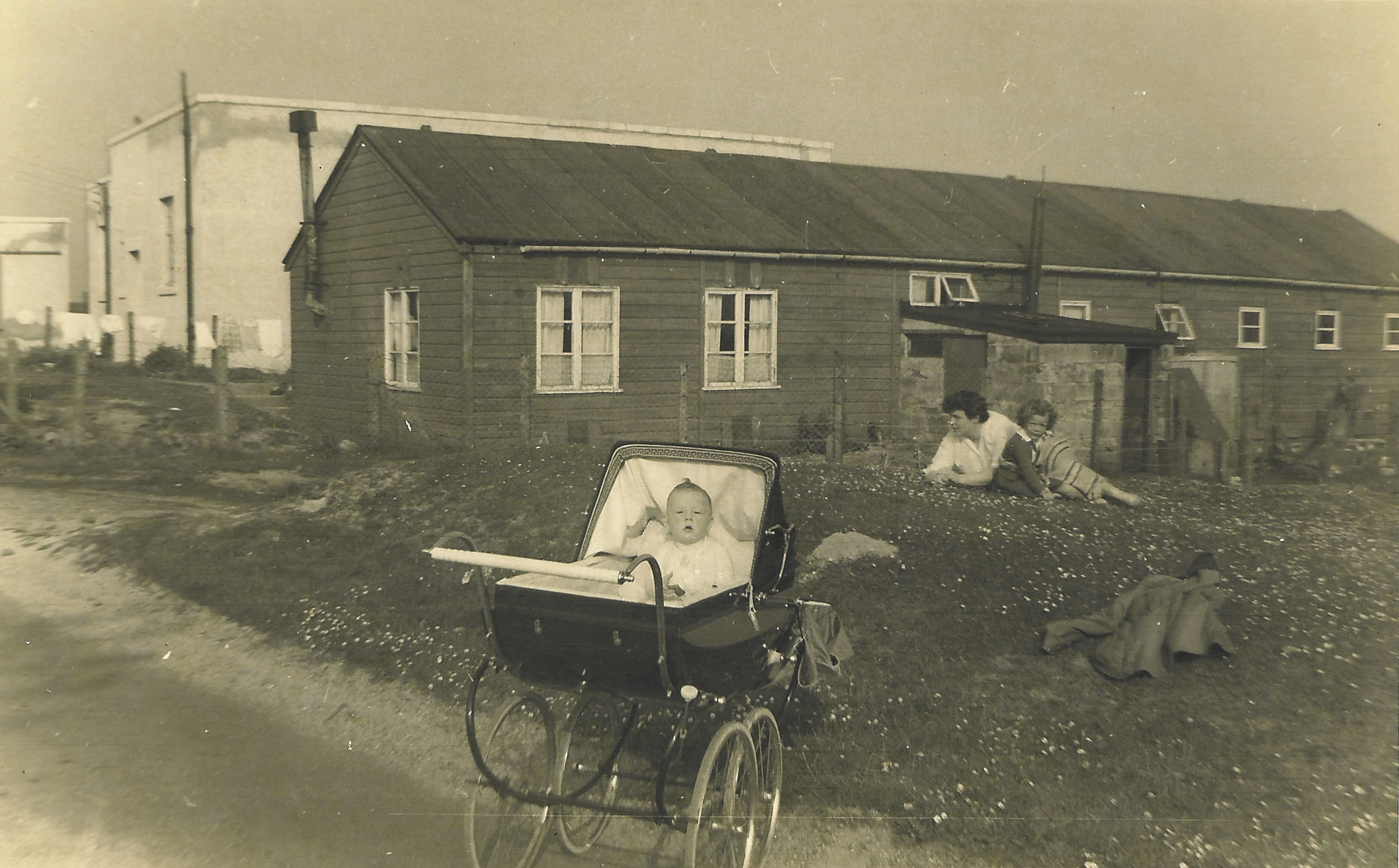
Photograph of Mary MacPhee, her baby, and a friend outside the old telephone exchange at Scarinish in 1949.
Courtesy of Mrs Mary MacPhee
Mary T. MacPhee, a friend and Mary’s son, either Christopher or Neil Urquhart in the pram, pictured outside the old telephone exchange in Scarinish in 1949. Mary had previously worked shifts at the Pitt Street exchange in Glasgow which had around two hundred operators.
In Scarinish, Mary worked twenty-four hours a day. The building had three bedrooms, a bathroom, a kitchen and a sitting room which contained the switchboard. The operator had to connect all calls by hand. If a call came in at night an alarm bell rang in the operator’s bedroom.
Mary recalls there being only around five private telephones on the island in 1949. Calls cost one penny, sixpence or a shilling and all were monitored. The operator would interrupt to advise when the time was nearly up.
Photocopied newspaper cutting about the 1949 Tiree Argricultural Show.
Revival of the Agricultural and Home Industries Show after a lapse of ten years with prize list (incomplete).
Photocopied speech by Ronald MacDonald, Cornaigbeg given on 26/7/1986 (2 copies).
Speech by Ronnie MacDonald, Cornaigbeg, given on 26/7/1986 at the opening ceremony of Tur Mhic Chaluim to commemorate one hundred years of the Crofters Act and to honour those who fought for crofters` rights. (For sound recording of event, see AC4 – `Tiree remembers` )
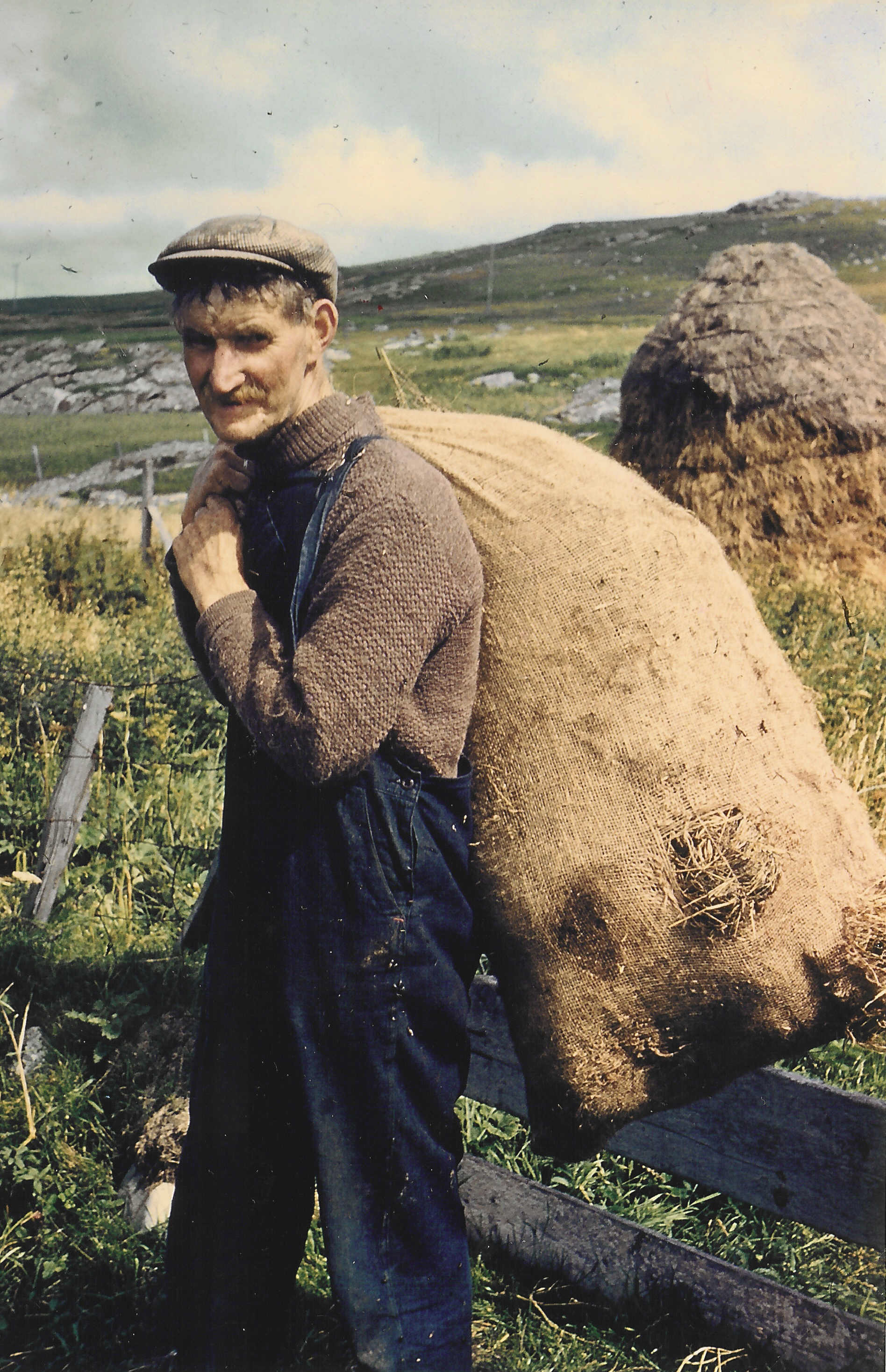
Colour photograph of Duncan MacDonald of Bail` Ur, Balephuill.
Duncan MacDonald (Donnchadh Bhan Mac Sheumais) of Bail` Ur, Balephuill, photographed by Morton Boyd in the 1940s or 50s.