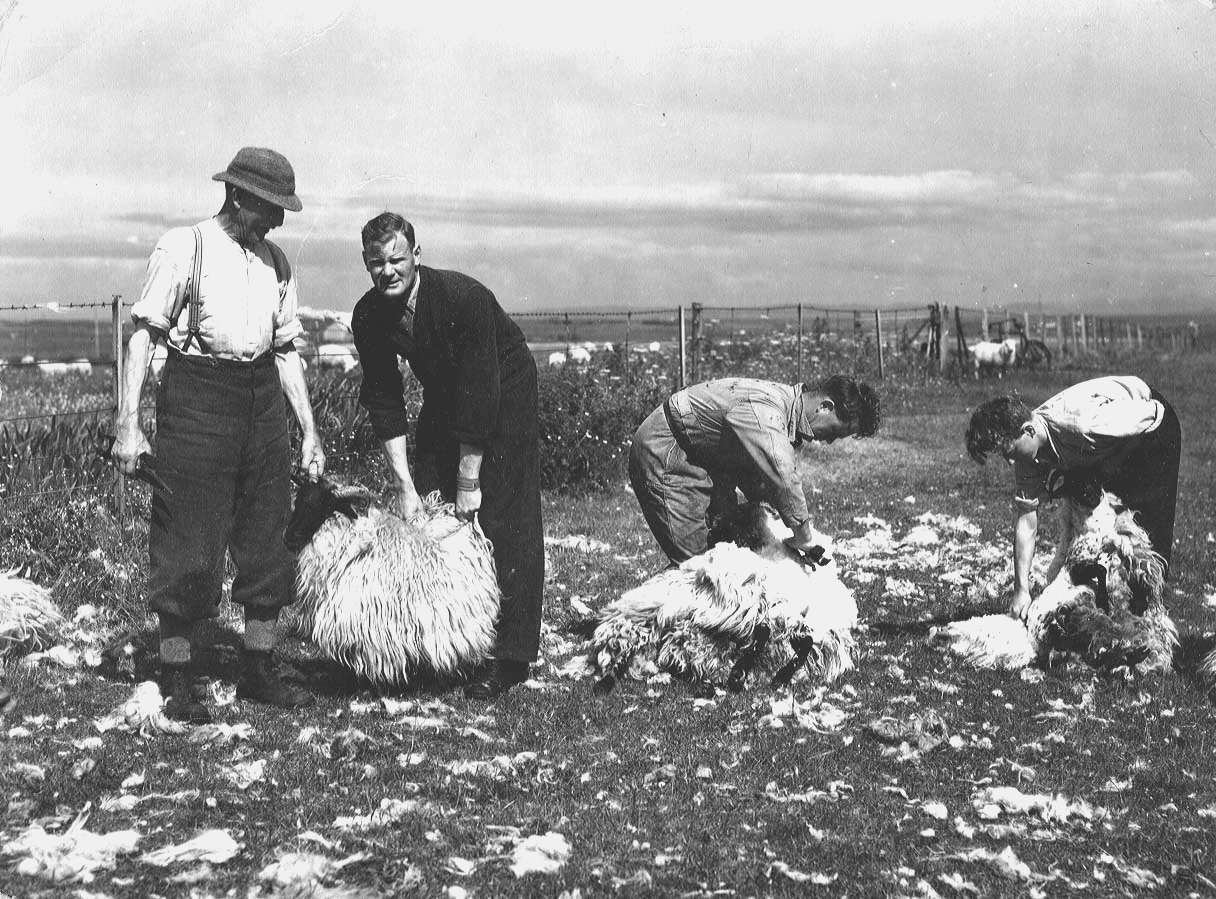
Photograph of sheep-shearing at Heylipol Farm in the 1940s.
Courtesy of Mrs Cathie Omand
From left to right, farm manager John Hume, factor Iain MacLaren, Lachie MacFarlane of Hynish and Neil MacLean of Heylipol are clipping black-faced sheep at Heylipol Farm using hand shears in the 1940s. Hogs are sheared at the end of May or the beginning of June. Sheep with lambs are sheared in July when the weather is warmer.
Crofters would send their best Cheviot fleeces to the Scottish Wool Growers mill in Brora on the Moray Firth to be made into blankets or spun into hanks known as ‘snath Gaidhealach’ (Highland wool). Wool prices plummeted in the 1980s coinciding with increasing use of feather duvets.
In Tiree nowadays, Suffolk tups (rams) are commonly put to ‘mule’ ewes, a black-face/Blue Leicester cross. The Blue Leicester input maintains the quality of the fleece and produces a larger lamb.
Black and white photograph of sheep-shearing at Heylipol Farm in the 1940s.
Sheep-shearing at Heylipol Farm in the 1940s. L-R: shepherd John Hume; factor Iain MacLaren; Lachie MacFarlane, Hynish; Neil MacLean, Heylipol Farm.
Photograph of WAAFs on the steamer ‘Lochearn’ in 1945.
Courtesy of Mrs Jean Inglis
The Women’s Auxiliary Air Force (WAAF) was created in 1939. Although WAAFs did not serve as aircrew, they played a vital role in transport, communications, meteorology, aircraft control and intelligence.
The group of WAAFs in this photo were leaving Tiree on the steamer ‘Lochearn’. Jean Inglis née Davies from Edinburgh (back row, extreme right) spent two years underground at 18 Group HQ, Coastal Command at Rosyth before being posted to Tiree in May 1945.
Jean was a wireless operator and, with her team, made contact with aircraft in the area, on one occasion helping to guide a damaged plane to a safe landing on the island.
Black and white photograph of WAAFs on `Lochearn` during WWII.
WAAFs on the `Lochearn` during WWII. L-R: (back) Joy Pearce, London; Nan Hogarth, Whitby; unknown; Jean Inglis nee Davies, Edinburgh; (front) Flora Semple, Aberdeen; Marjorie Pollard, Burnley; Jean Hind, England. Jean Inglis spent two years underground at 18 Group HQ, Coastal Command at Rosyth before being posted to Tiree on 27/5/1945. LACW (leading aircraft woman) Jean Hind was a Wireless Operator who met Wing Commander Bryn Lewis while both serving on Tiree on 8 July 1944). They married on 9 July 1950. Nan Hogarth was also a LACW Wireless Operator.
Audio cassette recording of John Fletcher, Balemartine, interviewed by Maggie Campbell on 8/2/2003.
John Fletcher of Balemartine talks to Maggie Campbell in March 2003 about different methods of domestic lighting, such as oil lamps, Chinese lanterns and Tilley lamps, their use and maintenance, before electricity came to Tiree in the mid-1950s; also the use of dog-fish liver oil in the cure of ringworm and scurvy. Tha Iain Fletcher a Baile Mhartainn a’ bruidhinn ri Magaidh Chaimbeul ann am Mart 2003 mu dòighean soillse de gach seòrsa ann an dachaigh mar làmpa ola, làmpa Shìna agus làmpa Tilley, am feum agus an dòigh air an cumail an òrdugh mun dh’ thàinig an dealan do Thiriodh anns na leth-ceudan, cuideachd feum ola grùthan a’ bhearaich airson leighis buaileag-thimchill agus an t-achas tioram.
Letter to the Editor of the Scots Magazine, September 1999, from Malcolm Till, about a visit he made to Tiree in 1993, where he met ex-serviceman George Hambling, a New Zealander posted to the RAF station on Tiree during World War II.