


Black and white photograph of war graves at Soroby graveyard.
World War II graves at Soroby.
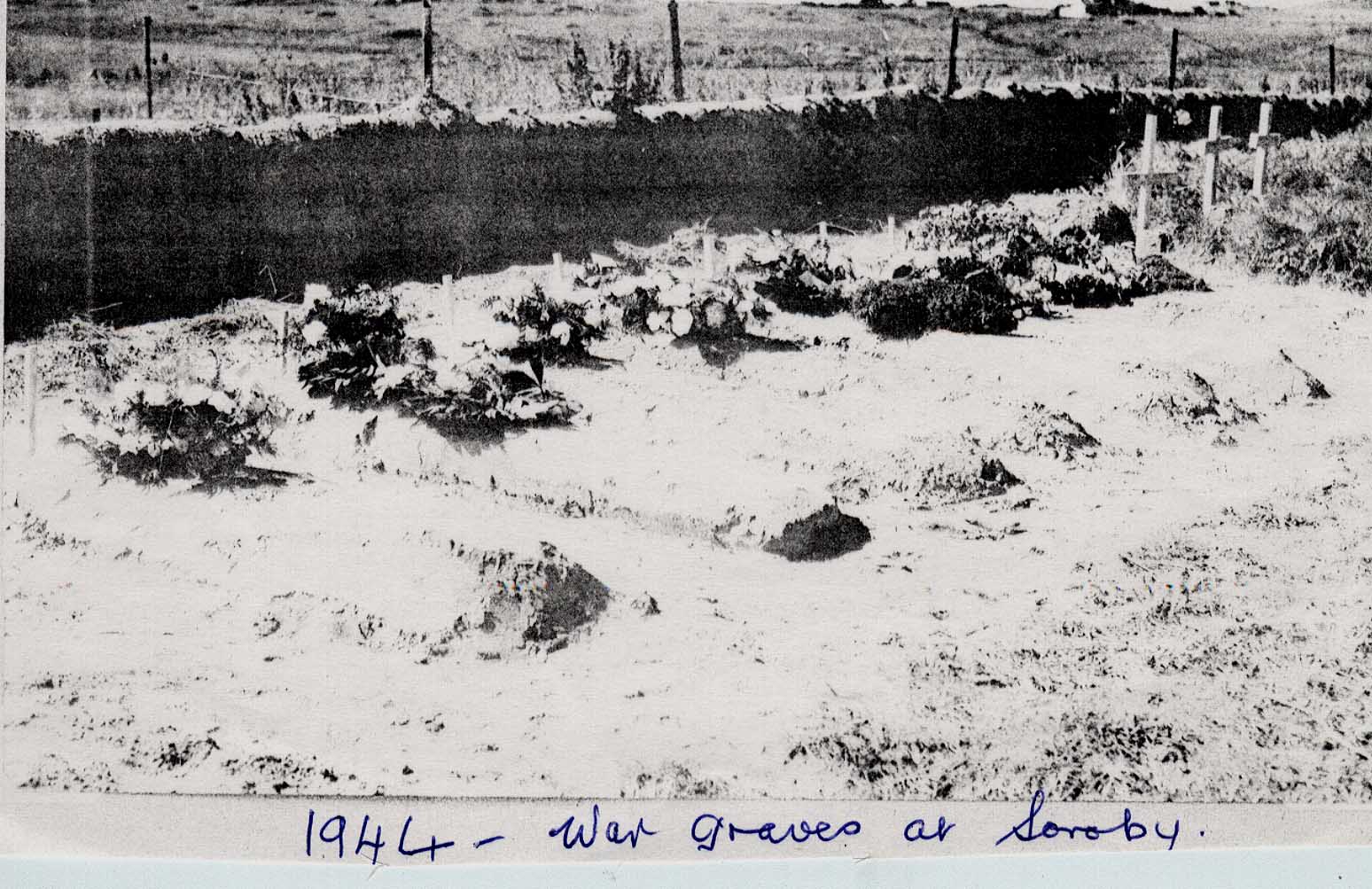

Black and white photograph of war graves at Soroby graveyard.
World War II graves at Soroby.
Black & white photograph of Mrs Revilliod and Grace Campbell of Tullymet, Gott, at the graveside of Flt. Lt. Leonard Revilliod who was killed in a mid-air collision over Island House in August 1944.

Courtesy of Mrs Grace Campbell
On the 16th August 1944, two Halifax aircraft from 518 Squadron took off for air tests before their usual nightly weather reconnaissance flights. They lost sight of each other in patchy cloud and collided, killing all on board.
An eyewitness on the top of Ben Hynish reported seeing one plane taking off while the other was coming in. ‘They appeared to come so close to each other that they tipped wings…and the next thing the two of them went up in flames and you could see the wheels with the tyres burning and falling right to the ground…’
One of those killed was Flight Lieutenant Leonard Revilliod, a grandson of the Czechoslovakian Prime Minister, Jan Masyrak, who flew with his daughter-in-law to Tiree for the funeral. The photograph shows Grace Campbell and Mrs Revilliod at her son’s graveside at Soroby in Balemartine.
Audio cassette recording of Hugh MacLeod, Cornaigbeg, interviewed by Maggie Campbell on 1/3/2003.
Hugh MacLeod (Eòghann Charrachan) of Cornaigbeg talks to Maggie Campbell about predicting the weather from the direction of the wind, the moon, stars, tides and rainbows, the behaviour of birds, the view of the islands, how these predictions regulated the crofting year in his younger days and how the weather has changed since then. Tha Eòghann Mhic Leòid a Cornaig Bheag a’ bruidhinn ri Magaidh Chaimbeul mu chomharradh na side a rèir na gaoithe, a’ gealach, na rionnagan, an tràghadh ’s an lìonadh, na boghachan-frois, cleachdadh nan eòin, sealladh nan eileanan agus mar a bha comharradh a riaghail bliadhna croitearachd ann an laithean òige.
Booklet titled `The Tiree Crofter`s Struggle 1886-1986` produced by Alex MacArthur in 1986.
Booklet produced to mark the centenary of the Tiree crofters` struggle for security of tenure.
Photocopied programmes of events held in Tiree during WWII.
Photocopied programmes of events held in Tiree during WWII including plays, revues, church services and sports.
Photocopied newspaper cutting about the Tiree Regatta in 1948.
Account of the 1948 Tiree regatta with list of prize-winners.
Photocopied magazine article about Tiree during WWII.
Article about RAF Tiree and weather reconnaisance flights by 518 Squadron.
Metal tin containing empty ointment boxes, empty lozenge tins and a pin-on apron. It also used to contain sterile dressings.

Doctor`s bag dating from WWII and medical equipment belonging to donor`s father, Dr Stuart Robertson.

Doctor`s bag dating from WWII belonging to Dr Stuart Robertson, GP in Margate 1926-40 and in Bournemouth 1940-60. Bag contains: an emergency enema in an envelope with a letter from the manufacturer`s Harker Stagg Ltd dated February 1959; empty bluish glass bottle with glass stopper; black case inscribed with Dr Stuart Robertson conatining 7 empty phials (pethidine, mogadon, etc); suspensory bandage from Army & Navy Stores in its box; Leslies Ltd catalogue dated August 1940 of medical and surgical plasters; empty glass bottle with cork stopper labelled Alkia Saltrates;packet of surgical staples; metal case containing glass syringe and hypodermic needles; brown glass jar containing collosal iodine ointment; two aluminium spatulas; screw top metal box of surgeons` finger stalls; lance; tongue depresser; box containing seven tubes of horsehair sutures and needles.

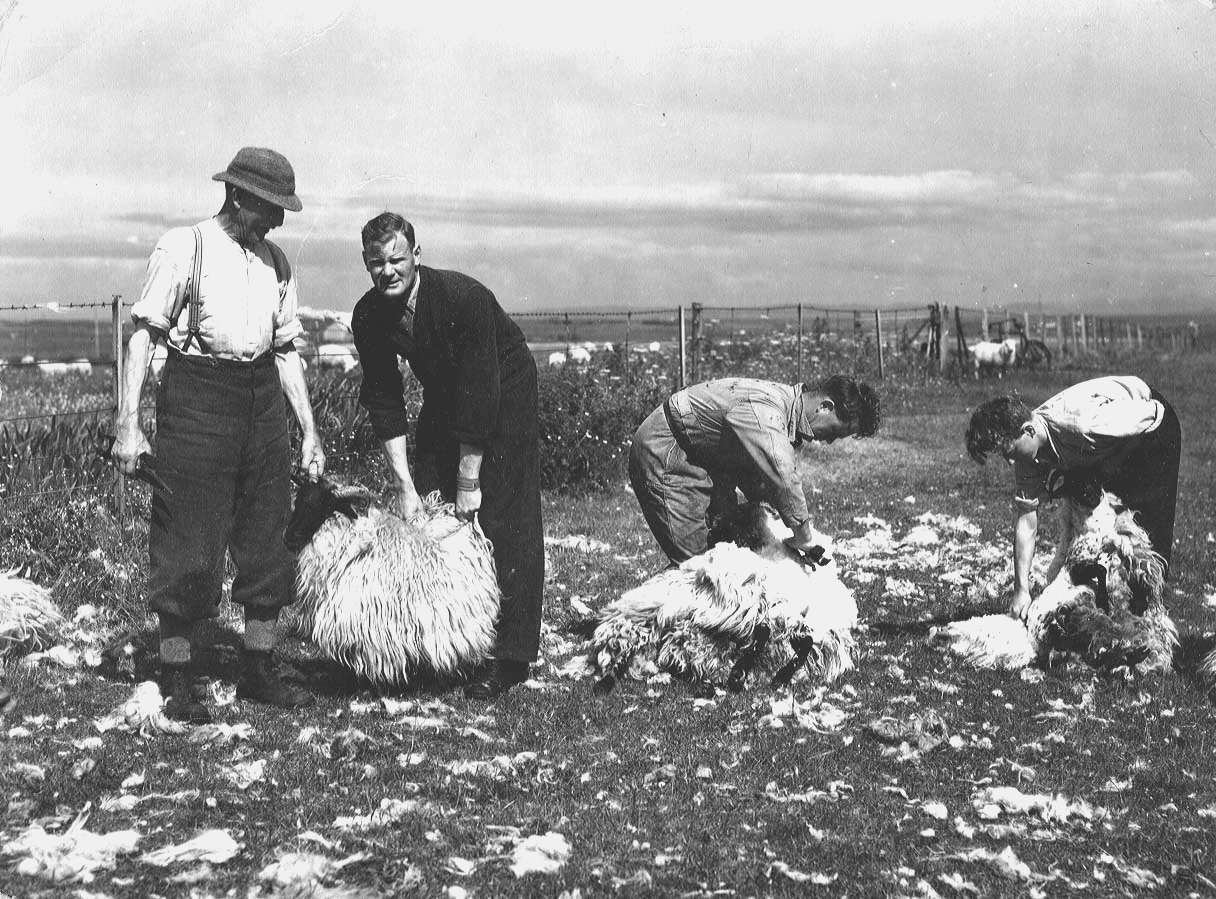
Shearing sheep at Heylipol Farm in the 1940s
Photograph of sheep-shearing at Heylipol Farm in the 1940s.
Courtesy of Mrs Cathie Omand
From left to right, farm manager John Hume, factor Iain MacLaren, Lachie MacFarlane of Hynish and Neil MacLean of Heylipol are clipping black-faced sheep at Heylipol Farm using hand shears in the 1940s. Hogs are sheared at the end of May or the beginning of June. Sheep with lambs are sheared in July when the weather is warmer.
Crofters would send their best Cheviot fleeces to the Scottish Wool Growers mill in Brora on the Moray Firth to be made into blankets or spun into hanks known as ‘snath Gaidhealach’ (Highland wool). Wool prices plummeted in the 1980s coinciding with increasing use of feather duvets.
In Tiree nowadays, Suffolk tups (rams) are commonly put to ‘mule’ ewes, a black-face/Blue Leicester cross. The Blue Leicester input maintains the quality of the fleece and produces a larger lamb.
Black and white photograph of sheep-shearing at Heylipol Farm in the 1940s.
Sheep-shearing at Heylipol Farm in the 1940s. L-R: shepherd John Hume; factor Iain MacLaren; Lachie MacFarlane, Hynish; Neil MacLean, Heylipol Farm.