Marion MacDonald churning butter at Sandaig
Photograph of Marion MacDonald churning butter at Sandaig in the 1940s.
Courtesy of Ms Linda Gowans
Marion MacDonald was photographed by George Holleyman churning butter outside her thatched house in Sandaig during World War II. The churn consists of a narrow wooden barrel (about 300 mm wide and 650 mm tall) and a plunger. At the end of the plunger is a wooden disc with holes drilled in it.
Milk would be left to stand in a metal basin and the cream skimmed off using a saucer or clam shell into an earthenware butter crock. The cream would be strained through muslin into the scalded churn and agitated using the plunger.
Once the butter had formed, it was put into cold water then slapped between the hands to remove excess liquid. The remaining buttermilk would be drunk or used for baking.
Black and white photograph of Marion MacDonald, Sandaig.
Marion MacDonald is pictured churning butter outside her thatched house in Sandaig, Tiree. The churn consists of a narrow wooden barrel (about 300 mm wide and 650 mm tall) and a plunger. At the end of the plunger is a wooden disc with holes drilled in it. Milk would be left to stand in a metal basin and the cream skimmed off using a saucer or clam shell into an earthenware butter crock. The cream would be strained through muslin into the scalded churn and agitated using the plunger. Once the butter had formed, it was put into cold water then slapped between the hands to remove excess liquid. The remaining buttermilk would be drunk or used for baking.
Black and white photograph of a horn spoon, a serving mallet and a butter pat.
Horn spoon from Balevullin (left); serving mallet made of whalebone found in a ruined cottage in Caoles (middle); wooden butter pat (right), all photographed by George Holleyman.
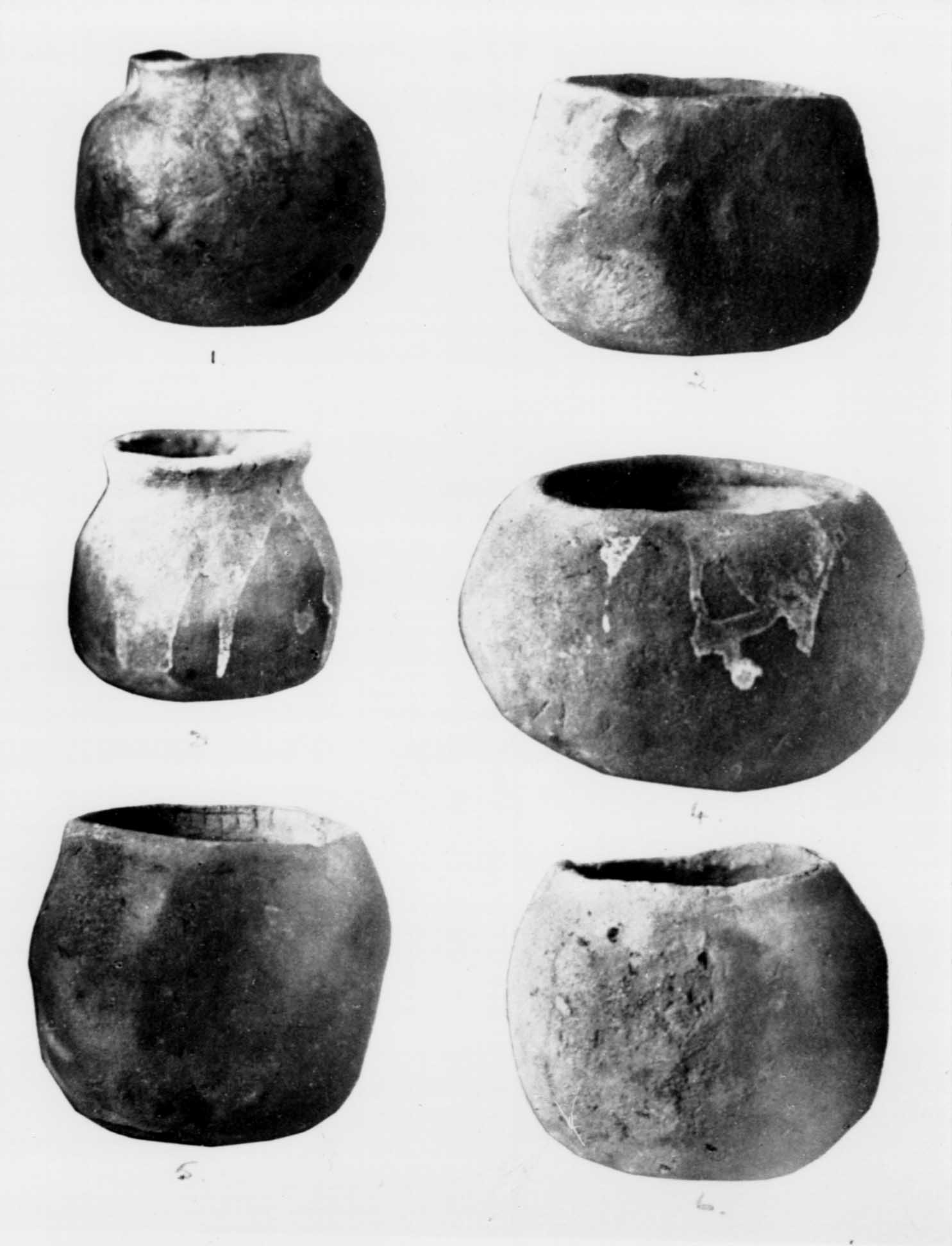
Black and white photograph of six Tiree craggans.
Six Tiree craggans photographed by George Holleyman between 1941 and 1943, and published in the paper ‘Tiree Craggans’, by G. A. Holleyman, in Antiquity 21, December 1947, pp 205-211. On the original slide, the craggans are captioned individually: 1 from Sandaig, 2 from Balevullin, 3-6 made by Hugh MacNeil in 1942.
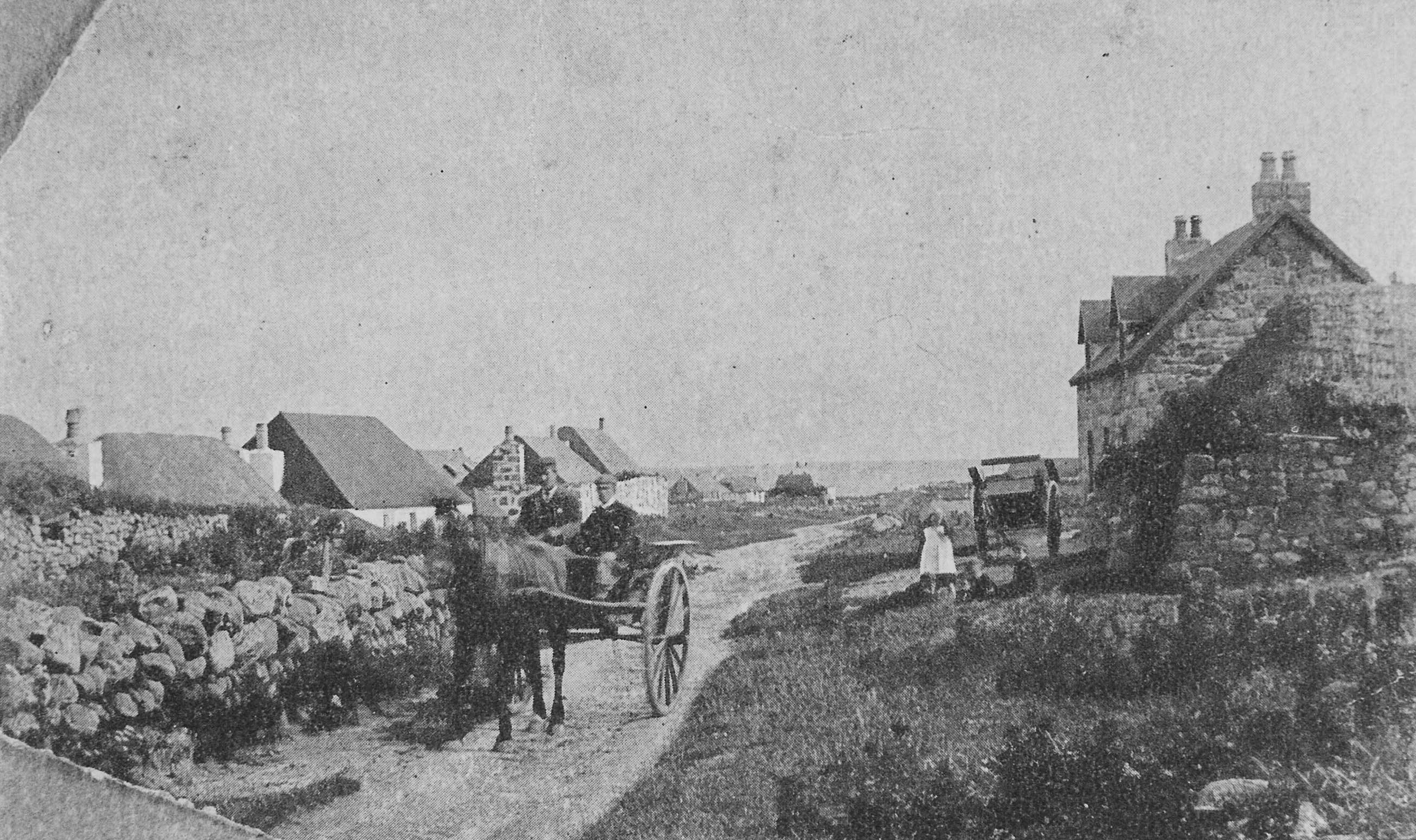
Black and white photograph of Mannal.
View of Mannal looking south with two men in a horse-drawn cart and children playing at the side of the road. (Original photograph 1997.178.1)
Iain MacFarlane
Photograph of Iain MacFarlane with Eachunn the cat.
This photograph of the late 1920s or early 1930s shows Iain MacFarlane when he was working as ‘am buachaille’ or herd boy in the east end of Tiree. Herding was done by boys when they left school at 14 and sometimes by old men.
As the common grazings and many fields were unfenced, their job was to keep cattle, sheep and horses within the township boundaries and out of the crops. Until wire fencing was introduced in the 1890s, fields were sometimes enclosed with turf or stone walls.
From May to October, Iain would have stayed in a ‘bothag’, a small round building constructed of stone and roofed with turfs over a timber frame. He died at sea at the beginning of World War II.
Black and white photograph of Iain, the herd boy, with Eachann the cat.
Photograph from a small album from Silversands, Vaul, titled `Iain, the herd laddie`, identified as Iain MacFarlane, (brother of Lachie MacFarlane of Hynish) by Chrissie, Lachie`s widow. Iain died at sea at the beginning of WWII. Probably taken in the late 1920s to early 1930s.
Crocheted doilly made by Isabella MacArthur.
Circular doilly 275 mm in diameter crocheted from white cotton with purple and gold lurex details, made by Isabella MacArthur (nighean a` mhinisdeir), Balephuil in the 1940s and given to Nan and David MacClounnan after their marriage in 1949.

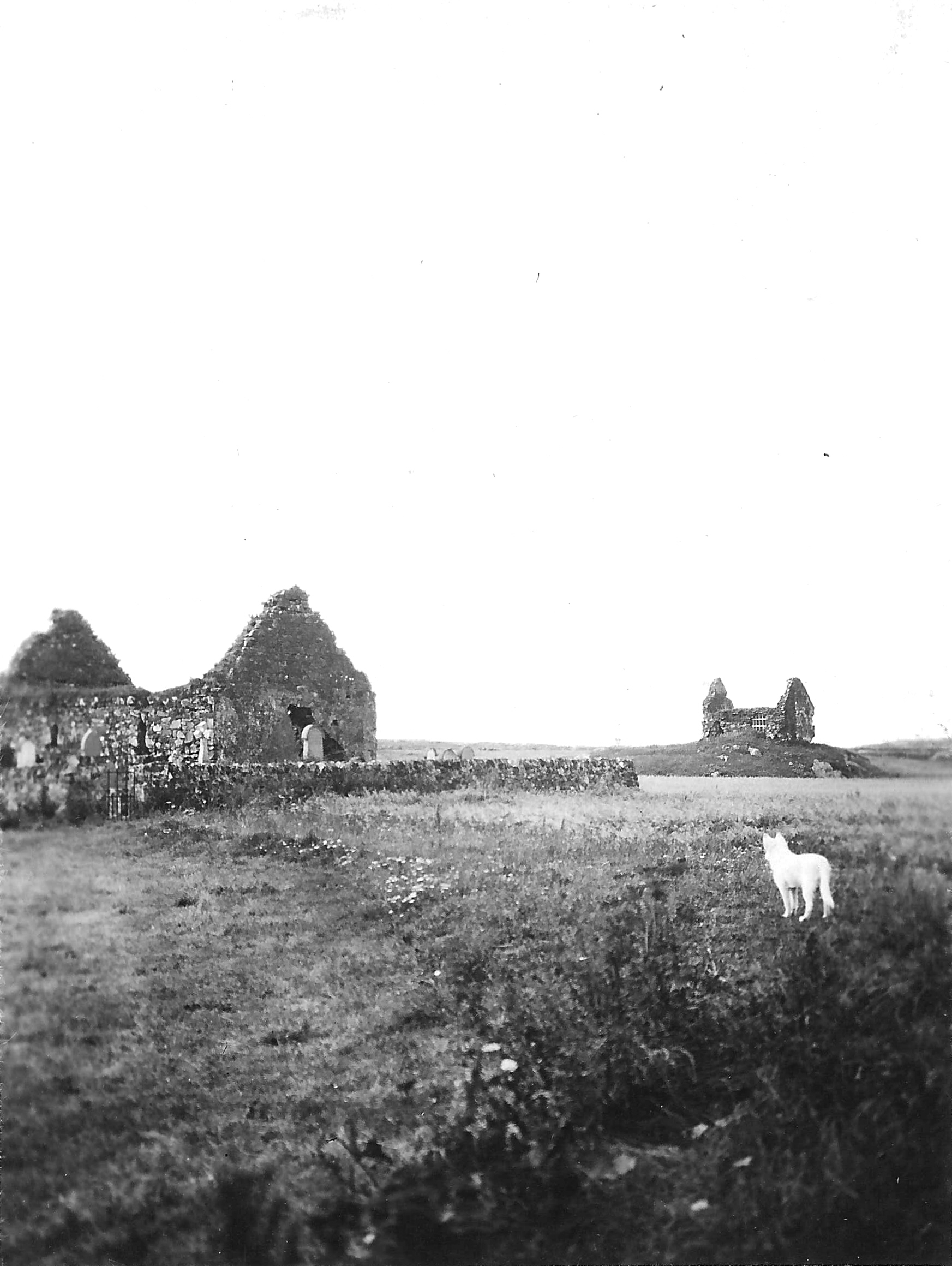
Black and white photograph of the Kirkapol Chapels in 1912.
The Kirkapol chapels with Lady Frances Balfour`s samoyed, Vaul, in the foreground, taken in 1912.
Corn stooks at Ruaig
Postcard of corn stooks at Ruaig in the mid-20th century.
This postcard shows a field of corn stooks at Ruaig in the mid-20th century. The corn was cut and bound into a ‘sguab’ (sheaf) using two handfuls pulled from the sheaf to make a ‘bann’ (tie). These were lined up into an ‘adag’, a short double row of eight to ten sheaves.
The old men were very particular to line up the row of ‘adagan’ in the field so that you could see ‘gobhal na h-adaig’ (the gap between the sheaves) from one end of the field to the other. If cut slightly unripe because of the weather, the sheaves were turned every day until they ripened.
Harvesting was hard, thirsty work and a tin of ‘sùgh min-choirce’ (cold well water mixed with oatmeal) was kept in the shade of an ‘adag’ to provide a refreshing drink.
Black and white postcard of Ruaig.
Ruaig with corn sheaves in the foreground and L-R Taigh Eoghainn Iain na Hongs (Ruaig Post Office in the 1930s) and Taigh Dhonnchaidh or Alasdair Dhonnchaidh (Ruaig Post Office in the 1970s).
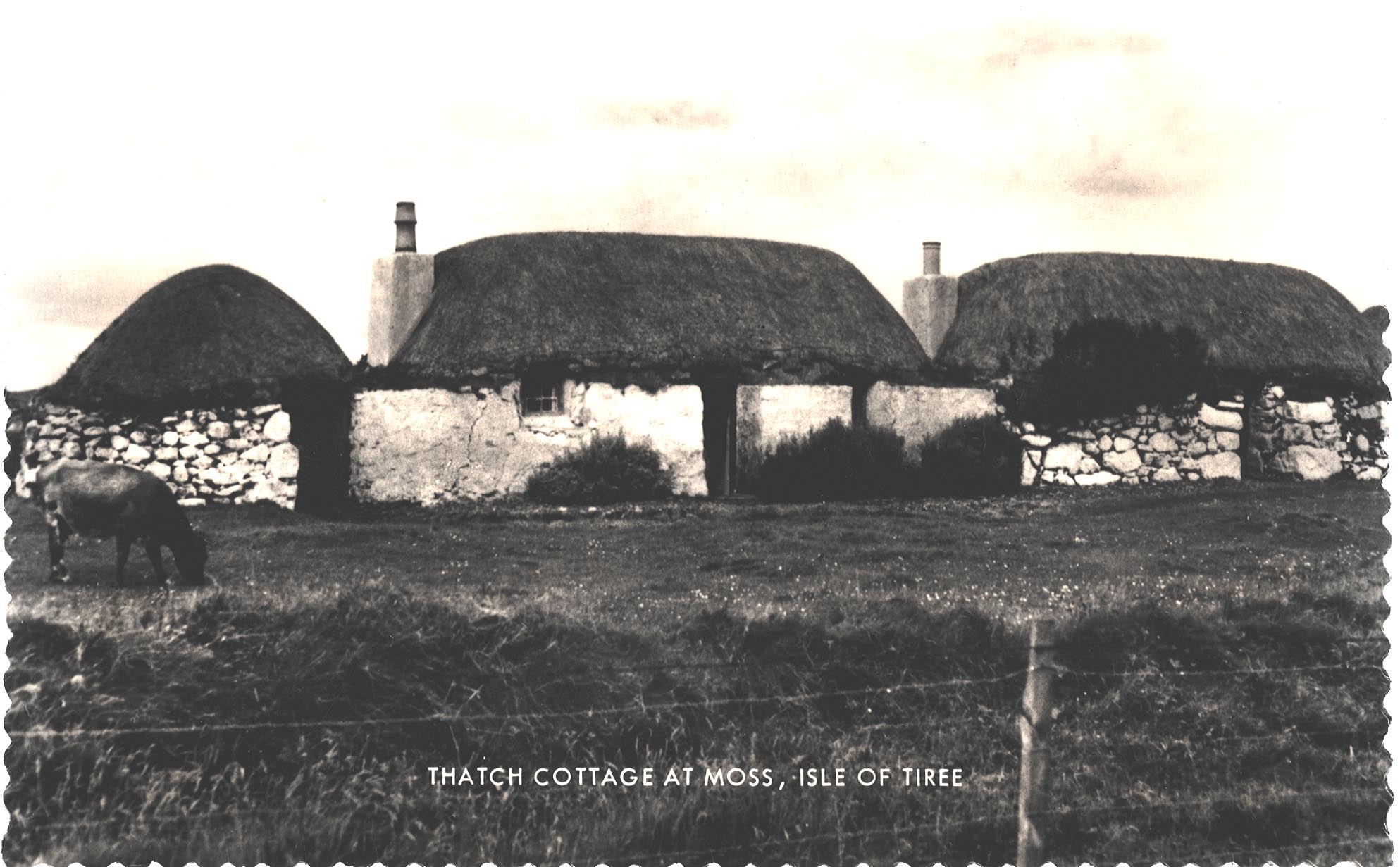
Black and white postcard of the thatched house at Moss.
The thatched house and outbuildings in Moss.
Black and white postcard of drawing of Caoles.
Drawing of Caoles with cultivated fields, crofthouses, stackyards and a view of Coll in the background.