


Large stoneware jar with lid, 240 mm high, 233 mm in diameter, bottom half uncoloured, top half with orange-brown glaze, from Taigh Peigi in Kilmoluaig.


Large stoneware jar with lid, 240 mm high, 233 mm in diameter, bottom half uncoloured, top half with orange-brown glaze, from Taigh Peigi in Kilmoluaig.
Set of two dowsing rods made and used by John MacFadyen, Caoles.

Medical equipment from Tiree Airport.
Medical equipment found at Tiree Airport, consisting 4 tourniquets, 1 corkscrew (1960), 1 urinometer, 2 x 4oz cotton wool (1952), 2 magnifying glasses, ether masks, airways, needle holder (1959), assorted catgut ampoules size 0.1, aromatic ammonia capsules, standard dressing no. 9, 2 standard dressings no. 12 (1945), Enflavine dressing no. 12, 3 shell dresssings (1944), dibromopropamidine cream, eye solution no. 1, finger dressing, sterliser with burner, 2 blood administration sets, 6 chloroform ampoules (1939; empty), 2 silkworm gut.

Gas mask with carrying bag from Scarinish Police Station, with `Light II M&CoH 5/44` printed on inside of bag flap, probably issued during WWII.

Brown glass disinfectant bottle with glass stopper labelled `Dettol` from the doctor`s surgery in Baugh.

Red ensign flag from the MV Loch Seaforth.
Red ensign from the CalMac ferry, MV Loch Seaforth, which sank at Tiree pier in the 1970s after scraping the rocks in Gunna Sound.

Off-white damask tablecloth with fringed edges said to have been made from spun bog cotton.

The fibres of bog cotton, or Common Cottongrass Eriophorum augustifolium, were used to stuff pillows and children’s mattresses, for wound dressings during the First World War, and in wicks for candles. The short, fragile fibres are, however, almost impossible to spin pure. A tradition collected by Alexander Carmichael in the nineteenth century set the task: “Canach an t-slèibhe/No maiden could get a man of old till she had spun and wove and sewn with her own hands a shirt of the canach. This was the marriage test!” (CW89/112 f.23v). There are a pair of stockings in the Orkney Museum in Kirkwall that are labelled: “made from bog cotton”. This reflects another tradition that a bride should wear bog cotton stockings on her wedding night. In the 1851 Great Exhibition catalogue (page 82) there is an entry from Inverness: “Linsey-woolsey made of cheviot wool and bog cotton. Bog cotton fibres can be spun if combined with other, longer, fibres like wool, linen or cotton.”
Cheese press or fiodhan.
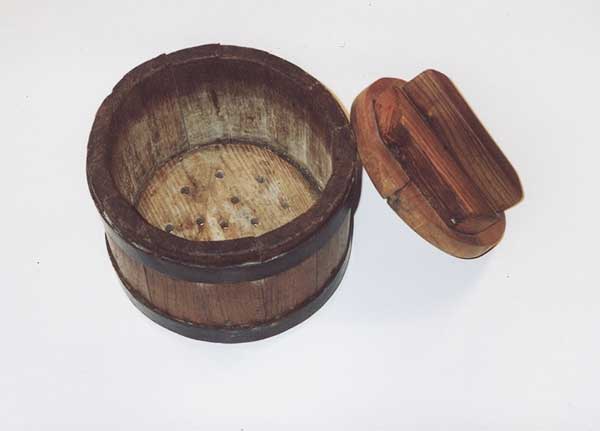
Courtesy of Mrs Meena Knapman
Probably made at the end of the 19th century by Donald MacLean of Whitehouse, Cornaigbeg, this wooden vat (known in Gaelic as a ‘fiodhan’) would have been used until the 1950s to make cheese.
Standing 165 mm high and with a diameter of 250 mm, the staves are bound with two iron hoops. Holes have been drilled in the sides and base to allow the whey to drain out.
The curds wrapped in muslin would be put in the vat and the lid placed on top. This would be weighted with stones or screwed down in a cheese press for about a week.
Knickers made from a flour sack
Photograph of a pair of knickers made from a flour sack.

These women’s knickers were made in Tiree from a flour sack in the first quarter of the 20th century. The isolation of the crofting community on Tiree made it necessary to make do with the materials to hand.
The knickers were sewn by machine with flat seams and decorated with hand-made tatting round the legs. The waist may have been elasticated or tightened with a drawstring.
Flour was purchased in 140 lb (65 kg) sacks made from closely woven cotton. The seams would have been unpicked and the material plastered with black soap (‘siaban dubh’) to remove the printing before putting it outside to bleach in the sun. The flour producer’s name, Harter, is still visible.
Black and white postcard of St Patrick`s chapel.
St Patrick`s chapel, Kennavara, showing gable end.
