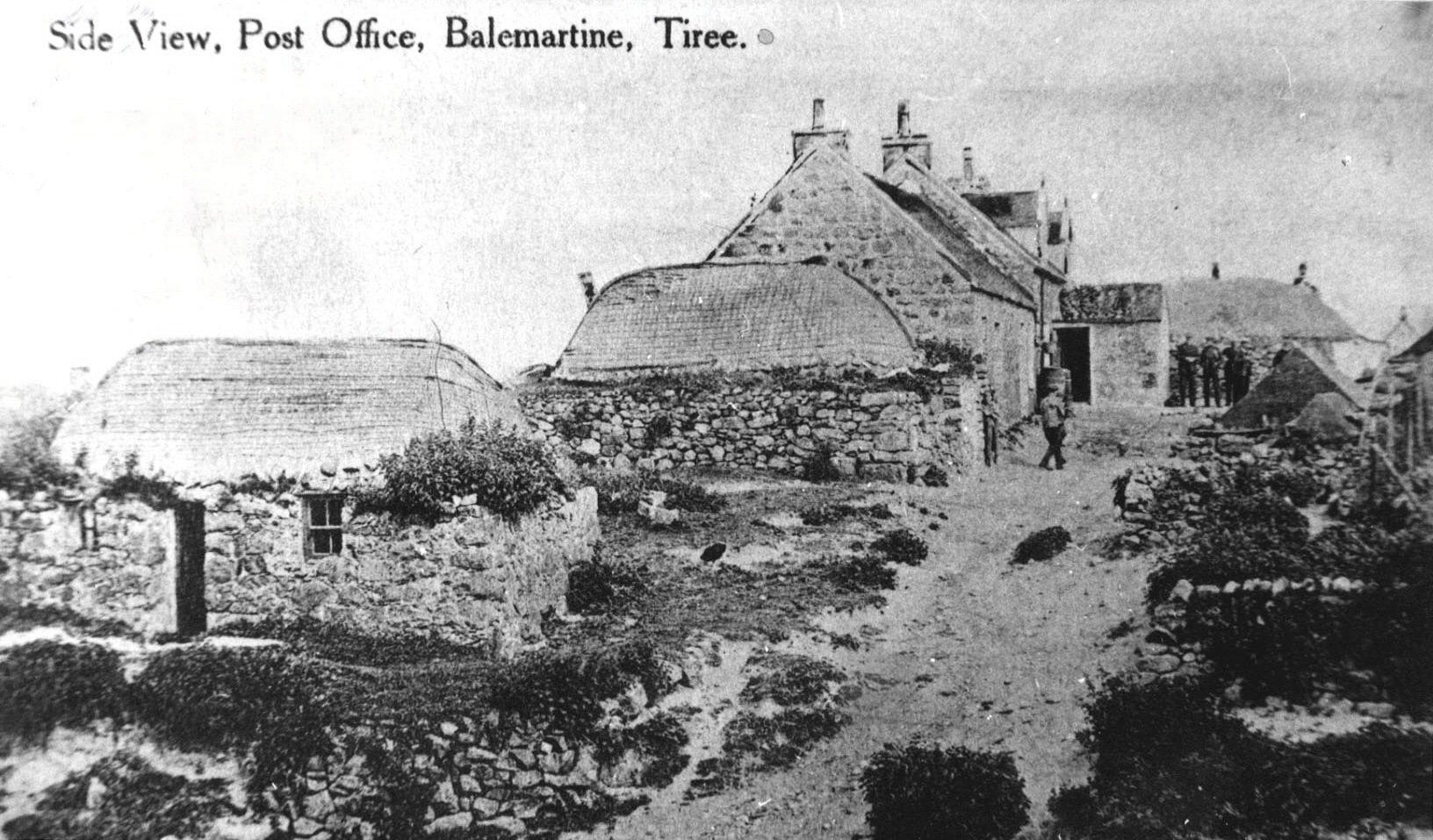
Postcard of Balemartine Post Office in Balinoe in the 1920s.
Courtesy of Mr Neil MacArthur
This postcard of Balemartine shows the Post Office and surrounding houses as they were in the 1920s. Tiree’s first post office was established in 1802 in Scarinish. Originally spelled Tyree, the name was changed in 1889 to avoid confusion with Tyrie in Aberdeenshire.
There were no internal delivery services until the 1880s and these were by foot. In the following decade three sub-post offices were established at Balemartine, Cornaigmore and Ruaig. A fifth office was added in 1934 at Middleton.
At the beginning of World War II a civilian camp was built at Crossapol to house the thousand construction workers engaged in building the Coastal Command aerodrome. A sub-post office was opened at the camp which was later taken over by the RAF. This office closed around 1946.
Black and white postcard of Balemartine Post Office.
The Post Office and thatched houses at Cu’ Dheis in Balinoe, taken in the 1920s.
Black and white photograph of a Baptist meeting at Middleton House in 1956.
Baptist meeting at Middleton House in 1956. L-R: Elizabeth and John MacDonald, Barrapol (children at front); (front row) Flora MacDonald, Kilkenneth; Hugh MacEachern, Cornaigbeg; Christina Sinclair, Barrapol; Effie Walker nee MacDonald; Robert Tester (boy); Catriona MacArthur, Middleton Post Office (extreme right); (back row) Lachie MacKinnon, Park House; Charles MacDonald, Middleton (at back); Donald MacIntyre, Gott; Mary MacKinnon, Park House; John MacFadyen, Lochside, Barrapol; Duncan MacPhail, Loch Phuil, Balephuil; John Brown, Balephuil sliabh (behind Robert Tester).
Black and white photograph of Donald MacLean and Donald MacArthur at a coal puffer.
Unloading coal from the puffer at Traigh Iochain, Caoles, with Donald MacLean standing on the cart and Donald MacArthur at the head of the horse, probably 1930s.
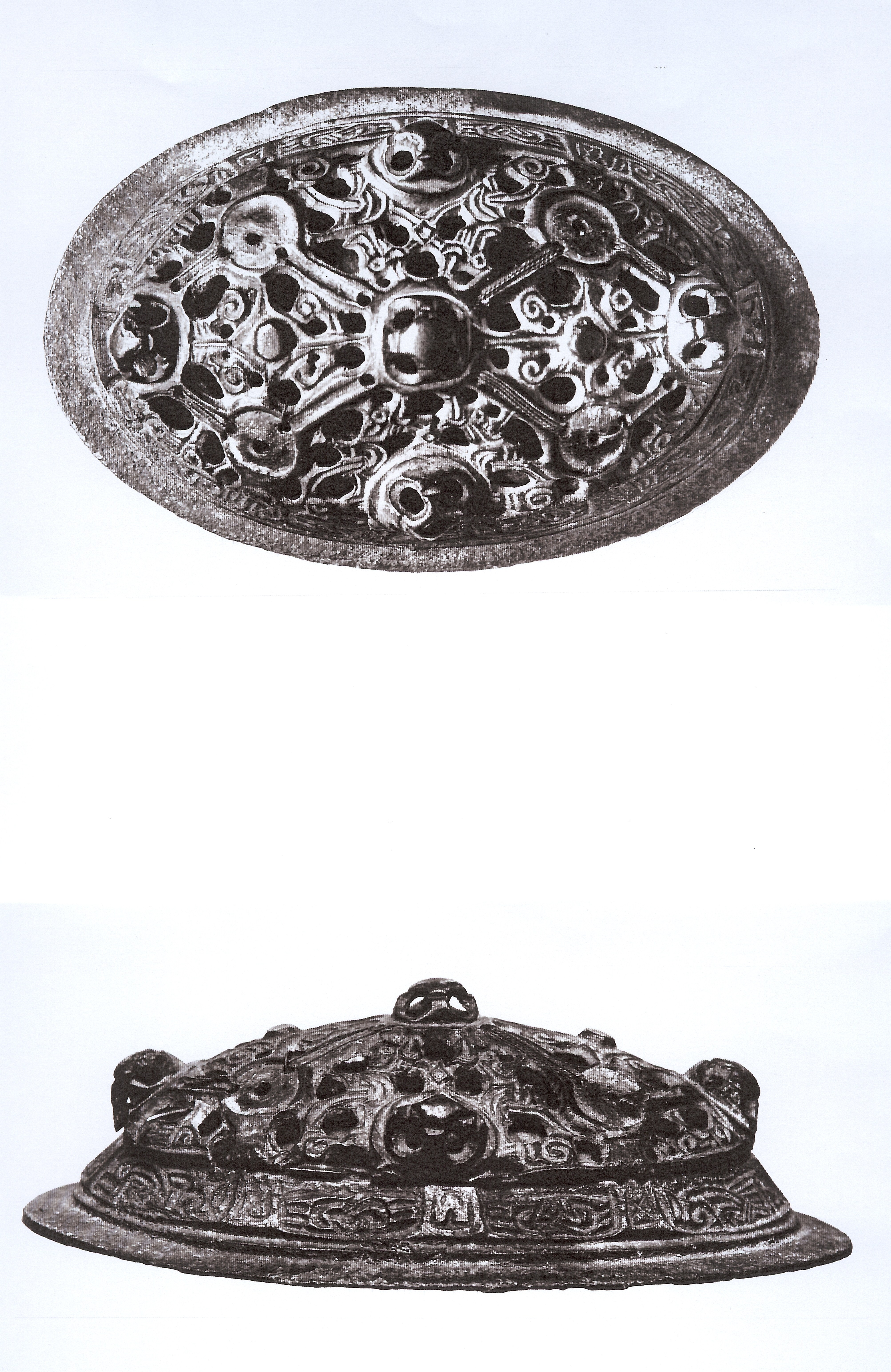
Photocopied photographs of a brooch found in a Viking burial site near Cornaigbeg.
This bronze ‘tortoise’ brooch was found with a bronze brooch-pin in a Viking burial site near Cornaigbeg some time before 1872, and was donated to the Royal Commission on the Ancient & Historical Monuments of Scotland. The exact location of the grave is no longer known.
Photograph of a pair of knickers made from a flour sack.
These women’s knickers were made in Tiree from a flour sack in the first quarter of the 20th century. The isolation of the crofting community on Tiree made it necessary to make do with the materials to hand.
The knickers were sewn by machine with flat seams and decorated with hand-made tatting round the legs. The waist may have been elasticated or tightened with a drawstring.
Flour was purchased in 140 lb (65 kg) sacks made from closely woven cotton. The seams would have been unpicked and the material plastered with black soap (‘siaban dubh’) to remove the printing before putting it outside to bleach in the sun. The flour producer’s name, Harter, is still visible.
Photograph of Marion MacDonald churning butter at Sandaig in the 1940s.
Courtesy of Ms Linda Gowans
Marion MacDonald was photographed by George Holleyman churning butter outside her thatched house in Sandaig during World War II. The churn consists of a narrow wooden barrel (about 300 mm wide and 650 mm tall) and a plunger. At the end of the plunger is a wooden disc with holes drilled in it.
Milk would be left to stand in a metal basin and the cream skimmed off using a saucer or clam shell into an earthenware butter crock. The cream would be strained through muslin into the scalded churn and agitated using the plunger.
Once the butter had formed, it was put into cold water then slapped between the hands to remove excess liquid. The remaining buttermilk would be drunk or used for baking.
Black and white photograph of Marion MacDonald, Sandaig.
Marion MacDonald is pictured churning butter outside her thatched house in Sandaig, Tiree. The churn consists of a narrow wooden barrel (about 300 mm wide and 650 mm tall) and a plunger. At the end of the plunger is a wooden disc with holes drilled in it. Milk would be left to stand in a metal basin and the cream skimmed off using a saucer or clam shell into an earthenware butter crock. The cream would be strained through muslin into the scalded churn and agitated using the plunger. Once the butter had formed, it was put into cold water then slapped between the hands to remove excess liquid. The remaining buttermilk would be drunk or used for baking.