


Black and white photograph of a dead killer whale on Crossapol beach.
Dead killer whale on Crossapol beach in 1989.
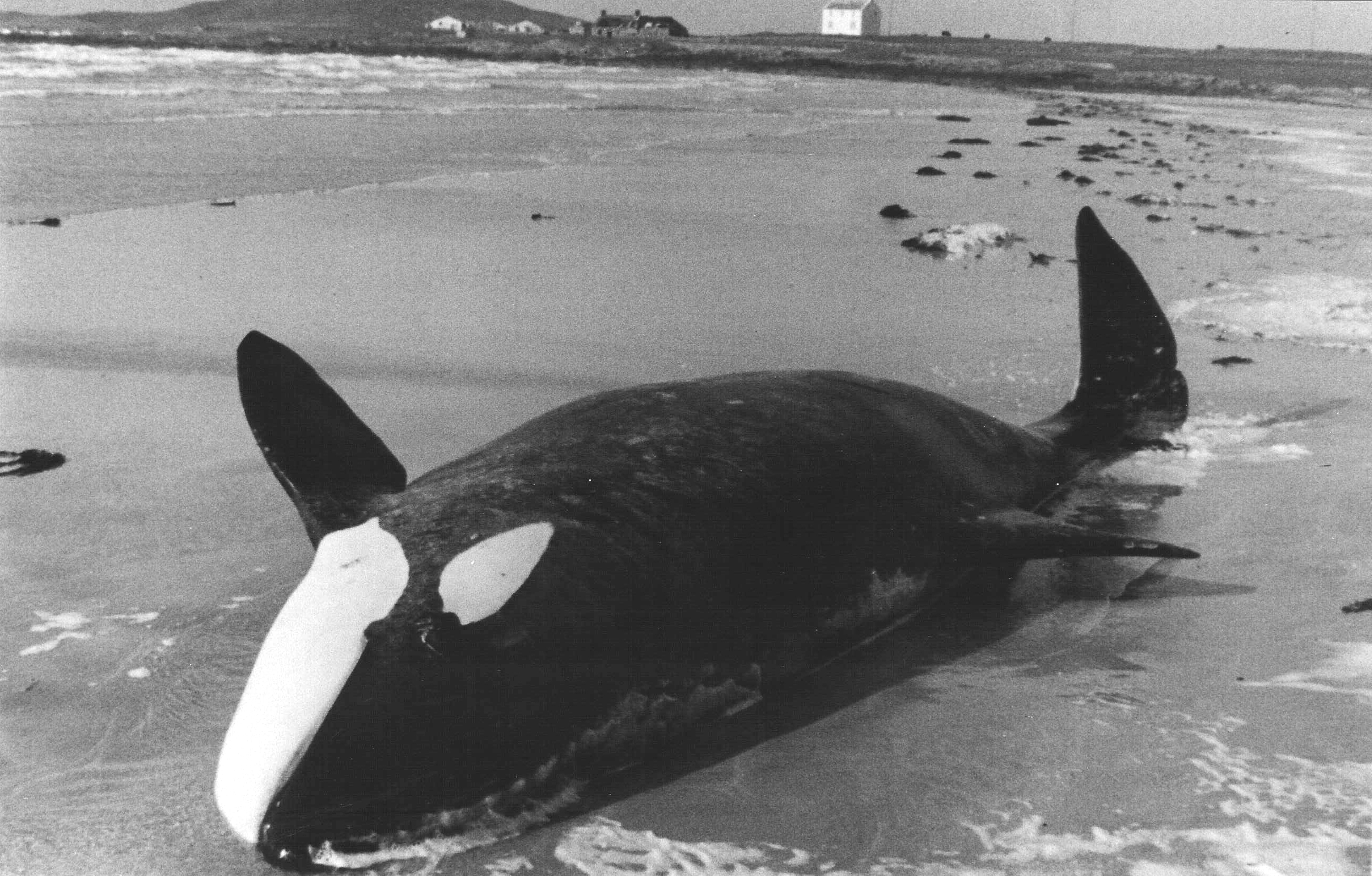

Black and white photograph of a dead killer whale on Crossapol beach.
Dead killer whale on Crossapol beach in 1989.
Black and white photograph of a lobster boat.
Lobster boat from Balephuil laden with with creels.

The Fever Hospital at Heanish
Photograph of the Fever Hospital at Heanish.

Courtesy of Mr Alasdair MacArthur
From the middle of the nineteenth century, Sanitary Laws were applied on Tiree to keep the island clean and infected patients were isolated. In 1892 the Sanitary Inspector visited the island and cautioned “several parties in regard to dung heaps in my opinion too near to houses”.
In 1893 three people died from typhoid which affected Balephuil. In 1895 an epidemic of scarlet fever swept through Tiree. The County Medical Officer, Dr. McNeill, had recommended the building of an isolation hospital on the island in 1893 and in 1905 the Fever Hospital was built in Heanish.
Made of corrugated iron lined with wood, it comprised two-bedded wards set at each end of the building with a kitchen, nurse’s room and bathroom in the centre. Outside was a washhouse, mortuary, disinfecting room and coalhouse. It was last used in the 1940s and sold in the 1960s as a private house.
Black and white postcard of Heanish machair and old the Fever Hospital.
Heanish machair and old the Fever Hospital. (Original postcard in Filing Cabinet 8 drawer 2)
Ruaig Public School Log Book 1919-1953.
Ruaig Public School Log Book for 14th January 1919 to 26th June 1953.

Balemartine Public School Log Book 1916-1933.
Balemartine Public School Log Book for 22nd April 1916 to 5th May 1933.

Laser print of a black and white photograph of Balevullin in 1922.
Balevullin in the early 1920s. (From Myra Lamont’s photograph album of the 1920s.)

Funeral procession at Soroby graveyard in the 1920s
Photograph of a funeral procession on its way to Soroby graveyard in the 1920s

Courtesy of Ms Rachel Wylie
Before World War II, coffins were made locally from lengths of sarking. MacArthurs’ shop in Scarinish supplied bundles containing black cloth, white cloth, a stack of embossed lead strips, eight handles and cords, and a black plaque, which were taken to the coffin-makers to complete the job.
On the day of the funeral, the mourners would gather outside the house where the coffin would be placed on two dining room chairs. After a short service the procession, traditionally composed only of men, would set off for the graveyard.
The coffin was carried on a bier by relays of men. They were accompanied by a basket containing cheese, oatcakes and whiskey to refresh the mourners on their journey which could be several miles long.
Laser print of a black and white photograph of a funeral procession on its way to Soroby in the 1920s.
Funeral procession on its way to Sorobaidh graveyard. (From Myra Lamont’s photograph album of the 1920s.)
Black and white group photograph taken outside Taigh a` Chiobair in wesy Hynish.
Unknown group of people outside Taigh a` Chiobair in West Hynish.

Black and white photograph of John Maclean of the Brae, Cornaigbeg.
John Maclean of the Brae, Cornaigbeg (Alec Mor`s father) with a Clydesdale stallion in the 1930s or 1940s.

Photocopied newspaper article about the Great Tea Race from China to London.
The Great Tea Race from China to London won by the `Taeping` captained by Donald MacKinnon of Heanish.
