Colour photograph of Jean MacCallum nee Watson of Balevullin, with a cow named ‘Lady Kathryn’.
When Jean’s grandson was courting his future wife, he bought a milking cow so that she could experience milk straight from a cow. He named the cow Lady Kathryn after her, and they made butter under Jean’s supervision. Unfortunately, however, the cow was bad tempered and only Jean was able to milk her.
Minidisk recording of Hugh MacLeod of Cornaigbeg talking to Maggie Campbell in November 2005.
Hugh MacLeod of Cornaigbeg talks to Maggie Campbell in November 2005 about the family of James Galbraith who was born in Gigha, and came with his family from Rothiemurchus, near Aviemore, to Balevullin to take the position of Head of the Parochial School at Balevullin in 1874. His daughter married into the MacDonald family of Kilmoluaig.
In a recording made in August in 2005, Mrs Jean MacCallum of Balevullin talks to Maggie Campbell about the clothes she wore to school in the 1940s. At the age of two, Jean was sent by Glasgow Corporation to be fostered by Alexander and Catherine Kennedy of Balevullin.
When she was fifteen, Jean was taken from Tiree by Glasgow Corporation, very much against her own and her foster family’s wishes, and placed in a Salvation Army home in Pollockshields. She was only returned to the island after her foster family took the matter to court.
Growing up on a Tiree croft, Jean developed a life-long love of the outdoors and of cattle. She later discovered that crofting was in her blood; her paternal grandmother had farmed into her eighties.
Photograph of Donald Archie Brown of Balevullin with an ‘àbh’.
Courtesy of Mr Donald Archie Brown
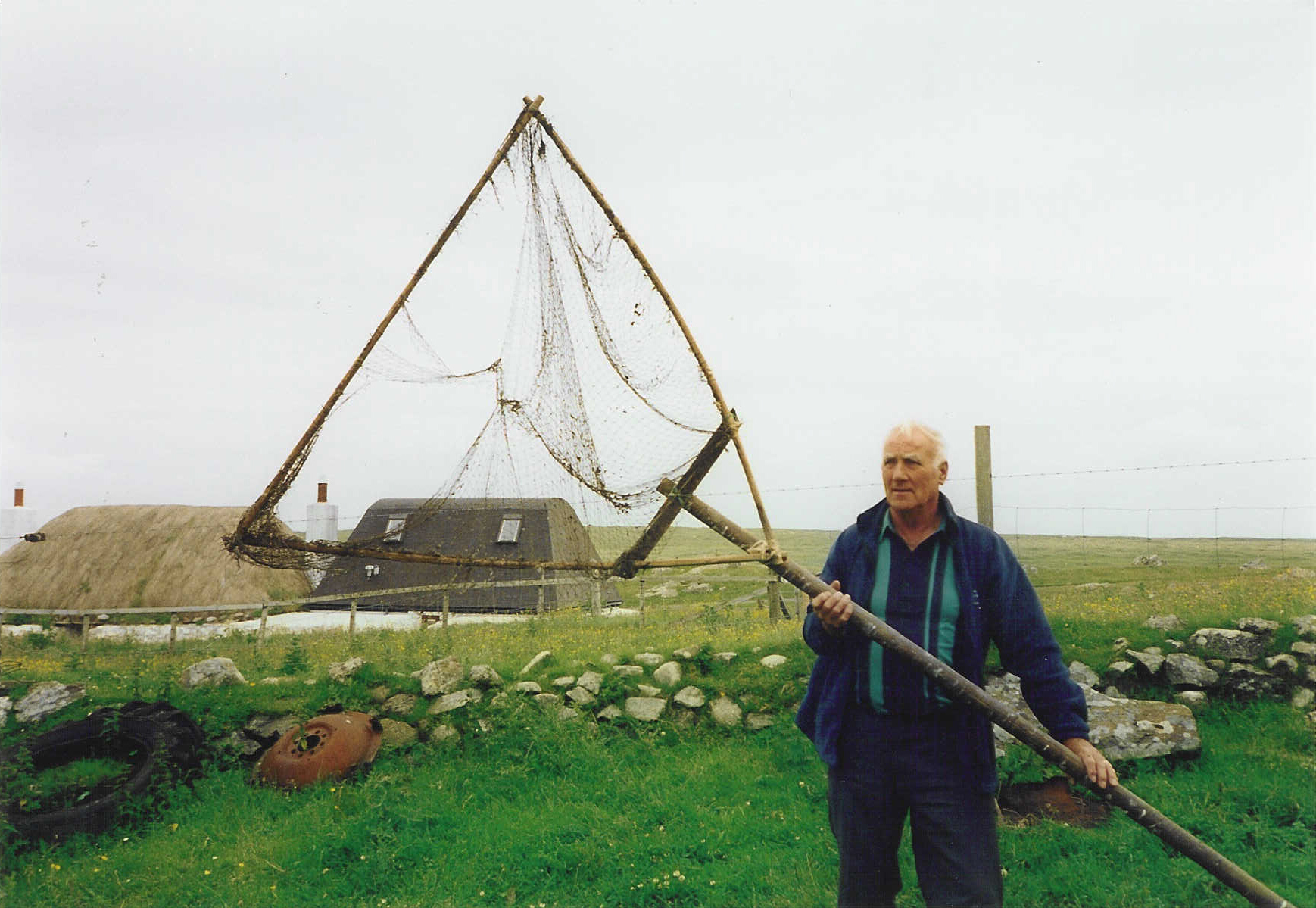
Donald Archie Brown from Balevullin is holding an ‘àbh’, a large triangular net on a long handle used to fish for cuddies (small fry) from certain rocks. Derived from the Old Norse word ‘haaf’ meaning sea, it may have been introduced to Tiree after the arrival of the Vikings in the 9th century AD.
The pieces of wood making up the ‘àbh’ were bound together with cord as nails or bolts would rust and split the wood. It was heavy and dangerous with a full net and used only by stronger, more experienced men.
The best time to use the ‘àbh’ was at dusk. The fish were brought close to the rock with bait, traditionally by spitting out chewed raw limpets. Then a handful of ‘siaban’, dried shell sand, was thrown on the surface of the water so that the fish could not see the net coming from above.
Colour photograph of Donald Archie Brown with an `abh` in 2004.
Donald Archie Brown of Balevullin with an `abh` made from an oar and herring net belonging to Donald Kennedy and made by Donald MacNeill, photographed by Dr John Holliday in August 2004.
Photograph of Donald Archie Brown of Balevullin spinning horsehair fishing line.
Courtesy of Mr Donald Archie Brown
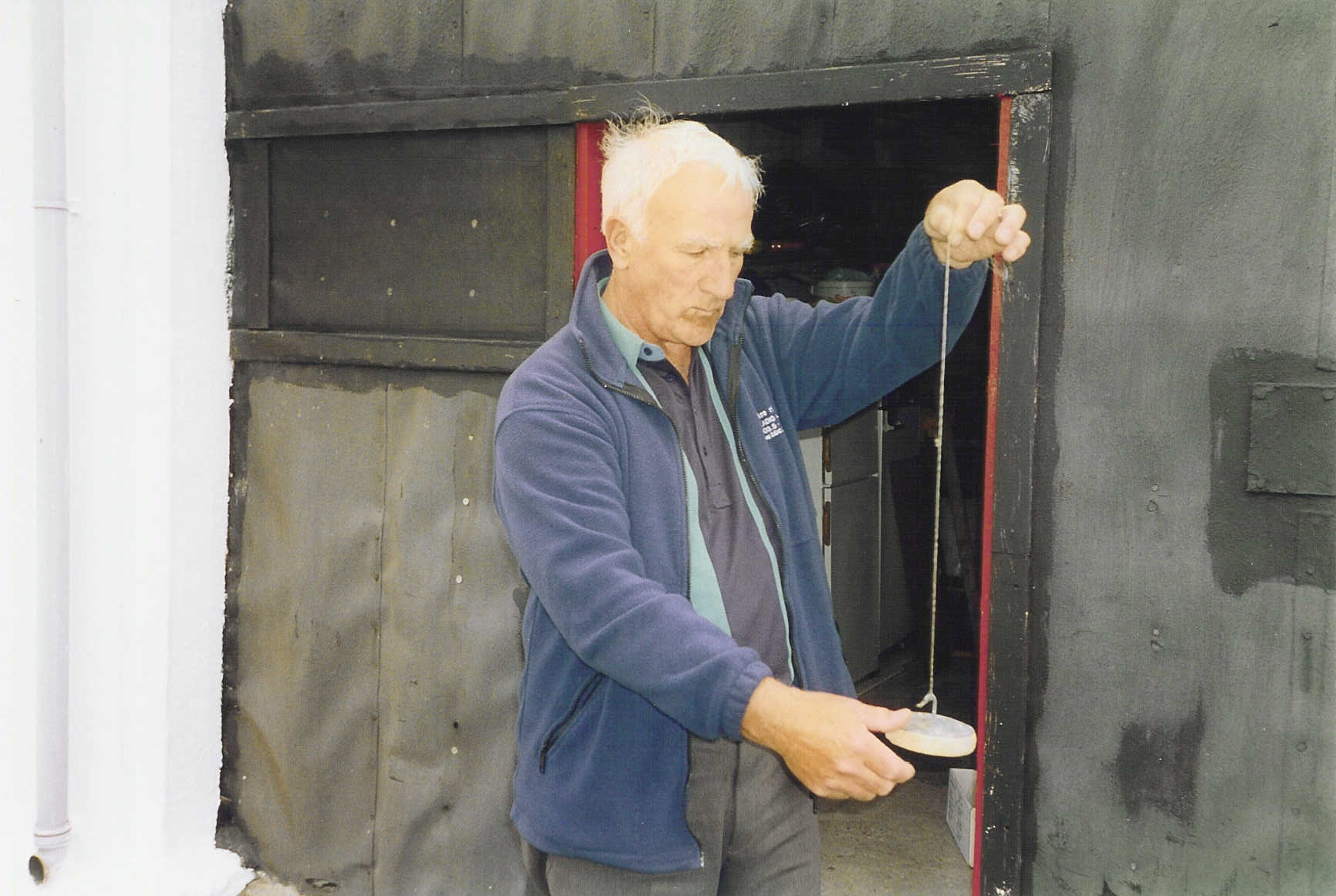
Donald Archie Brown of Balevullin is pictured spinning horsehair fishing line using a small weight. Joined together with smooth knots, the line was used for fishing with rods from a boat or short lengths were used to attach the hooks to the main line used for flounder fishing.
Second-hand haddock line was often bought from east coast fishermen to use for flounder fishing. The main line was weighted to keep it on the bottom and up to 500 hooks spaced a yard apart were attached to it using horsehair which was light and floated.
Baiting the hooks was a tedious job. Lugworms dug up from the beach were the usual bait but mussels, if ones large enough could be found, were also used.
Colour photograph of Donald Archie Brown making horsehair fishing line in 2004.
Donald Archie Brown of Balevullin spinning fishing line from horsehair, photographed by Dr John Holliday in August 2004.
Report on the Tiree Evaluation Survey by Steven Mithen, Tim Astin, Erika Guttmann, Anne Pirie, Sam Smith and Karen Wicks.
Report on the Tiree evaluation survey conducted by Professor Steven Mithen and others from the School of Human and Environmental Sciences, Reading University in the summer of 2004.